SKN LANDS : FOUGHT FOR AND PAID FOR- NEVER TO BE SOLD AGAIN !
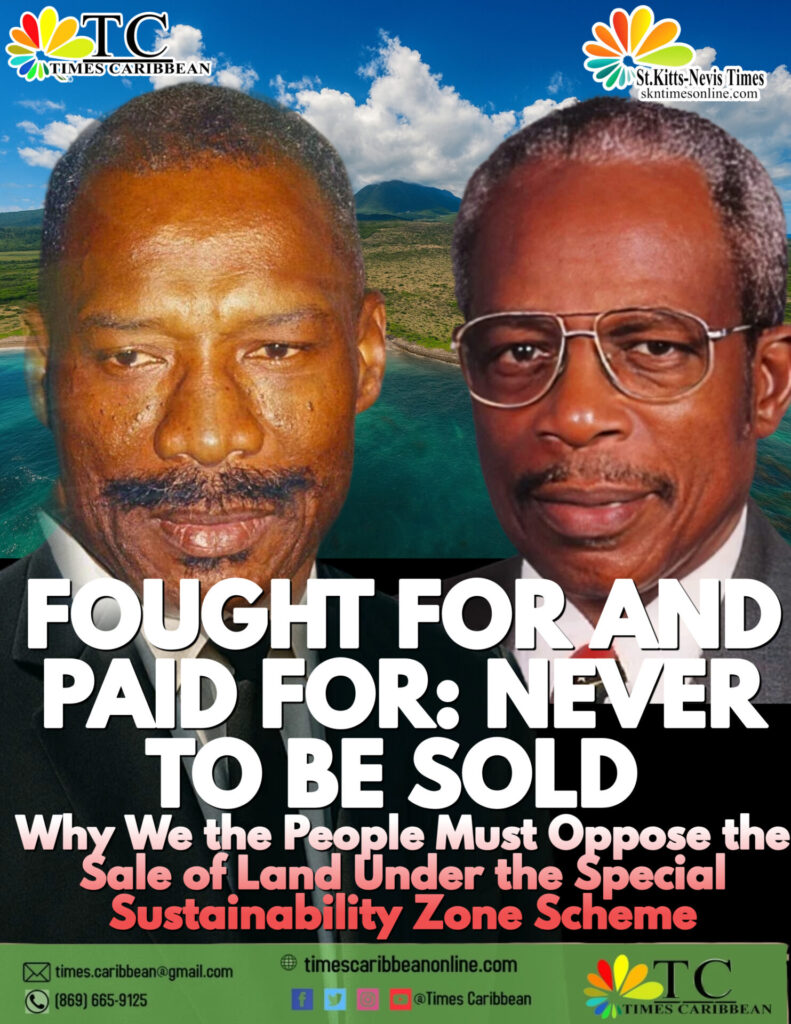
Why We the People Must Oppose the Sale of Land Under the Special Sustainability Zone Scheme
by Dr. McCarta Browne
The issue of land in St. Kitts and Nevis is not simply an economic matter—it is deeply historical, cultural, and emotional. Our very survival as a people, from the colonial era to independence, has been tied to the struggle over land.
The first wars of modern Caribbean history were fought on our soil, as French, English, and Dutch powers spilled blood for control of this small but priceless territory. At Bloody Point, Governor Sir Thomas Warner’s forces massacred hundreds of native Kalinago; their blood baptized our land and reminds us that land has always been sacred, bought at the ultimate cost of human lives.
As one who has stood in uniform, paying respects at the graves of our National Heroes, I cannot escape the weight of history. Sir Robert Llewellyn Bradshaw, our first National Hero, staked his life and legacy on the question of land. He fought tirelessly for justice, for dignity, and for equality, recognizing that true freedom for working people would never come without land ownership. His great victory came in 1975 when his government acquired the sugar lands, placing them into the hands of the state and, by extension, the people. This triumph broke the centuries-old stranglehold of plantation proprietors and made Bradshaw the architect of a new St. Kitts and Nevis.
His vision was cemented by our Father of Independence, Dr. Kennedy Simmonds, who in 1982 ensured that these lands were fully secured for the people of the Federation. Land, therefore, is not simply a commodity—it is the very inheritance that binds generations of Kittitians and Nevisians to their homeland.
And yet, in the 21st century, we face the disturbing reality of a government and opposition who appear to have forgotten this sacred history. Under the Special Sustainability Zone (SSZ) scheme, crown lands are to be sold outright to foreign investors in the name of “development” and “jobs.” Prime Minister Dr. Terrance Drew and Opposition Leader Hon. Mark Brantley both supported this legislation, signaling a bipartisan betrayal of our historical legacy. Even more troubling, the government openly admits that once sold, these lands belong to the developers permanently.
We have already lived through the painful lessons of failed projects: Christophe Harbour, botched CBI ventures, and stalled housing schemes. Across Africa, nations have learned the dangers of ceding land to foreign developers, often at the expense of their own people. Must we repeat those mistakes here, on an island only 68 square miles, and another of just 36? Land is the one resource we cannot replenish.
Let us be clear: we are not against foreign direct investment. Investors are welcome to lease land, partner with locals, and contribute to development. But the outright sale of our patrimony to foreigners is an abdication of our responsibility to future generations. Already, reports suggest that small businesses are being pressured off land to make way for foreign projects—something that would never have happened under Bradshaw’s philosophy of justice.
Land is our wealth, our legacy, and our sovereignty. To sell it is to impoverish future generations and dishonor the sacrifices of our past.
We must therefore ask our leaders:
- Why was there no public consultation before passing the SSZ legislation?
- Why must development come at the price of selling crown land?
- What investments are being targeted, and are locals allowed equal access?
- If voters had known you planned to sell our land, would they have supported you?
- What concessions are being offered to foreign investors, and will small local businesses benefit?
- What lands have already been identified as SSZs, and where?
- If lands are sold but not developed, can they be reclaimed?
- Why not lease instead of sell?
- Why are locals being told to build smaller homes on smaller plots while foreign developers are granted expansive zones?
- Do you believe Kittitians and Nevisians, if given support, could develop these same lands? If not, why? If yes, why not empower them first?
- Was any independent research conducted on the potential impact of SSZs?
- Are we now prepared to give back to wealthy foreigners the same lands that Bradshaw fought for and Simmonds paid for?
The answers to these questions will determine whether our leaders are guided by the legacy of our heroes or by short-term political and financial expediency.
Let us remember: once land is gone, it is gone forever. Our duty is to safeguard it, not sell it. To do otherwise is to betray our history, our heroes, and our children yet unborn.
















Leave a comment
You must be logged in to post a comment.