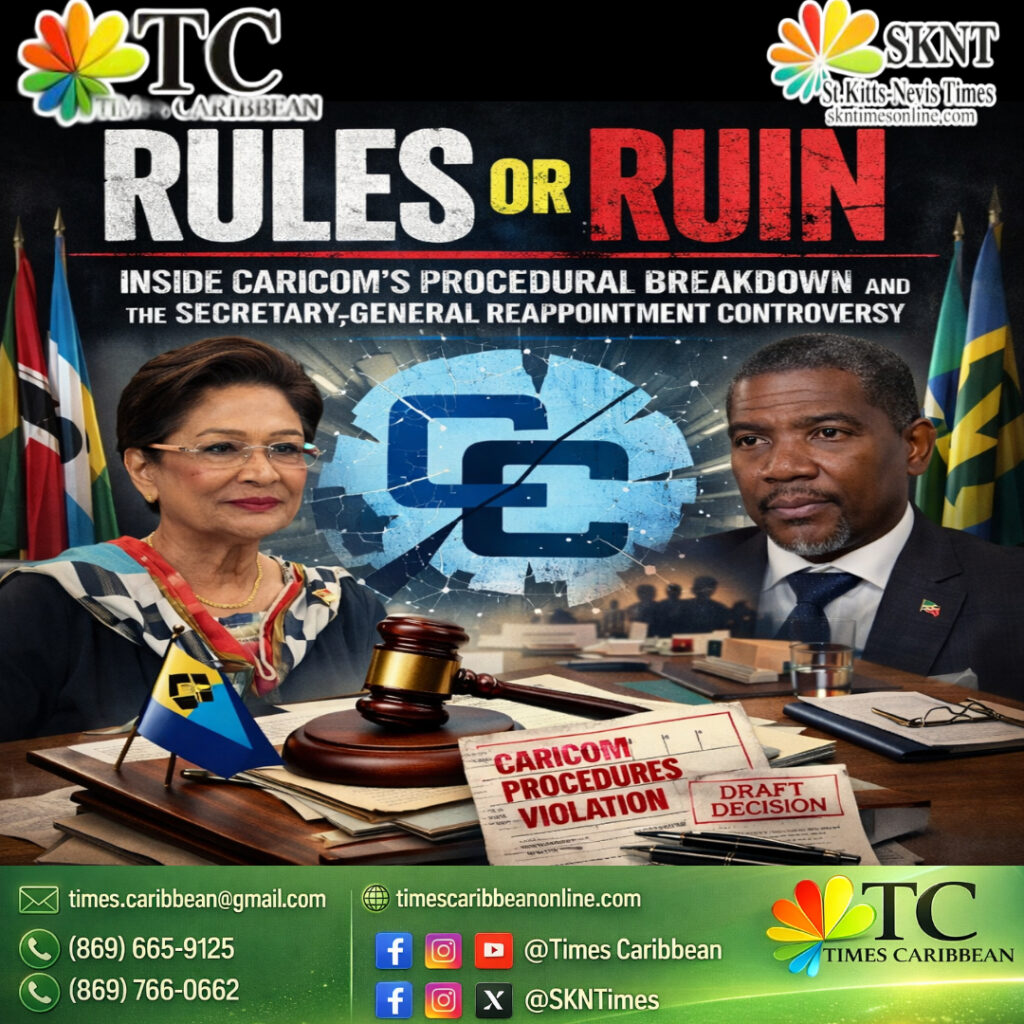
RULES OR RUIN: INSIDE CARICOM’S PROCEDURAL BREAKDOWN AND THE SECRETARY-GENERAL REAPPOINTMENT CONTROVERSY

RULES OR RUIN: INSIDE CARICOM’S PROCEDURAL BREAKDOWN AND THE SECRETARY-GENERAL REAPPOINTMENT CONTROVERSY
By Times Caribbean Editorial Desk
A TEST OF LEGITIMACY — NOT PERSONALITY
At the heart of the growing regional uproar over the reappointment of CARICOM Secretary-General lies a deceptively simple but profoundly consequential question: Were the rules followed?
This is not a debate about personalities, political allegiances, or leadership preferences. It is a legal and institutional reckoning. As outlined in the Legal and Procedural Assessment: The Reappointment of the CARICOM Secretary-General at the 50th Regular Meeting , the issue strikes at the very core of CARICOM’s credibility as a rules-based regional body.
If the rules were not followed, then the legitimacy of the decision collapses—regardless of who benefits.
THE FOUNDATION: A RULES-BASED COMMUNITY UNDER STRAIN
CARICOM’s authority derives not from political convenience but from the and its Rules of Procedure.
These instruments establish:
- Consensus as the primary decision-making mechanism
- Strict agenda and documentation requirements
- Mandatory participation rights for all Member States
The assessment makes one point unmistakably clear:
When rules are ignored or selectively applied, the institution itself is weakened.
This is not procedural nitpicking—it is constitutional governance.
THE RETREAT DECISION: A PROCESS IN QUESTION
The reappointment decision emerged from a Heads of Government Retreat during the 50th Regular Meeting hosted in .
While the Retreat formed part of the official Conference, multiple procedural breaches are identified:
1. The Agenda Failure
The reappointment was never listed as a named agenda item.
Instead, it was allegedly subsumed under a generic heading—“Financing and Governance of the Community.” This is a critical flaw.
A five-year leadership decision cannot be buried inside a catch-all item without explicit notice.
Impact:
Member States were deprived of the opportunity to prepare, consult, and participate meaningfully.
2. Absence of Required Documentation
Under Rule 26, all decision items must be supported by a working paper and draft decision circulated one month in advance.
None was provided.
Impact:
This alone signals that the reappointment was not processed as a formal decision item.
3. Consensus Was Not Sought
CARICOM rules mandate that consensus must be attempted before any vote.
Five Member States—including —were absent from the Retreat.
They were not absent by choice—but by lack of notice.
Impact:
A decision taken without one-third of the membership cannot credibly claim consensus.
4. The Numbers Don’t Add Up
Even if the process shifted to voting, the Treaty requires:
- Unanimity, or
- At least three-quarters of the full membership (12 of 15 states)
With five states absent, the maximum possible affirmative votes was 10.
Impact:
The threshold was mathematically impossible to meet.
5. No Formal Ratification
Decisions taken outside plenary must be:
- Ratified in plenary, or
- Circulated for formal confirmation
Neither occurred.
When formally objected, the Rules required re-submission to the Conference.
Instead, a public statement declared the decision final.
Impact:
This represents a direct contradiction of established CARICOM procedure.
6. Violation of Participation Rights
Article 11(2) guarantees each Member State the right to send a representative if its Head is absent.
The “Heads-only” format of the Retreat effectively excluded this right.
Impact:
This is not just procedural—it is a Treaty-level breach.
THE “REQUIRED MAJORITY” CLAIM: A LEGAL FICTION?
A public statement issued weeks later invoked a “required majority.”
But as the assessment highlights:
- The Treaty does not recognize this term for such decisions
- The numerical threshold was not met
This creates a dangerous precedent: redefining legal standards through public messaging rather than compliance.
A SYSTEMIC FAILURE — NOT A SINGLE ERROR
Taken individually, each breach is serious. Taken together, they paint a troubling picture:
- A decision not properly placed on the agenda
- No supporting documentation
- No consensus process
- Insufficient votes
- No ratification
- Denial of participation rights
This is not a technical oversight.
It is a systemic procedural breakdown.
THE POLITICAL TEMPTATION — AND THE INSTITUTIONAL RISK
There is a growing risk that this issue will be dismissed as a political clash—particularly given tensions involving in his role as CARICOM Chairman.
That would be a grave mistake.
The assessment warns:
If procedural violations are ignored for political convenience, CARICOM sets a precedent that its rules are optional.
That precedent would outlast any single administration or appointment.
THE ONLY PATH FORWARD: RESET OR RECKONING
The solution is neither radical nor disruptive:
- Acknowledge the procedural failure
- Re-table the matter properly
- Follow the Treaty and Rules
- Allow a legitimate decision to emerge
If the reappointment is indeed the correct outcome, it will withstand proper process.
If not, the institution must correct itself.
THE FINAL ARBITER: THE
Should political actors fail to resolve the matter, the issue is now squarely within the jurisdiction of the Caribbean Court of Justice (CCJ).
The legal questions are clear:
- Were Articles 11, 24, and 28 followed?
- Were the Rules of Procedure complied with?
- Is the decision valid under CARICOM law?
This is not merely a political dispute—it is a justiciable constitutional matter.
A DEFINING MOMENT FOR CARICOM
This controversy is bigger than any individual or appointment.
It is a referendum on whether CARICOM is:
- A rules-based institution, or
- A political club governed by convenience
The Caribbean public—and the credibility of regional integration itself—demands an answer.
Times Caribbean Insight:
CARICOM now stands at a crossroads. It can either reaffirm its legal foundations—or quietly erode them. History will judge which path it chooses.
















Leave a comment
You must be logged in to post a comment.