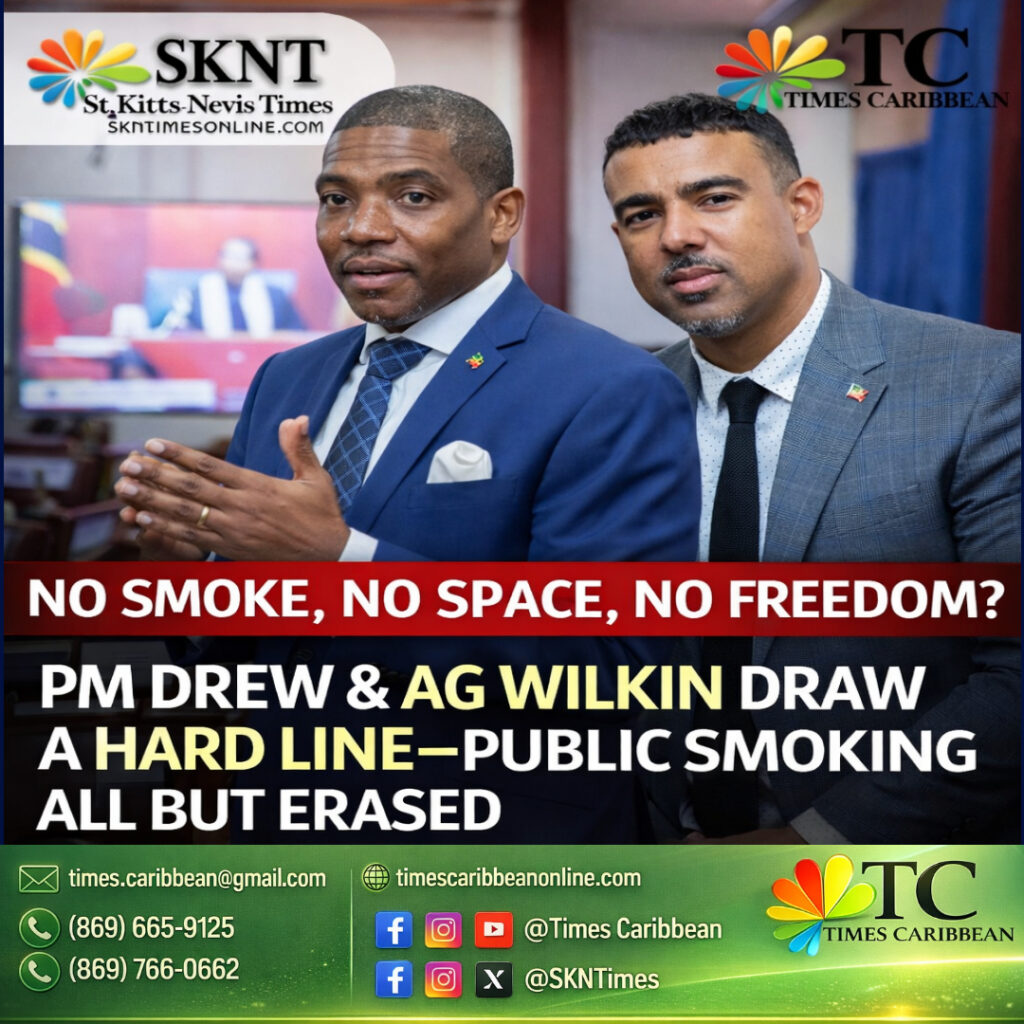
NO SMOKE, NO SPACE, NO FREEDOM?PM DREW & AG WILKIN DRAW A HARD LINE—PUBLIC SMOKING ALL BUT ERASED”

Basseterre, St. Kitts-Nevis — In what critics are already calling a contradictory and heavy-handed policy stance, Prime Minister Dr. Terrance Drew and Attorney General Garth Wilkin have drawn a hard line on cannabis use, rolling out strict no-smoking rules and rigid restrictions that some say blur the line between reform and repression.
Just days after reaffirming the Federation’s cannabis framework, both men stood in the National Assembly delivering a message that was unmistakably clear: “Use it responsibly—or don’t use it at all.”
But behind the polished language of “public health” and “protection,” a growing chorus of observers is asking a blunt question:
Is this legalization… or control in disguise?
ZERO TOLERANCE IN PUBLIC — “SMOKING IS SMOKING, PERIOD”
Prime Minister Drew did not mince words.
“You don’t know if there’s an asthmatic standing behind you… smoking is not targeting cannabis—it is targeting smoking, period.”
That declaration effectively places cannabis users under the same sweeping restrictions as tobacco smokers—banning use in shared public spaces and tightening behavioral expectations.
But critics argue the messaging is conflicted.
On one hand, the government speaks of rights and reform.
On the other, it imposes restrictions so tight they risk suffocating those very freedoms.
AG WILKIN’S WARNING: “NOT FOR CHILDREN — NOT EVEN CLOSE”
Attorney General Garth Wilkin went even further, laying down non-negotiable red lines:
- No cannabis for anyone under 18
- Strict storage rules inside homes
- Zero tolerance near schools — within 300 feet
- Absolute ban on use in school-related spaces
His warning to parents was blunt and almost alarming:
“If you are a parent… you should not be keeping cannabis on your kitchen table.”
The message?
This is not a casual policy. This is enforcement-heavy, compliance-driven legislation.
PROTECTION OR OVERREACH?
Government officials insist the measures are about shielding children and vulnerable groups—particularly those with respiratory conditions.
And yes, the public health argument is strong.
But the backlash is building.
Critics say:
- The 300-foot rule could effectively ban use in large residential zones
- The private storage expectations raise questions about enforcement
- The public smoking ban may disproportionately target certain communities
In short: the framework may be legal in theory, but restrictive in practice.
A GOVERNMENT WALKING A TIGHTROPE
The Drew administration now finds itself balancing two competing realities:
- Modern reform expectations
- Traditional public health conservatism
And in trying to satisfy both, some argue it risks pleasing neither.
Is this a bold, responsible approach to cannabis regulation?
Or is it a policy caught between fear and progress—too strict to feel free, too loose to feel controlled?
THE BIGGER QUESTION
At its core, this isn’t just about cannabis.
It’s about trust, freedom, and governance.
Can citizens be trusted to act responsibly?
Or must the state regulate every inch of behavior to protect the public good?
For now, the Drew-Wilkin doctrine is clear:
Rights exist—but only within tightly drawn lines.
FINAL WORD
As enforcement looms and public reaction intensifies, one thing is certain:
St. Kitts and Nevis is entering a new era of cannabis policy—one defined not just by legalization, but by limitation.
And the nation is watching closely.
Very closely.
















Leave a comment
You must be logged in to post a comment.