ICC: Robinson’s Court – The Caribbean statesman whose initiative helped bring the Court into being.
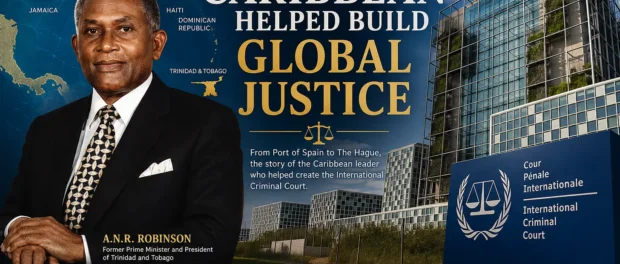
As Washington seeks to weaken the International Criminal Court, July 17 reminds us that one of the Court’s founding visionaries came from Trinidad and Tobago.
Jul 17, 2026
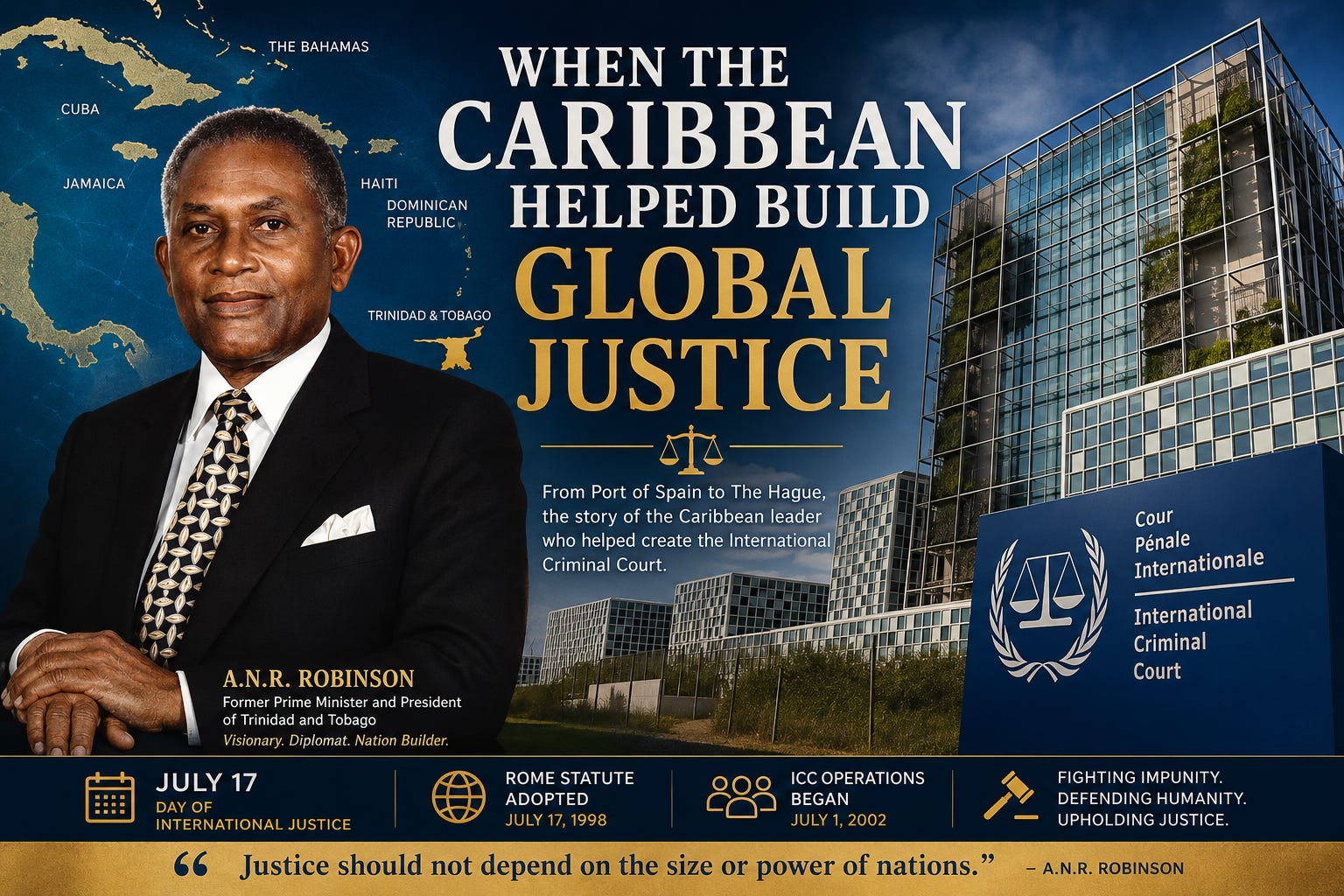
Today, July 17 marks the anniversary of the adoption of the Rome Statute in 1998 and the creation of the International Criminal Court (ICC).
This year’s observance carries unusual significance.
As the Trump administration intensifies its campaign against the ICC, with Secretary of State Marco Rubio declaring that Washington intends to “dismantle” the Court and urging other governments to withdraw their support, the anniversary reminds us of an extraordinary Caribbean achievement that deserves renewed attention.
One of the principal architects of the Court was not from Washington, London or Paris.
He was Arthur N.R. Robinson, the late Prime Minister and President of Trinidad and Tobago.
For Caribbean people, that should be a source of enduring pride.
One Man’s Vision
Long before the ICC became a reality, Robinson believed the international community needed a permanent judicial institution capable of prosecuting those responsible for the gravest crimes imaginable.
In 1989, Trinidad and Tobago formally revived the long-stalled proposal for an international criminal court. Robinson’s immediate concern was the growing threat of transnational drug trafficking, but his initiative reopened a much broader discussion about accountability for genocide, crimes against humanity and war crimes.
His proposal breathed new life into an idea that had languished for decades.
Nine years later, delegates meeting in Rome adopted the treaty establishing the ICC.
For a small Caribbean nation to have helped shape one of the most significant legal institutions of the modern era remains one of the region’s greatest diplomatic accomplishments.
Justice Without Replacing Sovereignty
The Court was never designed to replace national courts.
One of the Rome Statute’s most important innovations is the Principle of Complementarity. National judicial systems retain the first responsibility to investigate and prosecute international crimes. The ICC steps in only when a country’s legal institutions are genuinely unwilling or unable to do so.
That carefully negotiated safeguard persuaded many countries that the Court would complement, not undermine their sovereignty.
It remains one of the ICC’s defining strengths.
The Growing Political Storm
Like every international institution, the ICC has attracted criticism.
Some have questioned the pace of its proceedings. Others have challenged aspects of its prosecutorial decisions or accused it of disproportionate focus on certain regions. Several countries have withdrawn from the Rome Statute while others have continued to join.
Constructive criticism is healthy.
But criticism of the Court’s performance is fundamentally different from efforts to dismantle the institution itself.
The United States has never ratified the Rome Statute and has consistently opposed the ICC exercising jurisdiction over American personnel. The latest campaign by the Trump administration represents one of the strongest efforts yet to weaken the Court’s international standing.
Whether one agrees or disagrees with Washington’s position, the development places renewed attention on an institution whose very existence owes much to Caribbean leadership.
A Legacy Still Being Written
Trinidad and Tobago has not merely claimed a place in the Court’s history.
It has continued shaping its future.
Since the ICC became operational in 2002, Trinidad and Tobago has maintained an extraordinary judicial presence in The Hague. Karl Hudson-Phillips served among its first judges. Anthony Carmona followed before later becoming President of Trinidad and Tobago. Today, Judge Althea Violet Alexis-Windsor continues that distinguished tradition.
Few countries, regardless of size, can claim such sustained leadership within one of the world’s foremost international courts.
It is another reminder that Caribbean excellence extends beyond athletics, music and culture.
Our region has also shaped international law.
Why This Matters to Small States
Too often, we judge influence by military strength or economic power.
Arthur N.R. Robinson understood something different.
Small states can shape the world through ideas, diplomacy and moral leadership.
For countries like those of the Caribbean, a rules-based international order is not an abstract concept. It is an essential safeguard. International law offers smaller nations protections that power politics alone never can.
That is why the future of institutions such as the ICC matters to our region.
Supporting international justice does not require believing that every decision of the Court is beyond criticism.
No institution is perfect.
But abandoning the principle that those responsible for genocide, war crimes and crimes against humanity should be held accountable would represent a far greater failure.
A Caribbean Gift to the World
Nearly four decades after Trinidad and Tobago revived the campaign for a permanent international criminal court, and almost three decades after the Rome Statute was signed, July 17 should mean more to us than simply another international observance.
It should remind us that the Caribbean has already changed the course of global history.
At a moment when the future of the International Criminal Court is once again being fiercely contested, the legacy of Arthur N.R. Robinson deserves renewed celebration.
History is not always written by the largest nations.
Sometimes it is written by those with the courage to imagine a more just world and the persistence to make that vision a reality.
The International Criminal Court is one of those realities.
And the Caribbean helped build it.
















Leave a comment
You must be logged in to post a comment.