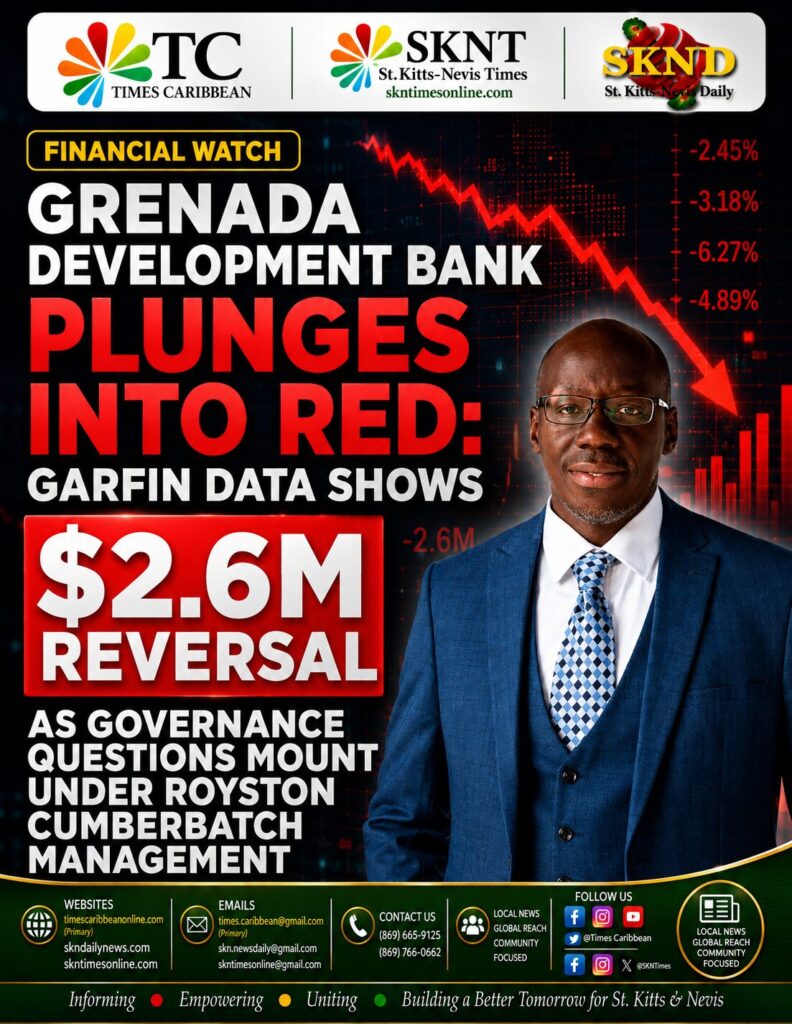
GRENADA DEVELOPMENT BANK PLUNGES INTO RED: GARFIN DATA SHOWS $2.6M REVERSAL AS GOVERNANCE QUESTIONS MOUNT UNDER ROYSTON CUMBERBATCH MANAGEMENT

By Times Caribbean
ST. GEORGE’S, GRENADA — The Grenada Development Bank (GDB), one of the country’s key state-owned development finance institutions, is facing growing scrutiny after watchdog data reportedly showed a dramatic reversal in its financial performance, moving from a $1.2 million operating surplus to a $1.4 million operating deficit in just one fiscal year.
According to information published in the 2024 Annual Financial Statement of the Grenada Authority for the Regulation of Financial Institutions (GARFIN), the statutory body responsible for supervising the institution, the GDB recorded total assets of $111.9 million as of December 31, 2024, with a loan portfolio of $96.1 million and a net operating deficit of $1.4 million.
The reported figures represent a troubling $2.6 million reduction in total assets and a $3.3 million contraction in the loan portfolio, ending what has been described as a sixteen-year run of consecutive operating profits.
Even more concerning, the Bank’s non-performing loans reportedly rose to 7.3 percent, more than double the 3 percent recorded in the previous year. For a development finance institution mandated to support national growth, small businesses, housing, entrepreneurship, and productive investment, such a sharp deterioration is likely to raise serious questions among taxpayers, policymakers, borrowers, and the wider financial sector.
The financial decline has placed renewed public attention on the management of General Manager Royston Cumberbatch, who reportedly assumed the post in September 2023 after being selected for the position under the administration of Prime Minister Dickon Mitchell.
While no official finding of wrongdoing has been presented, the timing of the Bank’s reversal has intensified scrutiny of leadership decisions, internal governance, and the strategic direction of the institution.
Sources familiar with the Bank’s operations have reportedly raised concerns that established governance procedures may have been bypassed in relation to Cabinet-level proposals connected to the Small Business Development Fund. According to those claims, a proposal was allegedly submitted directly to Cabinet without the customary routing through the relevant line ministry’s Permanent Secretary.
The reported outcome, critics say, was an increase in interest rates on loans designed to support micro and small enterprises — the very businesses the fund was created to assist.
If accurate, such a move could place additional financial pressure on entrepreneurs already operating in a challenging economic environment marked by rising costs, limited access to affordable capital, and post-pandemic recovery pressures.
Governance concerns have also reportedly extended to the Bank’s Board of Directors. The GDB’s website is said to list only five directors, along with the General Manager, despite the institution being structured for a nine-member board. Sources have alleged that resignations from the Board may not have been properly communicated to the Minister of Finance.
Those claims, if substantiated, would raise major questions about quorum, oversight, institutional accountability, and whether key decisions were being made under a fully functional governance structure.
The situation reportedly has also affected staff morale. More than one-third of GDB employees are said to have resigned since Cumberbatch’s arrival, with the Credit and Project Management departments reportedly among the hardest hit.
For a development bank, the loss of experienced credit and project officers can have direct consequences for loan assessment, risk management, project monitoring, and customer service. A weakened technical team may also affect the institution’s ability to properly evaluate business proposals and manage loan recovery.
Adding to the growing concerns are reports that in 2025, Cumberbatch allegedly approved a $2 million loan to a borrower said to have a history of repeated default, including an active default involving another statutory body.
No official determination has been made public regarding that allegation, but if confirmed, the matter would raise important questions about due diligence, credit underwriting standards, risk exposure, and whether proper safeguards were followed.
The controversy is further compounded by concerns over transparency. According to available information, annual financial reports covering the period of Cumberbatch’s tenure have not been made publicly available online or in the Library of Parliament, where the most recent report reportedly on file predates the current period under scrutiny.
For a publicly owned financial institution, transparency is not optional. It is central to public trust. The GDB manages resources intended to support national development, and taxpayers have a legitimate interest in knowing whether the institution is being governed prudently, professionally, and in accordance with its mandate.
The emerging picture is one of financial decline, rising bad loans, governance questions, reported staff departures, and growing public concern over the management of a critical national institution.
At this stage, the allegations remain serious but not yet fully tested through any publicly disclosed independent investigation. However, the reported GARFIN data alone is significant enough to demand answers.
Grenadians will now be watching closely to see whether the Government, the Ministry of Finance, the Board of Directors, GARFIN, and the Bank’s leadership will provide a full and transparent explanation of what has taken place at the Grenada Development Bank.
For now, the central question remains unavoidable: how did an institution reportedly enjoying sixteen consecutive years of operating profits fall into deficit so sharply — and who will be held accountable for explaining the reversal?
















Leave a comment
You must be logged in to post a comment.