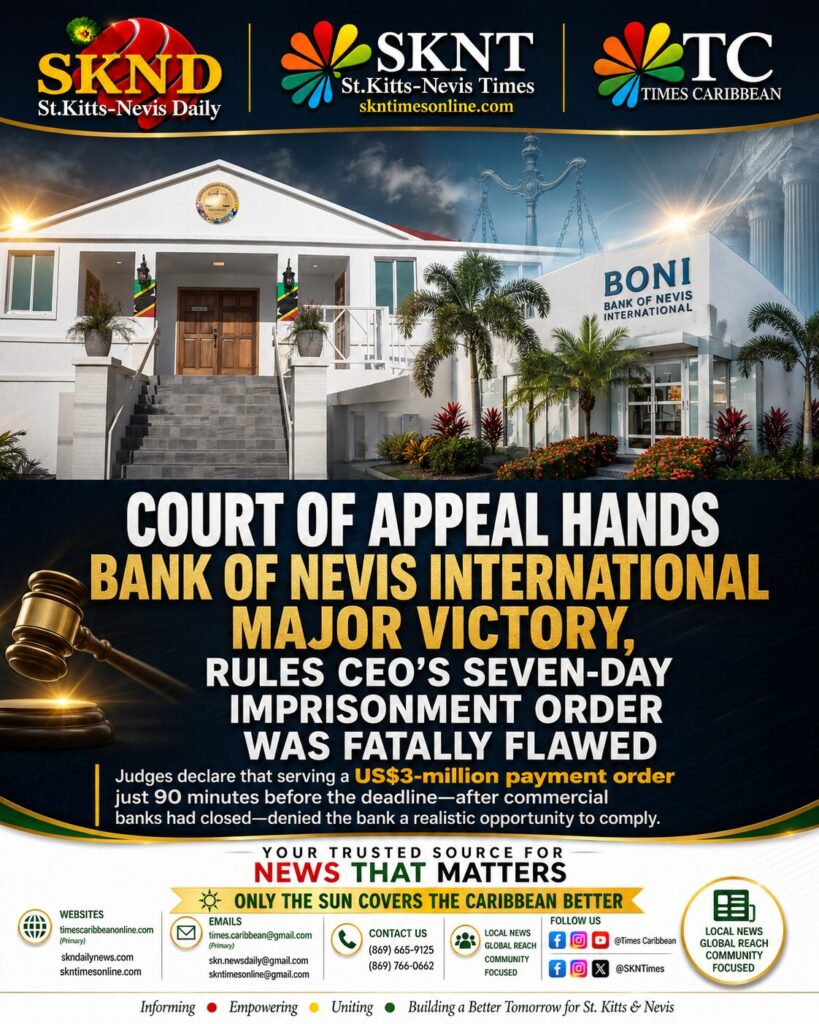
COURT OF APPEAL HANDS BANK OF NEVIS INTERNATIONAL MAJOR VICTORY, RULES CEO’S SEVEN-DAY IMPRISONMENT ORDER WAS FATALLY FLAWED

Judges declare that serving a US$3-million payment order just 90 minutes before the deadline—after commercial banks had closed—denied the bank a realistic opportunity to comply
CHARLESTOWN, NEVIS, July 14, 2026 — The Eastern Caribbean Supreme Court’s Court of Appeal has delivered a dramatic ruling in favour of Bank of Nevis International Limited, declaring that the legal process which resulted in its acting Chief Executive Officer being imprisoned for seven days was procedurally unfair and fundamentally defective.
In a judgment delivered on July 13, 2026, the appellate court allowed BONI’s appeal arising from contempt proceedings initiated by Selecta Insurance and Reinsurance Company (Caribbean) Limited.
The dispute centred on an order requiring BONI to pay the substantial sum of US$3,017,909.88 into the Nevis High Court.
However, the Court of Appeal highlighted a stunning procedural issue: the payment order carrying the warning of possible imprisonment was personally served on acting CEO James Simpson at approximately 2:34 p.m. on March 12, 2025—less than two hours before the 4:00 p.m. compliance deadline.
By that time, according to the judgment, commercial banking operations had already closed for the day.
Despite the extraordinarily short window, Mr. Simpson was subsequently committed to prison for seven days after the High Court found that BONI had failed to comply with the payment order.
He served the sentence.
The Court of Appeal has now firmly declared that the late service failed to provide either the bank or its CEO with a reasonable and realistic opportunity to carry out the court’s directive.
“This tardy service made the committal proceedings procedurally unfair and fatally flawed,” the appellate judgment stated.
The judges stressed that contempt proceedings, particularly those carrying the possibility of imprisonment, demand strict compliance with the procedural safeguards contained in Part 53 of the Eastern Caribbean Supreme Court Civil Procedure Rules.
Those safeguards, the court made clear, are not mere technicalities. They are fundamental protections designed to preserve procedural fairness and personal liberty.
CEO Had Already Won Separate Appeal
Mr. Simpson had previously filed his own appeal against the imprisonment order.
In October 2025, the Court of Appeal set aside the committal order after finding that the mandatory requirements governing contempt proceedings had not been properly observed.
BONI subsequently continued with its separate corporate appeal, arguing that the findings surrounding the contempt proceedings also carried serious legal, commercial and reputational consequences for the regulated financial institution.
Selecta challenged BONI’s right to continue the case, arguing that the imprisonment order had been directed personally against Mr. Simpson and had already been overturned.
The Court of Appeal rejected that argument.
The judges ruled that BONI had a sufficient legal interest in the matter because the entire committal process was based upon findings that the bank itself had disobeyed the payment order.
The court said BONI was not a mere spectator in the proceedings. It was the judgment debtor whose alleged failure to comply formed the sole basis upon which its acting CEO was deprived of his liberty.
The appeal was therefore not simply an attempt to challenge unfavourable comments or judicial reasoning. It was a legitimate challenge to an order arising directly from allegations about BONI’s conduct.
Court Bound by Earlier Decision
The three-member appellate panel—Justices of Appeal Vicki Ann Ellis and Esco L. Henry, along with Acting Justice of Appeal Reginald Armour—also ruled that it was bound by its earlier decision in Mr. Simpson’s appeal under the long-established doctrine of stare decisis.
That legal principle requires courts to follow their previous decisions in materially similar cases unless recognised exceptions apply.
The judges found no meaningful factual distinction between the two appeals.
The same payment order, service timeline, procedural rules and alleged defects were involved.
As a result, the Court of Appeal adopted its previous conclusion that service of the order only approximately 90 minutes before the deadline did not give BONI or its CEO a reasonable opportunity to comply.
Unusual Split Decision on Costs
Although BONI won the appeal, the court delivered an unusual ruling on legal costs.
BONI was awarded its costs incurred up to and including October 17, 2025, the date on which Mr. Simpson’s separate appeal was decided and the committal order was formally set aside.
However, Selecta was awarded its costs incurred after that date through the delivery of the July 13, 2026 judgment.
The court reasoned that once the earlier Simpson judgment had overturned the imprisonment order and settled the major legal issues, the continuation of BONI’s appeal became largely unnecessary.
The respective costs must be agreed upon within 21 days or assessed by a High Court judge.
The ruling brings another dramatic chapter in the multimillion-dollar legal battle to a close while sending a powerful message across the Eastern Caribbean judiciary: where an individual’s liberty is at risk, strict procedural fairness is not optional—it is mandatory.
















Leave a comment
You must be logged in to post a comment.