CARICOM IN TURMOIL — CHAIRMAN DREW REMAINS SILENT AS TRINIDAD PM PERSAD-BISSESSAR UNLEASHES EXPLOSIVE ACCUSATIONS OF INCOMPETENCE AND BACKROOM DEALINGS
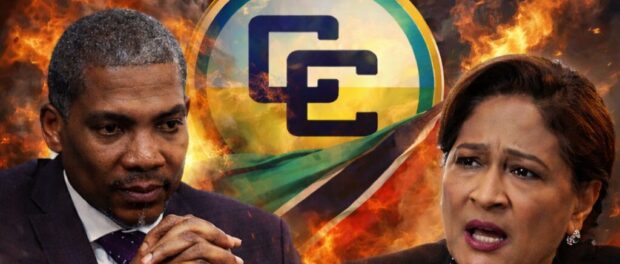
The Caribbean Community (CARICOM), long heralded as the region’s premier vehicle for integration, diplomacy, and collective strength, now finds itself engulfed in one of the most serious credibility upheavals in its modern history. At the center of the storm is current CARICOM Chairman, Dr. Terrance Drew, whose conspicuous silence in the face of mounting regional outrage is raising urgent questions about leadership, legitimacy, and the future of Caribbean unity.
A Diplomatic Explosion from Trinidad
In a stunning and unprecedented rebuke, Kamla Persad-Bissessar has launched a blistering critique of CARICOM’s internal operations and leadership, accusing the body of being “incompetent,” “odious,” “clandestine,” and fundamentally “out of order.” Her accusations were not vague political rhetoric—they were precise, targeted, and deeply damaging.
At the heart of the controversy lies the alleged exclusion of Trinidad and Tobago from critical discussions surrounding the reappointment of Dr. Carla Barnett. Persad-Bissessar’s administration claims that decisions of regional importance were conducted behind closed doors, deliberately sidestepping key member states and undermining the very principles of transparency and collective governance that CARICOM purports to uphold.
More alarmingly, the Trinidadian leader has gone as far as to threaten a withdrawal of support from CARICOM—an extraordinary escalation that signals a potential fracture at the highest levels of regional cooperation.
The Silence That Speaks Volumes
Yet, amid this diplomatic firestorm, Chairman Drew has remained conspicuously silent.
No formal press briefing.
No statesmanlike address.
No attempt at regional reassurance.
In moments of upheaval, leadership is not merely expected—it is demanded. CARICOM Chairmanship is not ceremonial; it is a responsibility to unify, to mediate, and to provide clarity when the region is at risk of fragmentation. Instead, what the Caribbean is witnessing is a vacuum.
This absence of response has fueled a growing perception that Drew’s leadership lacks the decisiveness, political maturity, and diplomatic strength required to manage a regional institution navigating increasingly complex geopolitical and economic pressures.
A Pattern of Weak Regional Stewardship?
Critics argue that this is not an isolated lapse, but rather part of a broader pattern. Observers across the region have begun to question whether the current CARICOM leadership possesses the strategic foresight and assertiveness necessary to safeguard the institution’s credibility.
The allegations raised by Trinidad and Tobago are not trivial procedural complaints—they strike at the core of governance:
- Was due process followed?
- Were all member states adequately consulted?
- Is the Secretariat operating with transparency and accountability?
Without a clear response from the Chairman, these questions continue to fester, eroding trust not only in the leadership but in the institution itself.
The Stakes: Regional Unity on the Line
CARICOM has historically been the Caribbean’s strongest platform for negotiating trade agreements, coordinating foreign policy, and advancing regional development. A breakdown in trust between major member states—particularly one as influential as Trinidad and Tobago—could have far-reaching consequences:
- Disruption of regional economic initiatives
- Weakening of collective bargaining power on the global stage
- Fragmentation of policy coordination on critical issues such as climate change, security, and energy
This is not merely a political dispute—it is a potential turning point for Caribbean integration.
Leadership or Liability?
The role of Chairman demands more than attendance at summits and ceremonial engagements. It requires courage under pressure, clarity in communication, and the ability to confront controversy head-on.
By remaining silent, Dr. Terrance Drew risks allowing a manageable dispute to spiral into a full-blown regional breakdown. Silence, in this context, is not neutrality—it is abdication.
Meanwhile, Kamla Persad-Bissessar has seized the narrative, positioning herself as a defender of transparency and fairness within CARICOM’s governance structure.
The Moment of Reckoning
The Caribbean now stands at a crossroads. Either CARICOM reasserts its foundational principles of inclusivity, accountability, and collective decision-making—or it risks descending into irrelevance, weakened by internal discord and leadership paralysis.
For Chairman Drew, the path forward is clear but urgent:
Engage. Address. Lead.
Anything less may not only define his tenure—but could fundamentally reshape the trajectory of regional cooperation for years to come.
















Leave a comment
You must be logged in to post a comment.