CARICOM 50 ENDS IN EMBARRASSING STUMBLE AS CHAIRMAN DR. HON. TERRANCE DREW DODGES AND FUMBLES STRAIGHT ANSWER ON U.S. MILITARY PRESENCE IN THE REGION
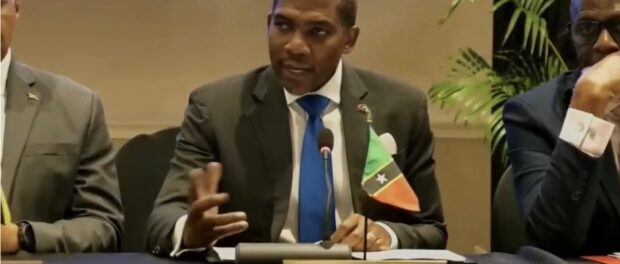
PRESS EXCHANGE HEATS UP OVER CARICOM POSITION ON U.S. MILITARY ACTION
BASSETERRE, St. Kitts — What should have been a routine, controlled closing press conference at the historic 50th Regular Meeting of the Conference of Heads of Government of the Caribbean Community instead ended in a moment that critics are already calling symbolic of a deeper leadership crisis within CARICOM.
At the centre of the storm: CARICOM Chair and Prime Minister of St. Kitts and Nevis, .
The question was simple. Direct. Impossible to misinterpret:
“Did CARICOM support or endorse U.S. military action in Caribbean waters against the illegal drug trade?”
What followed was not simple.
A Question. A Pause. A Fumble.
Dr. Drew appeared visibly unsettled. He sought clarification: “You mean to St. Lucia?”
The journalist, unfazed, pressed again. The question was clear. Had CARICOM endorsed the U.S. military action?
An aide then hurriedly passed the Chair a note — in full view of cameras and regional media. What followed was a halting, disjointed response:
“CARICOM stand on principle to make sure that anything that is done… this or anything… has to follow a particular international law… you’re asking that CARICOM, with CARICOM at this time and the necessary…”
No yes.
No no.
No articulated regional position.
Just diplomatic fog.
The Weight of the Moment
This was not an obscure policy question. It struck at the heart of sovereignty, regional security, and the Caribbean’s long-standing declaration as a “Zone of Peace.”
The United States has expanded security cooperation and interdiction operations across Caribbean waters under anti-narcotics frameworks. The issue is sensitive. It touches national sovereignty, regional autonomy, and geopolitical balancing between Washington, Beijing, Havana, and others.
At CARICOM 50 — a milestone summit marking five decades of regional integration — the Chair was asked whether the body endorsed such military action.
Instead of clarity, the region witnessed hesitation.
Leadership Under Scrutiny
Since assuming the CARICOM Chairmanship, Dr. Drew has faced mounting criticism over what some regional observers describe as muted or delayed responses on major geopolitical flashpoints.
From visa policy tensions to U.S.–Cuba diplomacy, from economic vulnerability to regional security frameworks, critics argue that CARICOM’s messaging under his tenure has lacked sharp definition.
The press conference exchange amplified those concerns.
When a Chair cannot articulate — cleanly and confidently — the bloc’s stance on foreign military operations in Caribbean waters, it invites uncomfortable questions:
- Is CARICOM unified on this matter?
- Was there a formal position agreed upon?
- Or is the region navigating sensitive waters without coordinated clarity?
Diplomacy often requires nuance. But nuance is not the same as incoherence.
Optics Matter
In international relations, perception is power.
The image of a CARICOM Chair seeking clarification on a straightforward question, receiving visible written prompts, and delivering an incomplete response was not the commanding display expected at a 50th anniversary summit.
For a region already battling perceptions of fragmentation and vulnerability, the optics were damaging.
Regional leadership demands preparedness — especially when addressing military operations in shared waters.
The Bigger Question: Unity or Uncertainty?
CARICOM’s credibility rests on its ability to project a unified voice. If the body supports U.S. anti-drug military cooperation, it should say so. If it insists on strict multilateral frameworks and sovereignty safeguards, it should articulate that firmly.
Ambiguity in moments like these does not project strategic depth. It signals uncertainty.
The journalist’s insistence reflected what citizens across the Caribbean want: clarity.
Instead, they got procedural language and unfinished sentences.
A Milestone Overshadowed
CARICOM 50 was meant to celebrate five decades of regional resilience and integration. Yet this exchange has become one of the most discussed moments of the summit.
It underscores a broader anxiety circulating quietly across capitals: Is CARICOM’s leadership keeping pace with the geopolitical pressures reshaping the hemisphere?
When confronted directly on U.S. military action in Caribbean waters, the Chair needed to demonstrate command.
Instead, the region saw hesitation.
And in diplomacy, hesitation speaks volumes.
















Leave a comment
You must be logged in to post a comment.