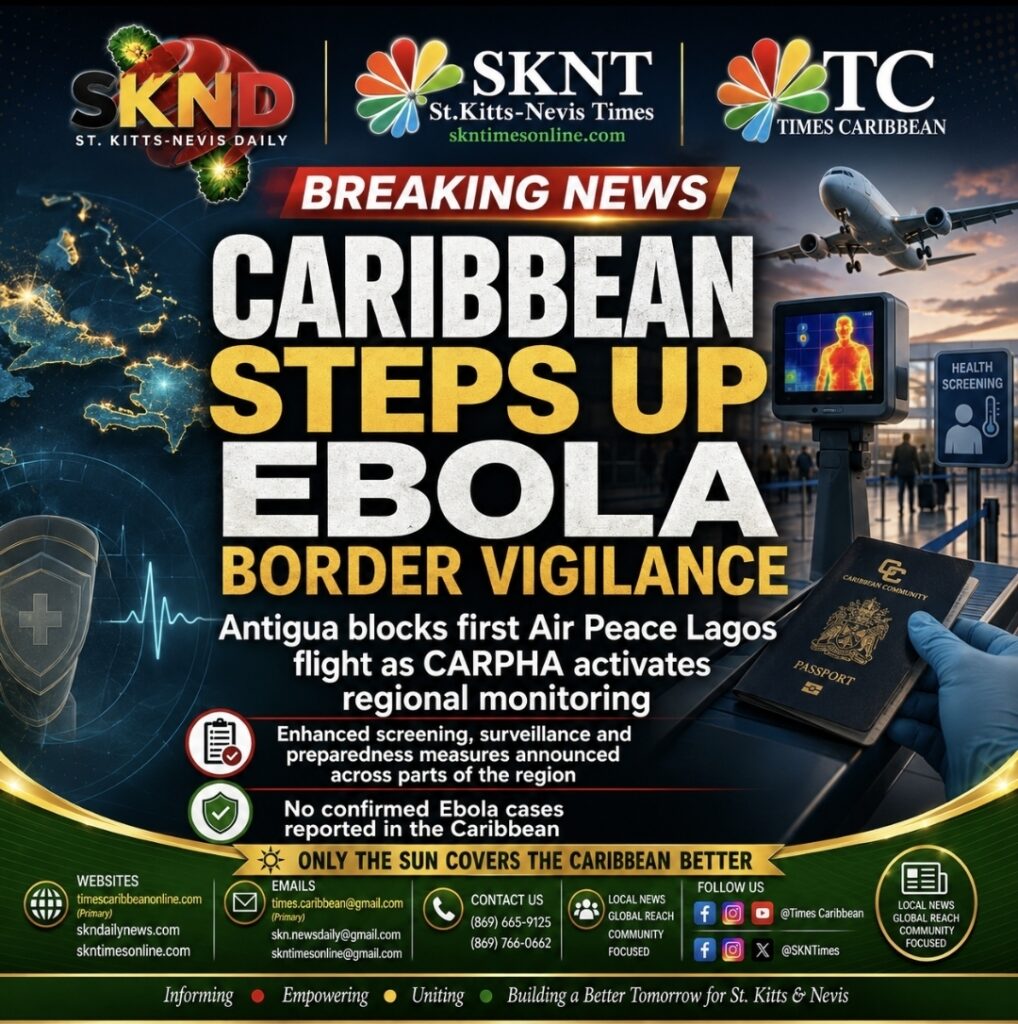
Caribbean Steps Up Ebola Border Vigilance as Antigua Blocks First Air Peace Lagos Flight and CARPHA Activates Regional Monitoring
TIMES CARIBBEAN | Regional Health Desk
May 25, 2026
CARIBBEAN REGION — At least three Caribbean territories have moved to strengthen health screening, surveillance, and border preparedness as regional authorities respond cautiously to the Ebola outbreak in the Democratic Republic of the Congo and Uganda.
Antigua and Barbuda, the Cayman Islands, and St. Lucia have all publicly confirmed enhanced or strengthened health measures, while the Caribbean Public Health Agency, CARPHA, has activated regional monitoring and early-warning systems to assist member states. The measures follow the World Health Organization’s declaration that the Ebola outbreak in the DRC and Uganda constitutes a Public Health Emergency of International Concern. WHO said the outbreak involves the Bundibugyo species of Ebola disease, with early confirmed and suspected cases concentrated in Ituri Province in northeastern DRC and linked cases reported in Uganda.
CARPHA has assessed the current risk to the Caribbean as low, but has urged vigilance because of the possibility of travel-associated cases. The regional public health agency said it is monitoring the outbreak through global scanning, early warning systems, the Tourism and Health Information System, the Caribbean Vessel Surveillance System, national syndromic surveillance systems, and social listening tools. CARPHA also confirmed that, on May 18, it partnered with CARICOM IMPACS to reactivate an advanced electronic screening system at border entry points to help securely review travel history linked to affected areas in Africa without disrupting normal travel and trade.
In Antigua and Barbuda, the health response has now taken on a direct travel-control dimension. Prime Minister Gaston Browne confirmed that the first scheduled Air Peace flight from Lagos, Nigeria, expected to land in Antigua on Monday, May 25, would not be permitted to do so while authorities continue monitoring the Ebola situation and strengthening safeguards. Local reporting indicates the aircraft was instead expected to proceed directly to Barbados, with onward arrangements for some Antigua-bound passengers.
The Antigua and Barbuda government’s wider response includes enhanced screening, temperature checks, traveler monitoring, strengthened port health surveillance, and preparations involving the country’s Infectious Disease Centre as a precautionary facility. Cabinet had earlier approved enhanced public health measures after being briefed on Ebola, hantavirus, and malaria concerns.
The Cayman Islands has also confirmed boosted screening and surveillance at ports of entry. The Ministry of Health, Environment and Sustainability said the measures include increased monitoring of travelers arriving from affected areas, coordination with airport and border control partners, and targeted health questionnaires for people who recently traveled from countries affected by Ebola outbreaks. Cayman officials said the current risk assessment remains low, in line with CARPHA and international public health agencies.
St. Lucia has also signaled a readiness posture. Health Minister Moses Jn Baptiste has said the country is moving to strengthen national protocols and preparedness, even while noting that the outbreak does not currently pose an immediate threat to the Eastern Caribbean. His message reflects the regional position: no panic, but no complacency.
The outbreak continues to evolve. According to international reporting on May 25, Uganda confirmed two additional Ebola cases, bringing its reported total to seven. The new cases involved health workers, and authorities were tracing contacts and placing patients in designated treatment units.
European and international health monitoring agencies also reported that, based on DRC Ministry of Health data as of May 23, there were more than 904 suspected cases and 119 suspected deaths in the DRC, underscoring why the outbreak is being closely watched beyond Central and East Africa.
Health authorities continue to stress that Ebola does not spread through casual airborne contact in the way COVID-19 does. It is transmitted mainly through direct contact with the blood or bodily fluids of an infected person, contaminated materials, or infected animals. The current Bundibugyo outbreak is particularly concerning because there is no approved vaccine specifically for that species, although supportive care and investigational options may be used in outbreak response.
For the Caribbean, the immediate focus is early detection, travel-history review, border coordination, and readiness of isolation and referral systems. Authorities are seeking to identify travelers who may have recent exposure risk while keeping normal travel and trade moving where possible.
As of the latest advisories reviewed today, there are no confirmed Ebola cases in the Caribbean. However, the actions by Antigua and Barbuda, the Cayman Islands, St. Lucia, and CARPHA show that the region is taking a cautious, layered approach: screen early, monitor closely, communicate clearly, and prepare before any suspected case reaches Caribbean shores.
















Leave a comment
You must be logged in to post a comment.