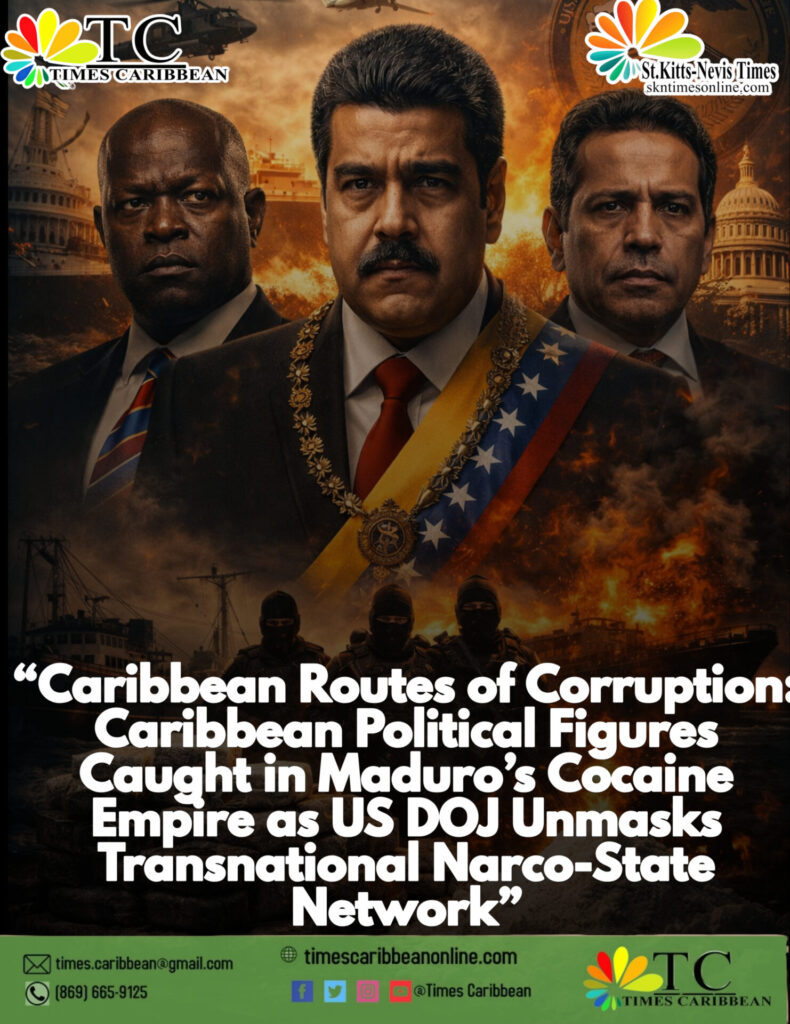
Caribbean Routes of Corruption: Caribbean Political Figures Caught in Maduro’s Cocaine Empire as US DOJ Unmasks Transnational Narco-State Network”
By [Times Caribbean Investigative Desk]
In a legal and geopolitical shockwave destined to reshape Americas policy for years, a newly unsealed U.S. Department of Justice federal indictment lays bare a sprawling drug-trafficking network that reaches far beyond Venezuela’s borders — ensnaring Caribbean political landscapes in a web of corruption, cocaine rackets, and narco-terrorism that has flowed through Caribbean routes for decades.
The 2026 indictment, filed in the Southern District of New York U.S. District Court, charges Venezuelan leader Nicolás Maduro Moros, high-ranking Venezuelan officials, family members, and criminal associates with narco-terrorism conspiracy, cocaine importation conspiracy, and related narcotics trafficking offenses allegedly spanning more than 25 years.
But the implications extend well beyond Venezuela. Caribbean nations, long utilized as transit points in the cocaine corridor from South America to North America and Europe, now face unprecedented scrutiny as U.S. prosecutors expose a systemic nexus of political bribery, protection rackets, and transshipment operations.
Maduro’s Network: From Caracas to Caribbean Corridors
According to the U.S. Justice Department indictment, Maduro and co-defendants “partnered with some of the most violent and prolific drug traffickers and narco-terrorists in the world,” including Colombian guerrilla groups, Mexican cartels, and criminal syndicates — all using Caribbean island routes to funnel cocaine northward.
These drug shipments — often hundreds of tons annually — allegedly moved through Honduras, Guatemala, Mexico, and multiple Caribbean transit points, exploiting weak maritime security and corrupt officials who turned a blind eye for payoffs and protection.
While the indictment directly names Venezuelan officials, U.S. prosecutors make clear that regional transshipment points — including Caribbean jurisdictions — were integral to the network, amplifying risks of political corruption among island nations traditionally seen as vulnerable to narcotics influence.
Caribbean Politicians Under the Lens of US Prosecutors
Although the recently unsealed indictment does not publicly name specific Caribbean political figures by indictment in the 2026 charging document, historical patterns of U.S. narcotics prosecutions paint a stark backdrop. Caribbean politicians and public officials have already been caught in U.S. narcotics corruption cases, including:
▪ Honduran Political Corruption
- Honduran lawmaker Fredy Renán Nájera pleaded guilty in the U.S. to conspiracy to import cocaine and illegal weapons possession — testifying how a serving politician used official influence to facilitate drug shipments destined for U.S. markets.
▪ Venezuelan Nexus & Caribbean Vulnerability
- Past cases such as the 2015 “Narcosobrinos” prosecution saw Venezuelan presidential relatives arrested in Haiti while attempting to traffic cocaine through the Caribbean — underscoring how regional transit islands are exploited by political figures and their networks.
▪ Implications for Caribbean Governance
With the U.S. Justice Department now framing Venezuelan political corruption as a central pillar of its cocaine trafficking apparatus — including the coordination with Caribbean transshipment and bribery networks — analysts warn that complicit or complacent Caribbean politicians are effectively on notice under U.S. narcotics and anti-corruption statutes.
Beyond Blame: Regional Impact and Strategic Fallout
Caribbean Security at Crossroads
For Caribbean nations that rely on tourism, trade, and remittances, the indictment’s revelations threaten to trigger:
- U.S. sanctions on political officials
- Enhanced financial monitoring of Caribbean banking systems
- Expanded DEA and FBI cooperation with island law enforcement
- Visa restrictions for implicated individuals
Such measures could destabilize fragile economies, especially where public trust is already eroded by perceptions of political impunity.
International Law and Sovereignty Clash
Legal scholars argue that the U.S. assault on Maduro’s narco-state raises complex questions of jurisdiction, sovereignty, and diplomatic norms — particularly if evidence increasingly points toward Caribbean intermediaries and public officials being complicit, whether actively or through negligence.
A Call to Accountability?
The Times Caribbean has learned that U.S. prosecutors are actively reviewing financial transactional data tied to Caribbean port operations, private airfields, and shipping registries — historically weak links in anti-narcotics enforcement. While no official Caribbean leader has been publicly charged in this 2026 filing, the Justice Department’s language strongly suggests that protection payments, bribes, and political cover for traffickers has extended into the region’s political class, albeit at different levels of visibility and consequence.
Conclusion: Narcotics, Politics, and the Caribbean Crossroads
As Venezuela’s embattled leader is en route to face justice in New York, the Caribbean stands at a pivotal moment — forced to confront a historical underbelly of narcotics transit, corruption, and political compromise. Whether this leads to sweeping reform or deeper turmoil will depend on how island states engage with international investigators, strengthen rule of law, and hold their own leaders accountable in an era when narcotics empires no longer hide in the shadows.
















Leave a comment
You must be logged in to post a comment.