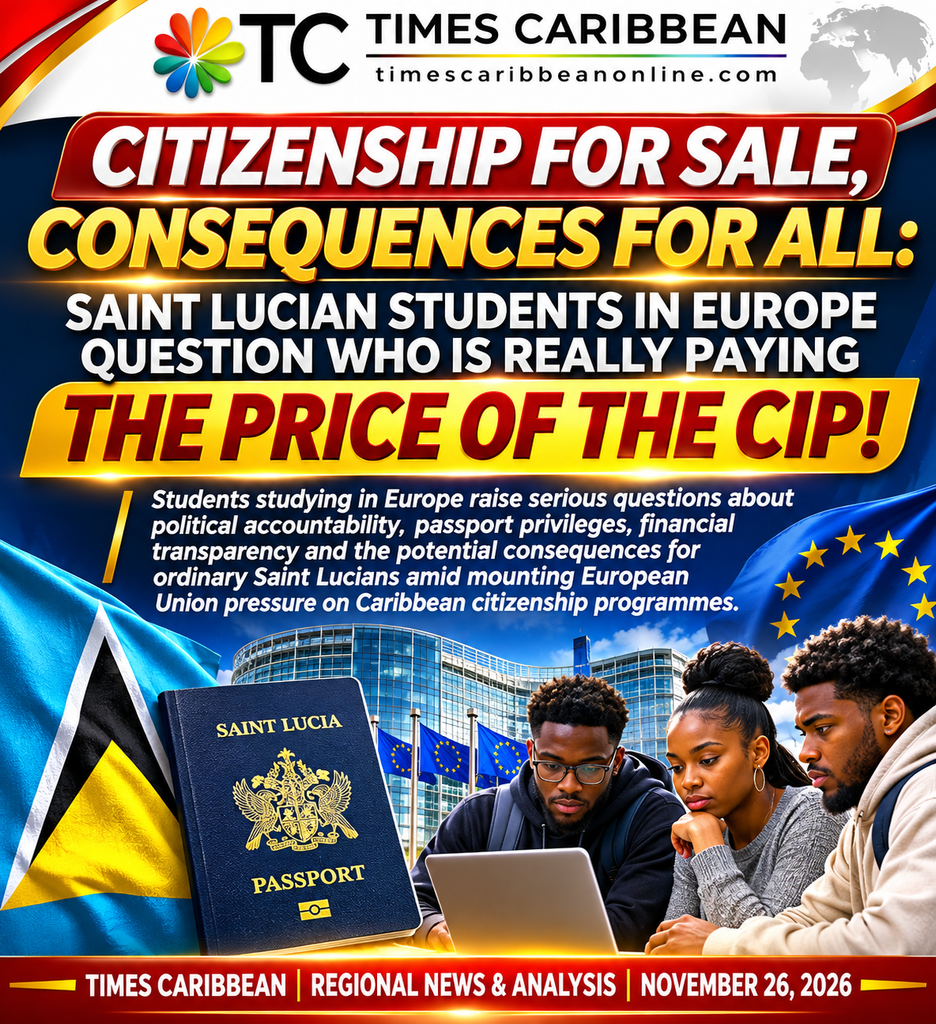
CITIZENSHIP FOR SALE, CONSEQUENCES FOR ALL: SAINT LUCIAN STUDENTS IN EUROPE QUESTION WHO IS REALLY PAYING THE PRICE OF THE CIP!

Students studying in Europe raise serious questions about political accountability, passport privileges, financial transparency and the potential consequences for ordinary Saint Lucians amid mounting European Union pressure on Caribbean citizenship programmes.
TIMES CARIBBEAN | REGIONAL NEWS & ANALYSIS | NOVEMBER 26, 2026
CASTRIES, SAINT LUCIA — As the debate surrounding the future of Saint Lucia’s Citizenship by Investment Programme (CIP) intensifies, a group identifying itself as Saint Lucian students studying in Europe has issued a pointed opinion piece questioning whether ordinary citizens are being asked to shoulder the potential consequences of government policy.
Entitled “Citizenship for Sale, Consequences for All: Who Is Really Paying the Price of Saint Lucia’s CIP?”, the commentary challenges political leaders to look beyond government revenue and consider the implications for citizens who depend on international mobility for education, employment, business and family commitments.
At the heart of their argument is one fundamental question: Who benefits, and who bears the consequences?
Ordinary Saint Lucians could pay the price
The students argue that much of the public debate has focused on national sovereignty, diplomatic relations and government revenue, while insufficient attention has been given to the potential difficulties facing ordinary passport holders.
Should Saint Lucia lose Schengen visa-free access, citizens could face additional application fees, documentation requirements, appointments and travel delays.
For students, entrepreneurs, professionals and families, these are not insignificant inconveniences. They could affect academic opportunities, international conferences, employment prospects and important family commitments.
The authors also question whether political leaders would defend the programme with the same determination if they and their immediate families were personally required to bear the full consequences of potential travel restrictions.
EU sovereignty versus Caribbean sovereignty
The students challenge the prevailing narrative that European scrutiny of Caribbean citizenship programmes represents an outright attack on national sovereignty.
They argue that while Saint Lucia has the sovereign right to determine its citizenship laws, European countries also have the authority to regulate entry into their territories.
Under Regulation (EU) 2025/2441, operating an investor citizenship programme that grants citizenship without a genuine connection to the issuing country constitutes a potential legal ground for suspending visa-free access. However, suspension is not automatic. EUR-Lex+1
The students identify a troubling economic contradiction: if Saint Lucia loses Schengen visa-free access while retaining its CIP, the programme could lose one of its most commercially attractive features.
EC$402.2 million in revenue — but where is the accountability?
Saint Lucia’s Citizenship by Investment Unit reported EC$402.2 million in revenue during the 2024–2025 financial year. St. Lucia Times+1
But the students contend that substantial revenue figures alone cannot establish whether the programme has delivered lasting economic benefits to ordinary Saint Lucians.
Their concerns include:
- The timely publication of audited financial statements.
- Greater transparency surrounding National Economic Fund expenditure.
- Detailed reporting on citizenship applications and approvals.
- Stronger oversight of applicant screening and compliance.
- Measurable infrastructure development and public debt reduction.
- Economic diversification to reduce dependence on citizenship revenue.
An International Monetary Fund consultation report published in January 2026 also recommended continued improvements in CIP governance, transparency and project monitoring. IMF eLibrary+1
Citizenship is more than a commercial transaction
The students maintain that citizenship carries responsibilities, international recognition and legal rights that extend far beyond the financial contribution of an investor.
They are calling for greater scrutiny of existing safeguards, including verification of applicants’ immigration histories, sources of funds and the accuracy of information submitted during the application process.
Importantly, the authors acknowledge that nationality alone does not make an individual a security concern and that legitimate applications for international protection should not automatically be regarded as misconduct.
Their central concern is whether adequate safeguards exist to protect the international reputation of Saint Lucia’s passport.
A warning for the wider Caribbean
Although the commentary focuses on Saint Lucia, its arguments carry considerable relevance for Antigua and Barbuda, Dominica, Grenada and St. Kitts and Nevis — countries facing similar European scrutiny of their citizenship programmes.
Governments must balance revenue generation, economic development, diplomatic relations and the interests of their citizens.
The students insist that questioning the administration of a citizenship programme should not be interpreted as opposition to national sovereignty or development.
Rather, it should be recognised as a legitimate exercise in democratic accountability.
Their final challenge to policymakers is particularly powerful:
Why has Saint Lucia not developed a sufficiently transparent, resilient and diversified economy capable of reducing its dependence on revenue generated through the sale of citizenship?
It is a question that extends well beyond Saint Lucia’s borders.
And one that Caribbean governments can no longer afford to ignore.
Based on an opinion submission attributed to Saint Lucian students studying in Europe, with additional reporting from published EU legislation, IMF assessments and CIP financial reporting. The identities of the authors have not been independently verified, and their criticisms represent their expressed opinions.
#TimesCaribbean #SaintLucia #CitizenshipByInvestment #CIP #CBI #EuropeanUnion #PoliticalAccountability #EconomicDiversification #CaribbeanNews #FinancialTransparency
















Leave a comment
You must be logged in to post a comment.