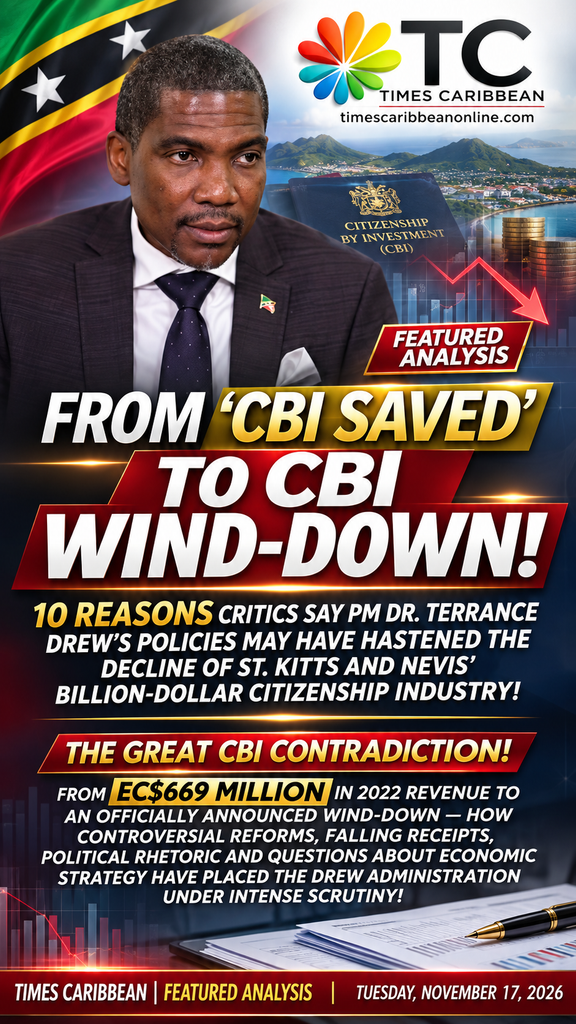
10 REASONS CRITICS SAY PM DR. TERRANCE DREW’S POLICIES MAY HAVE HASTENED THE DECLINE OF OR KILLED THE ST. KITTS AND NEVIS’ BILLION-DOLLAR CITIZENSHIP INDUSTRY!
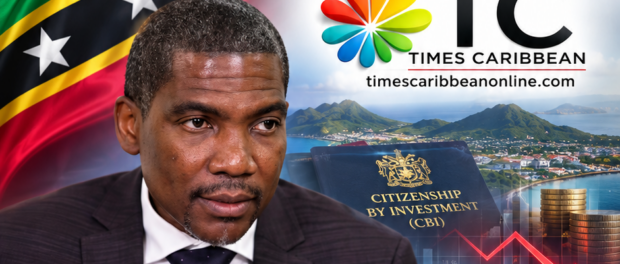
THE GREAT CBI CONTRADICTION! FROM EC$669 MILLION IN 2022 REVENUE TO AN OFFICIALLY ANNOUNCED WIND-DOWN — HOW CONTROVERSIAL REFORMS, FALLING RECEIPTS, POLITICAL RHETORIC AND QUESTIONS ABOUT ECONOMIC STRATEGY HAVE PLACED THE DREW ADMINISTRATION UNDER INTENSE SCRUTINY!
BASSETERRE, ST. KITTS AND NEVIS — One of the most consequential economic decisions in the modern history of St. Kitts and Nevis has exposed a stunning contradiction at the heart of Prime Minister Dr. Terrance Drew’s administration.
On October 17, 2024, the Prime Minister publicly declared that his government’s reforms had saved the Federation’s Citizenship by Investment (CBI) Programme.
On November 13, 2026, he announced that the same programme would be gradually wound down, with the transition timetable being negotiated with the European Union. SKNIS+1
Two years. Two dramatically different messages.
And one enormous question.
How did a programme the Prime Minister proclaimed had been saved end up on a path toward closure?
For decades, St. Kitts and Nevis operated the world’s oldest Citizenship by Investment Programme, established in 1984. Its revenues helped finance national development and supported the Federation’s transition away from its traditional sugar-based economy.
Now, an industry that once generated hundreds of millions of Eastern Caribbean dollars annually faces an uncertain future.
The government’s November 16 statement confirms that the programme remains operational during the transition, with applications continuing until an official final date is announced. The programme has therefore not yet closed. St Kitts & Nevis+1
The Drew administration argues that its decision is necessary to protect visa-free travel, international banking relationships and the country’s financial reputation.
Those concerns are serious.
But they do not eliminate legitimate questions about the government’s earlier decisions, the economic consequences of its reforms or the accuracy of its repeated declarations of success.
Times Caribbean examines 10 areas in which critics can reasonably question whether the administration’s policy choices, public messaging and strategic decisions accelerated the programme’s commercial decline — even as external European pressure ultimately drove the wind-down decision.
1. THE POLITICAL CAMPAIGN AGAINST THE PREVIOUS CBI ADMINISTRATION — DID THE GOVERNMENT UNDERMINE THE VERY BRAND IT INHERITED?
One of the most contentious features of the Drew administration’s approach to CBI was its repeated public criticism of the programme’s management under former Prime Minister Dr. Timothy Harris.
Rather than concentrating exclusively on restoring confidence and demonstrating international compliance, the government made alleged historical mismanagement a prominent part of its political messaging.
In a September 2024 statement and an October 2024 national address, Drew strongly criticised the former administration’s handling of the programme, particularly in relation to alleged underselling and international reputational concerns. SKNIS+1
The political question is unavoidable.
Can a government repeatedly question the integrity of its most internationally recognised investment product without creating additional concerns among prospective investors and industry partners?
Critics argue that the administration risked weakening commercial confidence in an established national brand through its confrontational public rhetoric.
That argument deserves examination.
But an important distinction must be made: there is no verified evidence establishing that Drew’s statements caused the European Union to adopt its current position. The EU’s objections extend across the Eastern Caribbean and are rooted in broader concerns about investor-citizenship schemes.
Still, reputational management is part of economic leadership.
And critics are entitled to ask whether the administration struck the right balance between exposing alleged historical problems and protecting a valuable national industry.
2. THE 2023 PRICE INCREASE — DID THE GOVERNMENT PRICE ST. KITTS AND NEVIS OUT OF THE MARKET?
In July 2023, the Drew administration increased the minimum qualifying CBI investment to US$250,000.
The government presented the decision as a necessary measure to strengthen integrity, improve standards and restore international confidence.
But commercial consequences followed.
According to the International Monetary Fund, CBI revenue declined substantially in 2024 as stricter requirements and higher investment costs took effect. The IMF also reported that subsequent price adjustments failed to generate the hoped-for recovery by early 2025. IMF eLibrary+1
That raises an uncomfortable question.
Did the government introduce necessary reforms without sufficiently protecting the programme’s competitiveness?
In an industry where investors compare pricing, processing requirements, investment options and international mobility benefits, changes in the cost of participation can have significant consequences.
The administration was right to consider integrity.
But integrity and commercial viability are not mutually exclusive objectives.
A responsible economic strategy must address both.
3. THE REVENUE COLLAPSE — HUNDREDS OF MILLIONS IN ANNUAL RECEIPTS DISAPPEARED FROM THE FISCAL PICTURE
The financial figures are among the most troubling elements of the entire controversy.
According to figures Prime Minister Drew himself presented in October 2024, CBI generated EC$669 million in 2022 and EC$620 million in 2023.
By September 2024, receipts stood at approximately EC$218 million for the first nine months of that year. SKNIS
REPORTED FEDERAL CBI RECEIPTS
2022
EC$669M
2023
EC$620M
Jan–Sep 2024
EC$218M
Government figures reported in the Prime Minister’s October 17, 2024 address. The 2024 figure covers nine months and is not a full-year total.
The IMF’s subsequent assessments confirmed that the decline continued beyond 2024.
Its 2026 Article IV report showed CBI revenue falling to approximately 5.3% of GDP in 2025, compared with 8.6% in 2024 and almost 26% at its 2022 peak. IMF eLibrary
These are not insignificant fluctuations.
They reflect a profound change in the country’s revenue structure.
Although the figures alone cannot establish that government policy was the sole cause, the IMF explicitly connected the decline to integrity-enhancing reforms.
The question is whether the administration adequately anticipated, managed and offset the resulting revenue losses.
4. DECLARING VICTORY TOO EARLY — THE 2024 “CBI SAVED” PROCLAMATION THAT NOW DEMANDS AN EXPLANATION
Perhaps no statement has returned to haunt the administration’s political messaging more than the Prime Minister’s October 2024 declaration that the CBI Programme had been saved.
That was no casual observation.
It was a central declaration in a nationally delivered address celebrating the administration’s reforms.
Yet, just over two years later, Drew announced a transition toward ending the programme.
Was the 2024 declaration an accurate assessment of the programme’s long-term security, or a premature political victory lap?
The government may legitimately argue that it succeeded in improving compliance and investor-screening standards, even though the EU subsequently moved toward opposing investor-citizenship programmes altogether.
But that explanation requires considerably more public scrutiny.
Saving a programme’s integrity is not necessarily the same thing as securing its commercial future.
The administration’s language in 2024 suggested both had been achieved.
The November 2026 announcement reveals a very different reality.
The government owes the nation a clear explanation of when it became apparent that compliance reforms alone could not preserve the programme.
5. THE REFORM AGENDA — DID ST. KITTS AND NEVIS ACCEPT THE COSTS WITHOUT SECURING THE EXPECTED LONG-TERM BENEFITS?
The Drew administration introduced sweeping CBI changes, including strengthened due diligence, applicant interviews, enhanced financial intelligence checks, independent audits and revised investment requirements.
Many of those measures addressed legitimate international concerns.
Indeed, in February 2026, the United States Financial Crimes Enforcement Network rescinded its 2014 advisory concerning the St. Kitts and Nevis CBI Programme — an important development cited by the government as evidence of reform progress. SKNIS
But the central question remains.
If the programme’s standards improved significantly, why was its future still considered unacceptable to European authorities?
The answer partly lies in a major change in European policy.
Under revised EU visa-suspension rules effective December 31, 2025, operating an investor-citizenship programme without a genuine-link requirement became grounds for considering visa-free travel restrictions.
This changed the fundamental operating environment. SKNIS+1
But critics can still question whether the government negotiated effectively enough, anticipated those developments early enough and communicated the changing risks honestly enough.
Reforms that improve international confidence represent progress.
Yet reforms that cannot preserve the programme’s future must also be assessed against their economic costs.
6. REGIONAL DIPLOMACY — DID ST. KITTS AND NEVIS FAIL TO SECURE A SUSTAINABLE CARIBBEAN SOLUTION?
The EU’s position is not directed exclusively at St. Kitts and Nevis.
Antigua and Barbuda, Dominica, Grenada and Saint Lucia have faced similar pressure.
Reuters reported on October 29, 2026, that the EU had asked five Eastern Caribbean governments to agree to phase out their programmes by June 1, 2028, or face the possibility of losing visa-free Schengen access. Reuters
That matters.
It would be inaccurate to suggest that Drew personally created the European Union’s regional policy.
Nevertheless, St. Kitts and Nevis has historically occupied a prominent position in the international citizenship investment industry.
The question is whether the Federation exercised sufficient leadership in pursuing a coordinated Caribbean response.
Could stronger regional diplomacy have secured a different outcome?
Could alternative investment-residency arrangements have been negotiated?
Was there an opportunity to preserve some economic benefits without undermining international travel privileges?
These are unanswered policy questions, not proof of diplomatic failure.
But they deserve much more than political reassurance.
7. THE LOSS OF COMPETITIVENESS — DID REPEATED POLICY CHANGES WEAKEN INVESTOR CONFIDENCE?
Successful international investment programmes depend on predictable rules.
Investors want certainty.
Developers need reliable financing expectations.
Authorised agents require clear procedures, competitive products and confidence that policies will remain commercially workable.
Between 2022 and 2024, St. Kitts and Nevis introduced several major changes to its programme, including adjustments to pricing and compliance requirements.
The IMF observed that the programme experienced a sharp revenue decline while competing regional programmes recorded widely varying results.
It also reported that reductions in certain investment prices during 2024 had not restored demand by early 2025. IMF eLibrary
This raises another question for policymakers.
Was the administration managing a long-term economic product, or repeatedly adjusting its commercial structure while the market moved elsewhere?
Not every decline in investor applications can be attributed to government decisions.
International demand, regulatory changes, competing jurisdictions and investor preferences all matter.
But consistency matters too.
And the government must account for how its policy changes affected the country’s competitive position.
8. ECONOMIC DIVERSIFICATION — DID THE GOVERNMENT MOVE QUICKLY ENOUGH TO REPLACE CBI REVENUE?
For years, political leaders have spoken about reducing the Federation’s dependence on citizenship investment receipts.
The need for diversification is not disputed.
In fact, heavy reliance on a single volatile revenue source creates serious fiscal risks.
The Drew administration has promoted its Sustainable Island State Agenda, renewable energy initiatives, tourism development, agriculture, infrastructure and other sectors as alternatives.
But one question now dominates the conversation.
Where is the fully funded, measurable economic replacement strategy for the revenue being lost?
The IMF has repeatedly urged St. Kitts and Nevis to strengthen domestic revenue mobilisation and respond to the structural decline in CBI income.
In its 2025 assessment, the institution highlighted the need for tax reform and wider fiscal adjustments. IMF eLibrary
Diversification cannot remain a campaign slogan.
The public deserves to know which projects will generate replacement revenue, when those revenues are expected, how many sustainable jobs will materialise and what happens if the projections are not achieved.
A national economy cannot survive on announcements alone.
It requires performance.
And the government’s diversification record must now be measured against the substantial revenue previously provided by CBI.
9. TRANSPARENCY AND ACCOUNTABILITY — WHY DID THE PUBLIC HAVE TO WAIT UNTIL NOVEMBER 2026 FOR THE WIND-DOWN ANNOUNCEMENT?
According to the government’s November 16 explanation, the European Commission invited St. Kitts and Nevis in June 2026 to begin winding down its CBI Programme.
The Prime Minister publicly announced the decision on November 13, 2026.
That leaves approximately five months between the reported European communication and the national announcement. SKNIS
A government may reasonably require time to conduct sensitive diplomatic negotiations.
But the size of the economic issue makes transparency especially important.
When did Cabinet formally consider the proposal?
When were economic impact assessments completed?
Were developers, financial institutions and major industry stakeholders adequately consulted?
Was Parliament briefed on the likely consequences?
And what protections were developed for public finances and investment commitments?
These are legitimate questions of governance.
The public should not have to depend on speculation to understand the future of one of the Federation’s most significant revenue-generating industries.
A decision of this magnitude demands a transparent national transition framework.
10. POLITICAL ACCOUNTABILITY — CAN THE PRIME MINISTER CLAIM SUCCESS FOR THE REFORMS BUT AVOID RESPONSIBILITY FOR THEIR ECONOMIC CONSEQUENCES?
This is the central issue.
Since assuming office in August 2022, Prime Minister Drew has consistently presented his administration’s CBI reforms as necessary to rescue the programme from reputational and regulatory difficulties.
His government has credited those reforms with improving governance and international confidence.
But the public must now evaluate the entire record.
The revenue decline.
The investment threshold changes.
The repeated public criticism of former programme management.
The October 2024 declaration of success.
The continued deterioration in CBI receipts.
And finally, the November 2026 decision to wind down the programme.
It is neither fair nor factually sustainable to assign sole responsibility for the programme’s impending closure to Drew.
The EU’s revised regulatory position is a major external factor, and the pressure extends across the region.
But external pressure does not absolve domestic policymakers of responsibility for their own decisions.
If the administration claims credit for reforming the programme, it must also explain how those reforms affected its competitiveness, revenue performance and long-term viability.
That is not a partisan demand.
That is accountability.
THE GREAT CONTRADICTION: FROM A CELEBRATED NATIONAL ASSET TO AN UNCERTAIN ECONOMIC FUTURE
The programme’s commercial and fiscal decline is undeniable.
But determining precisely how much responsibility belongs to Prime Minister Drew’s policies, earlier administrative practices, shifting international demand and EU pressure requires a transparent assessment of the evidence.
What is already clear is that the Federation is approaching an extraordinary economic transition.
The CBI Programme has supported public finances, development projects and wider economic activity for decades.
It cannot be replaced overnight.
Nor can its disappearance be dismissed as a routine administrative adjustment.
The stakes extend far beyond partisan politics.
They involve the government’s future ability to finance development, maintain public services, manage fiscal pressures and support economic growth.
The European Union has established a difficult international environment for investor-citizenship programmes.
The Drew administration has chosen a wind-down strategy in response.
Now it must demonstrate that this strategy protects the Federation’s long-term interests.
TIMES CARIBBEAN EDITORIAL: THE NATION DESERVES ANSWERS — NOT ANOTHER VICTORY SPEECH
There is a fundamental difference between explaining a difficult decision and accounting for the decisions that preceded it.
The Prime Minister has explained why international banking access and visa-free travel matter.
He is right that they matter enormously.
But the government must also account for the economic consequences of its earlier policies and explain why its highly publicised 2024 optimism proved so short-lived.
The people of St. Kitts and Nevis deserve a published transition timetable, independent economic impact assessment, detailed fiscal replacement strategy, transparent reporting on existing CBI obligations and regular parliamentary scrutiny.
Nothing less will suffice.
In October 2024, the nation was told the CBI Programme had been saved.
In November 2026, it was told the programme would be wound down.
The gap between those two announcements is now a defining test of the Drew administration’s credibility.
And history will judge not merely how the programme eventually ends, but how the government managed its final years.
The unanswered question is no longer simply who saved CBI.
It is whether St. Kitts and Nevis received the strongest possible leadership when its most internationally recognised economic programme needed it most.
TIMES CARIBBEAN — FEATURED POLITICAL & ECONOMIC ANALYSIS
















Leave a comment
You must be logged in to post a comment.