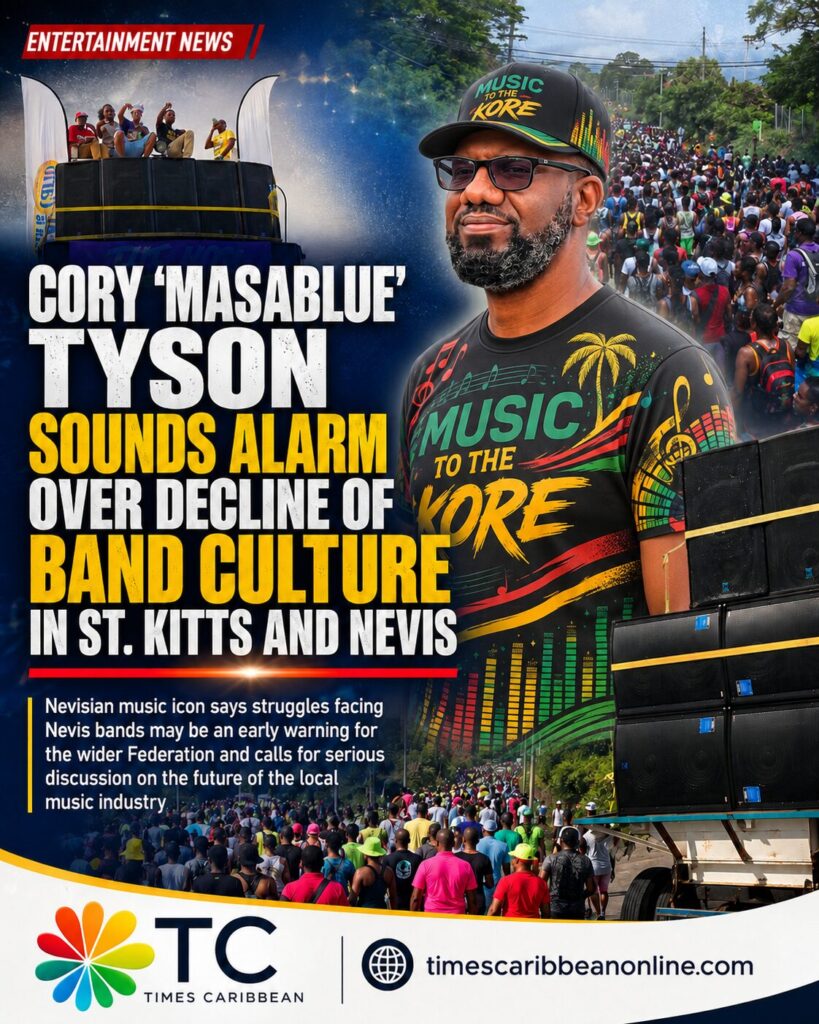
CORY “MASABLUE” TYSON SOUNDS ALARM OVER DECLINE OF BAND CULTURE IN ST. KITTS AND NEVIS

Nevisian music icon says struggles facing Nevis bands may be an early warning for the wider Federation and calls for serious discussion on the future of the local music industry
CHARLESTOWN, NEVIS, July 30, 2026 — Times Caribbean
Nevisian music icon Cory “Masablue” Tyson has sparked a major conversation about the state of live band culture in St. Kitts and Nevis, warning that the challenges presently confronting musicians and bands in Nevis should not be dismissed as merely a “Nevis band” problem.
In a strongly worded public commentary, Tyson argued that the difficulties being experienced on the smaller island may instead be an early indication of pressures affecting the music industry across the Federation.
“This isn’t just about the strength of the Nevis bands. That’s the symptom, not the disease,” Tyson wrote.
He noted that Nevis, because of its smaller population and economy, may feel industry pressures earlier and more sharply than St. Kitts.
But his wider warning was clear.
“Band culture in SKN is declining FAST!” Tyson declared, urging persons who disagree to speak directly with band managers about the realities of maintaining a functioning musical group.
According to Tyson, the real conversation should include the number of paid engagements bands are receiving, the increasing costs associated with keeping groups operational, difficulties retaining musicians and whether the present economics of live entertainment remain sustainable.
“Go sit down with a band manager and have an honest conversation,” he urged. “Ask them how many gigs they’re actually getting, what it costs to keep a band alive, how hard it is to retain musicians, and whether the economics still make sense.”
Tyson said musicians and other industry stakeholders have been discussing the causes of the problem for years and have also developed ideas which could form part of possible solutions.
He warned, however, that ignoring the issue could allow the situation to deteriorate further.
The longtime entertainer also questioned what he described as a past tendency by some decision-makers connected to Culturama and entertainment in Nevis to respond to struggling local bands by bringing in what were viewed as stronger bands from St. Kitts.
Tyson suggested that while such an approach may have addressed immediate entertainment needs, it did little to strengthen the underlying local music ecosystem.
He pointed to changing attendance patterns as another sign that simply booking a popular band may no longer automatically guarantee large crowds.
“Just a few years ago, simply putting a SK Band in the village would have resulted in a decent turnout… Not now!” Tyson stated.
His comments also raised a broader question surrounding the increasing presence of regional acts during major national festivals.
Tyson asked what happens if bands in St. Kitts eventually encounter the same economic and organisational pressures facing their Nevis counterparts.
“When SK bands continue facing the same pressures, and they are, what will be the plan then? Replace them with the ‘stronger’ regional bands?” he asked.
He encouraged cultural administrators, promoters and members of the public to look more closely at how many St. Kitts bands are actually securing work during the Carnival season and why opportunities may be changing.
Tyson also challenged the argument that festival organisers are simply responding to public demand.
“It’s what the people and revellers want,” he said, describing that explanation as insufficient.
According to Tyson, cultural leadership should play a role not only in responding to popular trends but also in helping to preserve and develop important parts of the Federation’s musical identity.
“Leadership is supposed to shape culture, not simply surrender to it,” he wrote.
His intervention touches on a much wider discussion surrounding the future of live bands in St. Kitts and Nevis at a time when DJs, international and regional performers, changing entertainment preferences and higher operational costs are reshaping the Caribbean entertainment landscape.
For generations, bands have been central to Carnival, Culturama, village festivals, fetes and community events across St. Kitts and Nevis. They have also served as training grounds for musicians, vocalists, producers and other creative professionals.
Tyson made clear that his comments were not intended simply to generate online controversy.
“Anyways… I ain’t interested in arguing for likes,” he stated. “I’m interested in protecting an industry that has given so much to me and this Federation.”
And he ended with an open invitation.
“If anyone wants to have a serious conversation about solutions instead of excuses, I ain’t hard to find.”
Tyson’s comments are likely to resonate well beyond Nevis, particularly among musicians, promoters, cultural officials and supporters who have increasingly questioned how local bands can remain viable in a rapidly changing entertainment environment.
The bigger question now being raised is not simply whether Nevis bands are struggling.
It is whether St. Kitts and Nevis is prepared to confront the economic and cultural challenges facing its live music industry before more bands disappear from the national stage.
















Leave a comment
You must be logged in to post a comment.