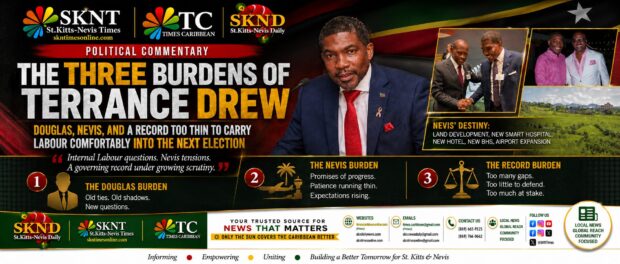
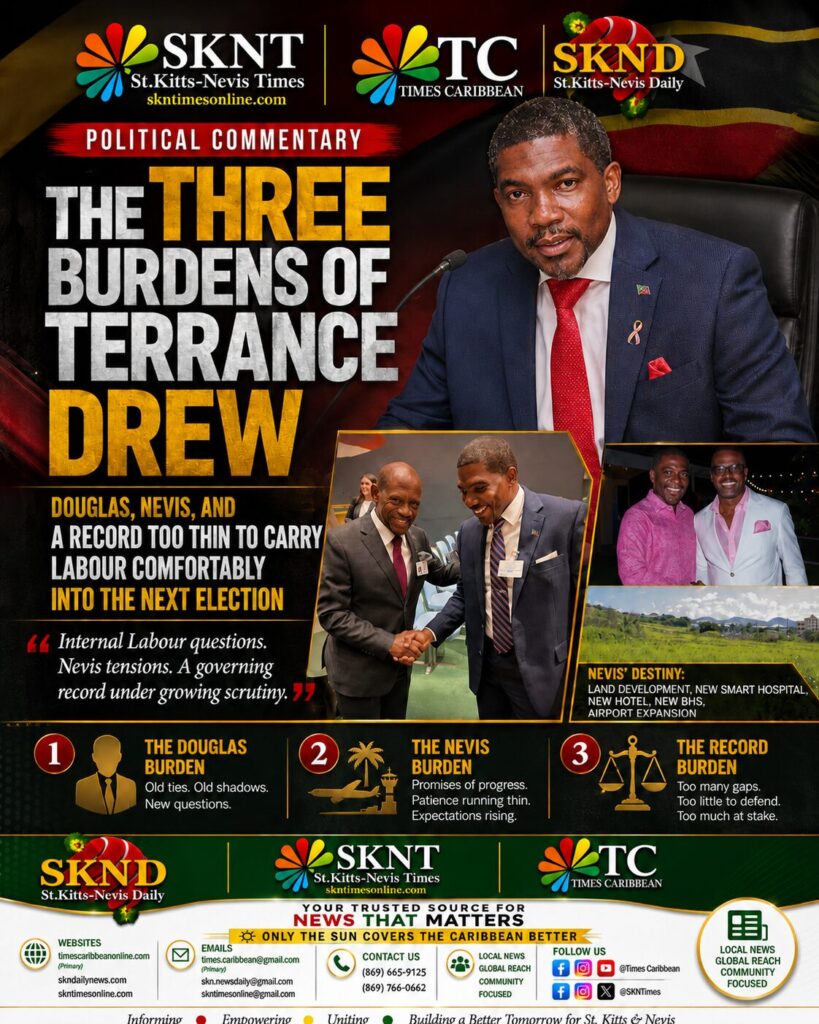
THE THREE BURDENS OF TERRANCE DREW: DOUGLAS, NEVIS, AND A RECORD TOO THIN TO CARRY LABOUR COMFORTABLY INTO THE NEXT ELECTION
Political Commentary
Prime Minister Dr. Terrance Drew appears to be moving toward the next general election carrying not one, not two, but three major political burdens — and each one has the potential to weigh heavily on the St. Kitts-Nevis Labour Party’s hopes of securing a renewed mandate.
The first burden is the reported internal question surrounding Senior Minister and former Prime Minister, the Right Honourable Dr. Denzil Douglas. It has been suggested in some political circles that Prime Minister Drew may have asked, or may be considering asking, Dr. Douglas to stand down for the coming election. That has not been officially confirmed, and it must be treated as political speculation unless and until Labour or Dr. Douglas himself speaks clearly on the matter.
However, in politics, perception can travel faster than confirmation.
If there is any truth to the suggestion, it could create a serious internal problem for Labour. Dr. Douglas is not an ordinary candidate. He is a former prime minister, a former party leader, a sitting senior minister, and one of the most experienced political figures in the Federation. He remains deeply rooted in Labour’s history, especially in Constituency Six, and continues to command respect among long-standing supporters.
Any move that appears to sideline him could be interpreted by some Labour supporters as unnecessary, risky, and politically insensitive. For a party that must keep its base energized and united, the last thing Prime Minister Drew needs is a perception that Labour’s old guard and new leadership are not fully aligned.
The second burden is Nevis.
Labour may be heading into the next election without strong political friends in Nevis. That is no small matter in a federation where federal power is shaped not only by numbers, but by relationships, trust, and national balance.
By placing distance between his administration and the ruling Concerned Citizens Movement-led Nevis Island Administration, Prime Minister Drew risks allowing the perception to harden that Basseterre is not moving with urgency on matters of major importance to Nevis. Two issues stand out: the proposed Destiny project and the Vance W. Amory International Airport expansion.
Whether the delays are constitutional, procedural, financial, legal, or political, the public perception in Nevis could still be damaging. If Nevisians believe that their development priorities are being slowed, second-guessed, or trapped in federal red tape, then Labour will have a difficult time convincing voters across the channel that it is the best partner for Nevis’ future.
That perception matters.
Nevis politics is never just local. It is federal. It affects national mood, coalition possibilities, and post-election arithmetic. If the Prime Minister is viewed as having weakened relations with the CCM while failing to build a meaningful Labour bridge into Nevis, then Labour could enter the election exposed on one of the Federation’s most sensitive political fronts.
But the third burden may be the heaviest of all: the performance burden.
After nearly four years in office, Prime Minister Drew’s government is facing a growing question from voters and critics alike: where is the transformational record?
The administration came to office with high expectations, bold promises, and a powerful message of change. Labour promised relief, renewal, stronger public services, improved infrastructure, better healthcare, housing solutions, and a modernized national development agenda. Yet for many citizens, the daily reality remains far from the political promise.
Water and electricity remain major public concerns, despite earlier assurances that these long-standing challenges would be urgently addressed. The government will point to the Basseterre Desalination Plant as a major achievement, and it is. It will also point to the St. Peter’s Main Road and F.T. Williams Highway East rehabilitation project as a completed infrastructure success, and that too is a visible project.
But the broader question remains: is that enough to carry a government into a second term?
The much-touted smart hospital has not materialized as a completed project. The long-awaited new Basseterre High School remains a symbol of promises still pending. The major hotel developments spoken about with great optimism, including the much-discussed Ritz-Carlton expectations, have not yet become visible economic reality. The promised housing revolution, including the heavily promoted smart homes agenda, has not delivered at the scale many voters expected.
There is no completed smart hospital. No completed new BHS. No major new hotel opening to transform the tourism landscape. No 2,400 smart homes delivered at the level once projected. No sweeping wave of major capital projects that citizens can point to and say: this is the visible transformation we were promised.
This is where the comparison with the former Team Unity administration becomes politically unavoidable.
Supporters of Team Unity continue to point to the second cruise pier, island-wide road rehabilitation, Old Road Bay, police and fire facilities, bus terminals, health facilities, court buildings, and other visible projects as evidence that the former administration, whatever its political controversies, delivered major physical infrastructure within its first term.
That comparison may be uncomfortable for Labour, but it is now part of the national conversation.
Elections are not won by excuses. They are won by visible delivery, public confidence, and a believable case for continuation. Right now, Prime Minister Drew appears to be facing a difficult political reality: despite the fragmentation of the opposition, he has not yet built the kind of overwhelming performance record that makes an early election attractive.
That may explain why an early election has not been called.
A divided opposition should, in theory, create an opportunity for a sitting government. But opportunity means little if the government itself is carrying heavy political baggage. If voters are dissatisfied with the cost of living, frustrated by utility challenges, disappointed by unfulfilled promises, and unconvinced by the pace of development, then opposition weakness alone may not be enough to guarantee Labour comfort.
Prime Minister Drew’s challenge is not simply to defeat his opponents. His greater challenge is to defend his own record.
He must explain why so many flagship promises remain incomplete. He must convince the public that delays are not failures. He must show that projects are not just announcements, consultations, renderings, and speeches, but real developments that improve lives. He must reassure Labour supporters that the party is united. He must repair or redefine the federal relationship with Nevis. And he must give voters a clear reason to believe that a second term would be more productive than the first.
That is a difficult message to sell when the country is still waiting to see several of the big promises become reality.
The Prime Minister’s three burdens are therefore clear.
The Douglas burden: the risk of internal Labour tension if a political veteran is perceived to be pushed aside.
The Nevis burden: the risk of entering the election with strained relations and weak alliances across the channel.
The performance burden: the risk of facing voters without a sufficiently strong record of completed, transformational delivery.
Any one of these would be serious. Together, they form a political load that cannot be ignored.
Prime Minister Drew still has time to change the narrative. Governments can recover. Projects can advance. Relationships can be repaired. Political missteps can be corrected. But time is not unlimited, and public patience is not endless.
The next election may not simply ask whether the opposition is ready.
It may ask something far more dangerous for Labour:
After nearly four years, has the Drew administration delivered enough to deserve five more?
















Leave a comment
You must be logged in to post a comment.