HIGH COURT ORDERS POLICE OFFICER TO PAY EC$30,000 AFTER BAR SECURITY ASSAULT IN NEVIS
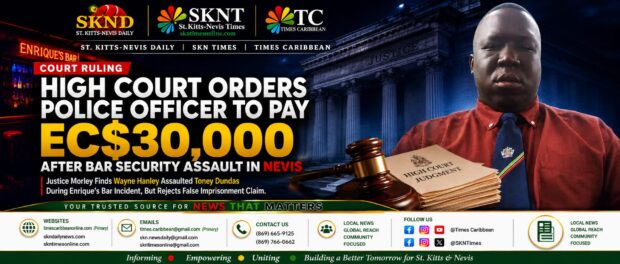
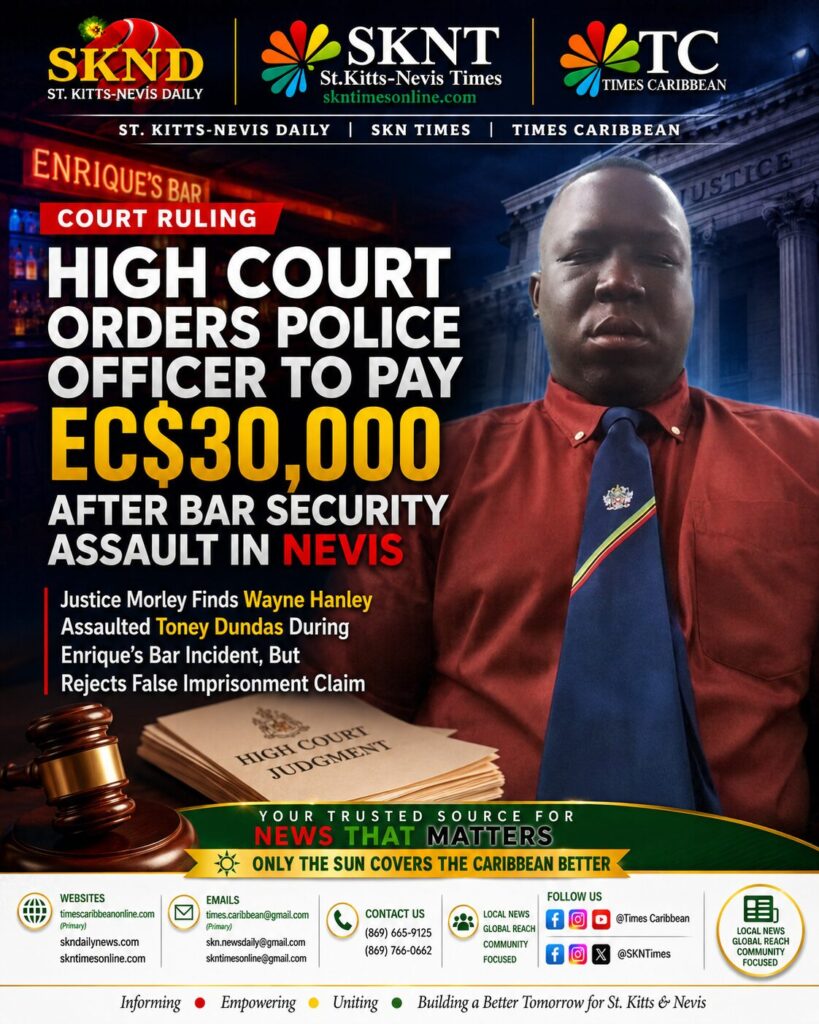
Justice Morley Finds Wayne Hanley Assaulted Toney Dundas During Enrique’s Bar Incident, But Rejects False Imprisonment Claim
CHARLESTOWN, NEVIS — In a dramatic High Court ruling delivered on May 27, 2026, the Eastern Caribbean Supreme Court has ordered police officer Wayne Hanley to pay a total of EC$30,000 in damages and costs after finding that he assaulted Nevis resident Toney Dundas during a confrontation at Enrique’s Bar in Cedar Trees, Charlestown.
The judgment, handed down by The Honourable Mr. Justice Iain Morley KC, brings legal closure to a civil claim filed by Dundas following an incident on March 26, 2023, where Hanley, while working as security at the bar, was accused of assault and false imprisonment.
According to the court, Hanley was working as a bouncer at Enrique’s Bar, vetting persons entering the establishment and checking for weapons. The incident unfolded shortly after an earlier altercation involving a knife at the same location.
The court reviewed CCTV footage, witness evidence, and medical records before concluding that Hanley assaulted Dundas. The judgment states that Hanley rose from his seat, grabbed Dundas around the neck and shoulder area, and repeatedly struck him on the head with a paddle scanner during the struggle.
Dundas later attended Alexandra Hospital, where medical records showed a laceration to the frontal region of his head requiring sutures, a deep laceration and abrasions to the right elbow, a laceration to the right knee, a hematoma to the right hip, tenderness to the chest wall, and multiple wheals to the front and back of the torso.
However, while the court accepted that Hanley assaulted Dundas, it rejected the claim of false imprisonment. Justice Morley found that although Hanley appeared to want to arrest Dundas and take him to the nearby Charlestown Police Station, the evidence did not prove that a lawful or unlawful arrest was actually completed before other police officers arrived.
The court also noted that Hanley, despite being off-duty and working private security, remained a police officer with powers available to him at all times to uphold law and order. But the judge made clear that if Hanley had arrested Dundas in the circumstances, such an arrest would have been unlawful because Dundas had not done anything to warrant arrest.
One of the most significant features of the ruling was the court’s careful assessment of Dundas’ own conduct. Justice Morley found that Dundas had provoked Hanley, noting that Dundas approached him after speaking with a man connected to the earlier knife incident and insulted Hanley during the confrontation.
The court found that this provocation did not excuse Hanley’s conduct, but it did reduce the damages awarded. Justice Morley stated that while the assault remained wrongful, the circumstances mitigated the level of compensation.
The court awarded Dundas EC$25,000 in damages, including general damages for pain and suffering, medical bills, and loss of wages. With prescribed costs of EC$5,000, Hanley was ordered to pay a total of EC$30,000.
The judgment also strongly criticized the initial inclusion of soldier LCpl Assot Eddy as a defendant in the case. Proceedings against Eddy were withdrawn after the CCTV footage showed that he was not culpable and had instead tried to calm the situation.
Justice Morley commended Eddy for his intervention, stating that he was someone who should never have been sued and was instead to be praised for helping to de-escalate the incident.
The court further cautioned that claims for damages must be realistic and not pursued in what it described as “adventurous excess.” Dundas had initially sought as much as EC$78,420, while Hanley’s side had suggested a far lower award.
The matter is scheduled to return before the court on November 27, 2026, to monitor progress on payment.
The ruling now stands as a major reminder that police officers, even when working in private security settings, remain accountable for their conduct — and that the courts will carefully examine both the use of force and the surrounding circumstances before determining liability and compensation.
















Leave a comment
You must be logged in to post a comment.