When ‘Righteous’ Leaders Practice Injustice: Making Mockery of Christianity
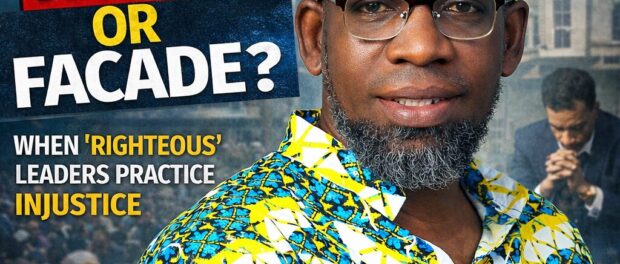
There is a growing dissonance within contemporary Christianity, one that is impossible to ignore. It is the gap between the language of righteousness and the practice of injustice; between fervent public prayer and quiet complicity in wrongdoing; between sermons about holiness and lives marked by indifference to suffering.
Nowhere is this contradiction more visible than in the workplace, and within church leadership itself. Increasingly, believers and observers alike are asking: what does it mean when those who proclaim righteousness fail to practice justice?
The Bible is unequivocal about what God requires. “He has told you, O man, what is good; and what does the Lord require of you but to do justice, and to love kindness, and to walk humbly with your God?” (Micah 6:8). Likewise, Amos declares, “Let justice roll down like waters, and righteousness like an ever-flowing stream” (Amos 5:24). These are not abstract ideals. They are practical mandates. Yet many who loudly profess faith seem to reduce Christianity to performance, prayer meetings, eloquent speech, and outward displays, while neglecting the weightier matters of justice, fairness, and compassion.
In many workplaces, self-professed Christians are known for their visible religiosity, praying openly, quoting Scripture, and speaking about integrity, yet their actions tell a different story. Employees are underpaid, overworked, or treated unjustly, while those in authority turn a blind eye or actively perpetuate the injustice. Promotions are denied unfairly, grievances are ignored, and exploitation is rationalised. In such environments, prayer becomes a cover for inaction, and spirituality becomes a shield against accountability.
This is not a neutral stance. Ignoring injustice is itself a form of participation in it. Silence in the face of wrongdoing enables its continuation. When Christians choose comfort over confrontation, they align themselves not with righteousness, but with oppression. James 2:14–17 makes this clear: faith that does not produce action is dead. To pray for change while refusing to act is not faith, it is avoidance dressed in religious language.
This disconnect is further amplified within church leadership, particularly in the rise of what might be called “professional Christianity.” Increasingly, pastoral ministry is treated less as a divine calling, and more as a career path. Churches are structured like corporations, pastors function as executives, and success is measured by metrics, attendance figures, building projects, and financial growth, rather than by spiritual health or community impact.
In this model, the pastor becomes a hireling rather than a shepherd. Jesus warned against such leadership in John 10, describing the hireling as one who works for pay and abandons the sheep when trouble arises. This warning echoes the prophetic rebuke in Jeremiah 23:1–2: “Woe to the shepherds who destroy and scatter the sheep of my pasture!” When ministry is reduced to employment, the focus shifts from care to compensation, from service to self-interest.
The consequences are visible across many communities. Large, impressive church buildings rise across the Caribbean, funded by the sacrificial giving of congregants. Yet many of these same congregants remain in poverty, unskilled, undereducated, and struggling to meet basic needs. Meanwhile, church leaders often enjoy elevated lifestyles, insulated from the hardships of their members. This disparity raises uncomfortable questions: whose kingdom is being built? And at what cost?
The emphasis on prosperity theology in some circles has only deepened this problem. By equating faith with financial blessing, it subtly encourages self-centred spirituality. Giving becomes transactional, success becomes a sign of divine favour, and concern for the marginalised is overshadowed by the pursuit of personal gain. In such an environment, justice is sidelined, and compassion becomes optional.
This is not the Christianity of Scripture. Jesus consistently prioritised the poor, the oppressed, and the overlooked. He rebuked religious leaders who meticulously observed rituals while neglecting justice. In Matthew 23, He condemned the Pharisees for tithing herbs while ignoring “the weightier matters of the law: justice, mercy, and faithfulness.” His message was clear: outward religiosity without inward transformation is hypocrisy.
The “Sabbath-Sunday-Monday gap” illustrates this reality vividly. On Sabbaths and Sundays, believers gather, worship passionately, and speak of holiness. But by Monday, many return to environments where they act ruthlessly, compromise integrity, or ignore injustice. Faith is compartmentalized, confined to church settings rather than integrated into daily life. This fragmentation undermines the credibility of Christianity and fuels disillusionment among believers.
Indeed, many are leaving churches not because they reject faith, but because they are disillusioned by leadership that appears disconnected from real-world struggles. They see churches prioritising building funds over community outreach, attendance numbers over individual care, and image over authenticity. They witness leaders who preach sacrifice, but live in excess, who demand loyalty but offer little accountability. In such contexts, the church ceases to be a refuge, and becomes a source of frustration.
Burnout among pastors is also a symptom of this professionalisation. When ministry is treated as a job rather than a calling, it loses its spiritual foundation. The pressure to perform, maintain growth, and meet expectations can lead to exhaustion and disengagement. Without a genuine sense of calling, the work becomes burdensome, and relationships with congregants become transactional.
The solution is not to abandon the church or dismiss faith, but to return to its foundational principles. Christianity, at its core, is not about performance, but transformation. It calls for a life that reflects God’s character, marked by justice, mercy, and humility. It demands consistency between belief and behaviour, between public declarations and private actions.
This requires repentance, not just individual, but collective. Christians must confront the ways in which they have allowed convenience, culture, and self-interest to distort their faith. Leaders must re-examine their motives, priorities, and practices. Are they serving the people or using them? Are they building communities or empires? Are they shepherds or employees?
It also requires courage from believers. Silence must be replaced with advocacy. Injustice, whether in the workplace, the church, or society, must be challenged, not ignored. Prayer must be accompanied by action. Faith must be lived, not merely spoken.
True righteousness is not measured by how loudly one prays, or how eloquently one speaks, but by how justly one lives. It is seen in fair treatment of others, in compassion for the vulnerable, and in integrity in all areas of life. Anything less is not only hypocrisy, it is a mockery of the very faith it claims to uphold.
The call of Micah 6:8 still stands. The cry of Amos 5:24 still echoes. And the warning of James 2 still challenges: faith without works is dead. The question is whether those who claim the name of Christ will heed that call—or continue to speak of righteousness while practicing injustice.
-30-

















Leave a comment
You must be logged in to post a comment.