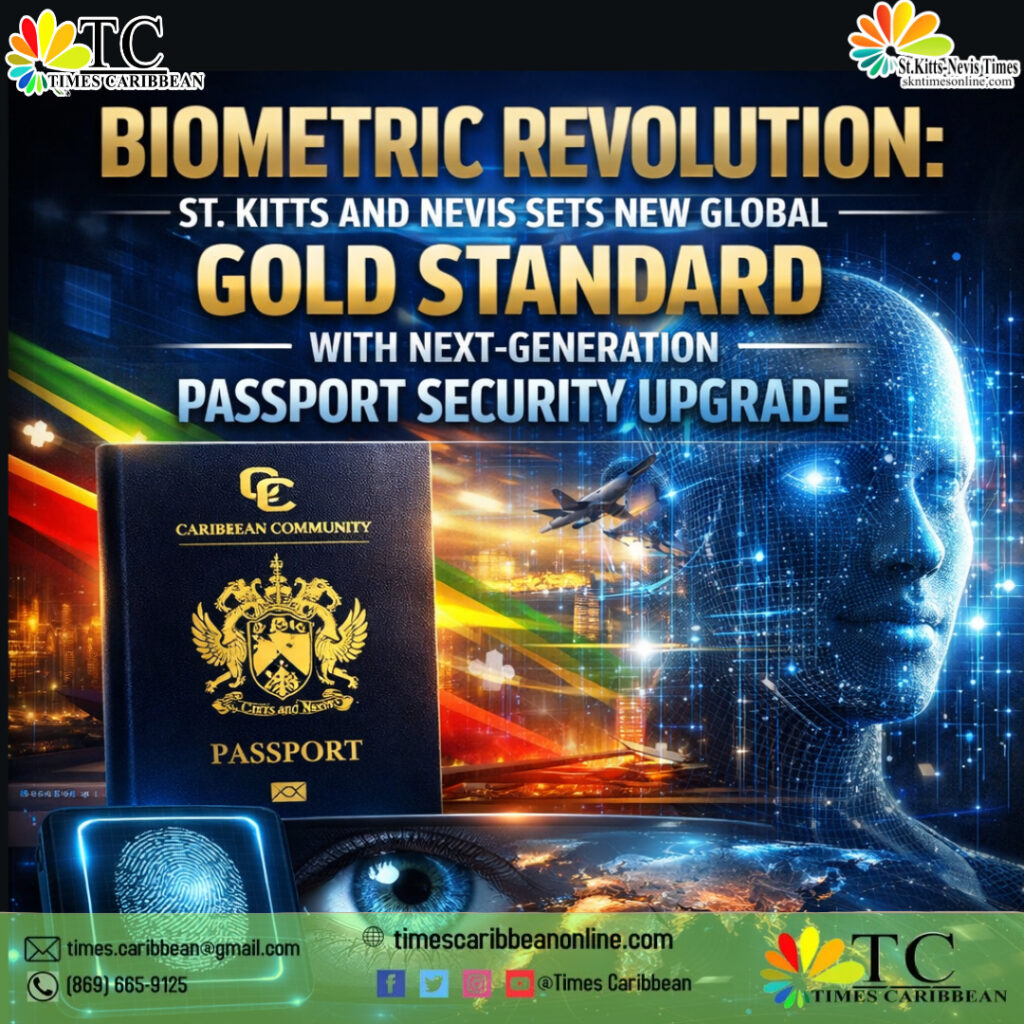
BIOMETRIC REVOLUTION: ST. KITTS AND NEVIS SETS NEW GLOBAL GOLD STANDARD WITH NEXT-GENERATION PASSPORT SECURITY UPGRADE

By Times Caribbean | Feature Analysis
In a bold, strategic move that is already sending ripples across the global citizenship and border security landscape, St. Kitts and Nevis has once again positioned itself at the forefront of international innovation with the launch of its National Biometric Enrolment and Passport Modernisation Programme—a transformative initiative that redefines what it means to hold a secure, globally respected passport.
This is not merely an upgrade. It is a declaration.
A declaration that the Federation—long regarded as the pioneer of the global Citizenship by Investment (CBI) industry—is not content with meeting international standards, but is determined to set them.
A STRATEGIC LEAP INTO THE FUTURE OF GLOBAL IDENTITY
With an official launch date set for April 14, 2026, the programme ushers in a new era of biometric-enabled travel documentation, aligning St. Kitts and Nevis with—and in some respects ahead of—major global powers such as the European Union, the United States, and the United Kingdom.
At its core, the initiative integrates cutting-edge biometric identifiers, including:
- Fingerprint recognition
- High-resolution digital facial imaging
- Optional iris scanning
These features are seamlessly embedded into a secure, encrypted identity infrastructure, fully compliant with International Civil Aviation Organisation (ICAO) standards—widely regarded as the global benchmark for travel document security.
The implications are profound: enhanced border control interoperability, reduced identity fraud, and strengthened international trust.
PROTECTING VALUE, PRESERVING REPUTATION
For decades, the strength of the St. Kitts and Nevis passport has been intrinsically tied to the credibility of its CBI programme. In recent years, however, increased scrutiny from international partners placed mounting pressure on small states to tighten governance, transparency, and due diligence frameworks.
This biometric modernisation initiative is a direct, decisive response.
Prime Minister Dr. Terrance Drew captured the gravity of the moment:
“St. Kitts and Nevis does not follow the global standard—we set it.”
This statement is more than political rhetoric—it reflects a calculated effort to future-proof the nation’s most valuable international asset: its passport.
By embedding advanced biometric verification into the passport issuance process, the government is effectively raising the barrier to fraud, misuse, and reputational risk, while simultaneously reinforcing confidence among international partners, financial institutions, and border agencies.
STRUCTURED TRANSITION: CLEAR DEADLINES, ZERO AMBIGUITY
The programme’s rollout is defined by precision and clarity:
- Launch Date: April 14, 2026
- Transition Deadline: July 31, 2027
Passports issued prior to the launch will remain valid only within this transition window, after which they will be rendered obsolete for international travel—a decisive move that underscores the seriousness of the reform.
Citizens—particularly those who obtained nationality through the CBI programme—are strongly urged to complete biometric enrolment early, avoiding potential travel disruptions.
HOW IT WORKS: STREAMLINED, SECURE, CENTRALIZED
The enrolment process has been designed for efficiency and integrity, operating exclusively through the government’s official biometric platform:
- Digital Registration & Application Submission
- Appointment Scheduling at Approved Centres
- In-Person Biometric Capture (15–30 minutes)
Notably, the government has taken a firm stance against third-party interference:
Only the official platform is authorised. All external processing channels are strictly prohibited.
This centralisation is a critical safeguard—ensuring data integrity, system security, and full governmental oversight.
GLOBAL SIGNAL: FROM COMPLIANCE TO LEADERSHIP
Perhaps the most significant dimension of this initiative lies in its geopolitical signaling.
St. Kitts and Nevis is not acting in isolation—it is responding to a rapidly evolving global environment where identity, mobility, and security are increasingly intertwined.
Recent developments—including the rescission of a longstanding advisory by the United States Financial Crimes Enforcement Network (FinCEN)—suggest that the Federation’s reforms are already gaining international recognition.
Executive Chairman of the Citizenship Unit, H.E. Calvin St. Juste, framed the initiative as part of a broader, long-term vision:
“We are not simply maintaining a programme—we are building one designed to endure.”
This is a critical distinction.
While many jurisdictions react to global pressure, St. Kitts and Nevis is proactively shaping the future architecture of citizenship governance.
A LEGACY REINFORCED, A FUTURE REDEFINED
Since pioneering the world’s first Citizenship by Investment Programme in 1984, St. Kitts and Nevis has consistently walked a delicate line—balancing economic opportunity with international credibility.
This latest reform represents the next evolutionary step in that journey.
It sends a powerful message:
- To investors: your citizenship is protected and globally respected
- To global partners: the Federation is a serious, compliant, and forward-thinking jurisdiction
- To its people: national reputation is non-negotiable
THE BOTTOM LINE
In an era where passports are no longer just travel documents but symbols of trust, access, and global standing, St. Kitts and Nevis has made a decisive move.
This is not just modernization.
This is global leadership in action.
And once again, the Federation has made one thing abundantly clear:
It is not following the future of citizenship—it is defining it.
















Leave a comment
You must be logged in to post a comment.