BIOMETRIC ERA BEGINS: ST. KITTS & NEVIS CITIZENSHIP UNIT UNVEILS MANDATORY SECURITY OVERHAUL
By Times Caribbean News Desk
Basseterre, St. Kitts — In what is being described as one of the most consequential policy shifts in the history of the Federation’s Citizenship by Investment Programme (CIP), the St. Kitts and Nevis Citizenship Unit has announced the mandatory implementation of biometric data collection for programme applicants and existing economic citizens.
The move, scheduled to take effect before the end of Q1 2026, signals a defining moment in the evolution of the world’s oldest Citizenship by Investment Programme — and a bold recalibration of St. Kitts and Nevis’ position within the global security architecture.
A Strategic Reset in a Changing Global Climate
The biometric initiative is not occurring in isolation. It emerges amid sustained international scrutiny of investment migration programmes and growing demands for transparency, traceability, and harmonized border security protocols.
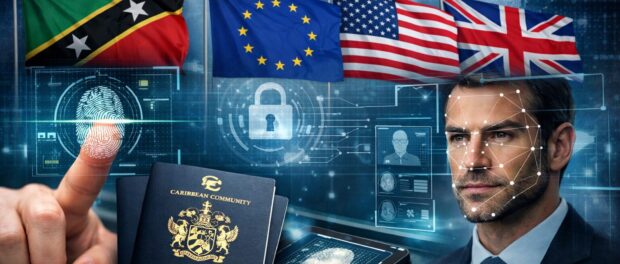
By introducing biometric verification — which typically includes fingerprinting, facial recognition mapping, and secure identity authentication — St. Kitts and Nevis is aligning itself with the gold-standard frameworks employed by the European Union, the United States, and the United Kingdom.
Executive Chairman H.E. Calvin St. Juste framed the initiative as a decisive step toward safeguarding the Federation’s international reputation.
“This biometric initiative underscores our unwavering commitment to maintaining the integrity and reputation of St. Kitts and Nevis as a responsible global partner,” St. Juste stated. “By implementing these enhanced security measures, we are ensuring that we meet the highest international standards while contributing meaningfully to global border security efforts.”
Behind the diplomatic language lies a clear strategic message: St. Kitts and Nevis intends not merely to defend its programme — but to future-proof it.
Who Is Affected — And Who Is Not
The new biometric requirement will apply exclusively to:
- All new applicants entering the Citizenship by Investment Programme.
- Existing economic citizens who previously acquired citizenship through the programme.
Notably, native-born nationals of St. Kitts and Nevis are exempt from the requirement.
Existing programme citizens will be granted an extended compliance window, a move designed to ensure administrative stability and prevent disruption for legitimate passport holders.
This distinction is critical. It preserves constitutional and sovereign rights of native-born citizens while strengthening due diligence mechanisms within the investment migration framework.
Protecting the Brand of the World’s Oldest CIP
Established in 1984, the St. Kitts and Nevis CIP has long marketed itself as the platinum standard in investment migration. Yet in recent years, global pressures have intensified.
Visa waiver arrangements, correspondent banking relationships, and international partnerships now hinge more than ever on demonstrable compliance with anti-money laundering (AML), counter-terrorism financing (CTF), and border security standards.
The biometric rollout therefore represents more than a technical upgrade — it is a geopolitical signal.
Analysts suggest the move is designed to:
- Reinforce trust with visa-free partner states
- Strengthen due diligence credibility
- Protect financial services relationships
- Insulate the programme from external regulatory pressure
- Enhance real-time identity verification across jurisdictions
In short, biometric integration transforms the CIP from a document-based verification system into a data-driven identity assurance framework.
A Regional Benchmark?
With Caribbean investment migration programmes under increasing multilateral review, St. Kitts and Nevis’ decision may set a new regional benchmark.
Should the initiative be successfully implemented by Q1 2026, the Federation could position itself once again as a policy leader rather than a policy respondent — reclaiming narrative control in an industry often shaped by external diplomatic influence.
The Broader Security Implications
Biometric systems strengthen:
- Identity authentication accuracy
- Fraud detection capabilities
- International data-sharing compatibility
- Border management coordination
For a small island state operating in a hyper-connected global environment, such systems reduce reputational risk while enhancing national sovereignty.
Critically, this initiative does not signal contraction of the programme — it signals maturation.
The Bottom Line
The biometric rollout marks a pivotal chapter in the evolution of St. Kitts and Nevis’ citizenship framework.
It is a declaration that the Federation understands the stakes: in an era of heightened geopolitical sensitivity, passport integrity is national security.
If executed effectively, the initiative could reinforce St. Kitts and Nevis’ standing as a responsible, forward-thinking global partner — proving that small states can lead in compliance innovation rather than merely react to international pressure.
As the clock ticks toward Q1 2026, one thing is clear:
The era of enhanced biometric citizenship has arrived — and St. Kitts and Nevis intends to be ahead of the curve.
















Leave a comment
You must be logged in to post a comment.