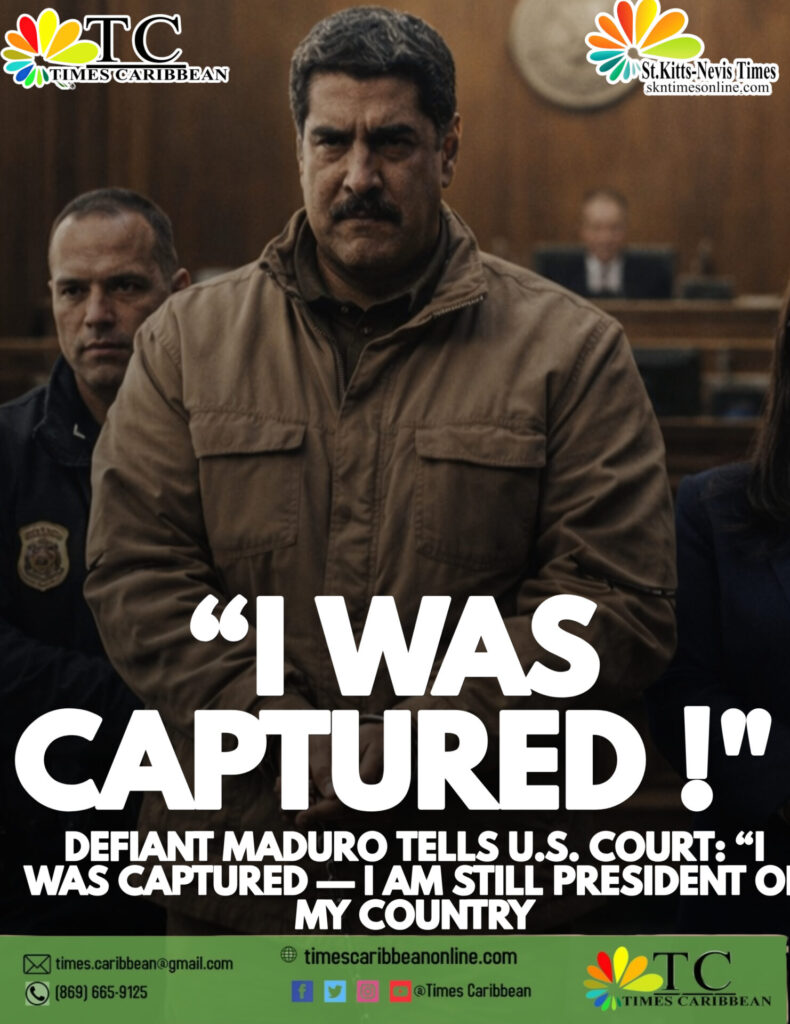
DEFIANT MADURO TELLS U.S. COURT: “I WAS CAPTURED — I AM STILL PRESIDENT OF MY COUNTRY”
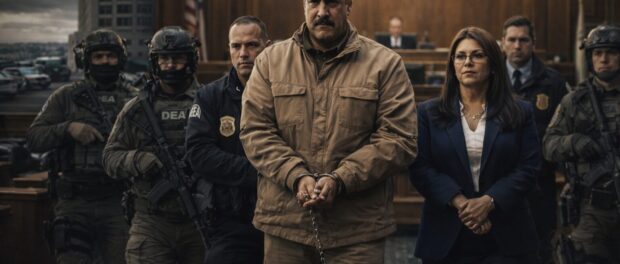

NEW YORK — In a dramatic and defiant first appearance in a Manhattan federal courtroom, deposed Venezuelan leader Nicolás Maduro repeatedly rejected the legitimacy of the charges against him, declaring himself “the president of my country” and insisting he was unlawfully seized in what his lawyers describe as a military abduction from sovereign Venezuelan territory.
Maduro, speaking through a Spanish interpreter, pleaded not guilty on Monday to sweeping U.S. federal charges including narco-terrorism conspiracy, cocaine importation conspiracy, and weapons offenses — the same charges the Trump administration has cited to justify his removal from power and transfer to U.S. custody.
“I was captured,” Maduro told the court before being cut off by the presiding judge. Moments later, when formally asked how he pleaded, he responded bluntly: “I am innocent. I am not guilty. I am a decent man. I am still president of my country.”
A Courtroom Confrontation With Global Implications
Maduro and his wife, Cilia Flores, appeared before U.S. District Judge Alvin Hellerstein at noon, following their detention at the Metropolitan Detention Center in Brooklyn (MDC-Brooklyn). Flores, who also entered a not-guilty plea, described herself as the “first lady of Venezuela” during the proceedings.
Their defense attorney, Barry Pollack, immediately signaled that the case would extend far beyond standard criminal law, raising profound questions of international legality and sovereignty.
“There are serious issues about the legality of his military abduction,” Pollack told the court, indicating that the defense may seek to assert head-of-state immunity and challenge U.S. jurisdiction altogether.
Maduro went further, calling himself a “prisoner of war” and asserting he had been kidnapped from his home in Caracas during a U.S. military operation — language that sharply escalates the diplomatic and legal stakes of the case.
Judge Hellerstein advised Maduro that there would be time later to challenge the legality of his detention, before proceeding to read him his constitutional rights. Maduro responded pointedly: “I did not know of these rights. Your Honor is informing me of them now.”
Washington’s Message: Power, Oil, and Consequences
The courtroom drama unfolded against an increasingly aggressive posture from U.S. President Donald Trump, who declared publicly that the United States is now “in charge” of Venezuela and warned the country’s interim leadership to cooperate or face a “very big price.”
Trump has also openly stated that Washington intends to tap into Venezuela’s vast oil reserves, fueling accusations from Caracas and regional observers that the prosecution is inseparable from strategic and economic ambitions. His rhetoric has not stopped at Venezuela — issuing warnings to Colombia and Mexico, reviving inflammatory remarks about Greenland, and predicting the imminent collapse of Cuba’s government.
A New President in Caracas — and a Nation in Flux
As Maduro stood in a New York courtroom proclaiming himself Venezuela’s rightful leader, political power in Caracas shifted decisively. Delcy Rodríguez, Maduro’s longtime vice president, has been sworn in as Venezuela’s new president, consolidating control at home while denouncing the U.S. operation as an act of aggression.
The parallel realities — Maduro asserting presidential authority from a federal dock in Manhattan while a successor governs in Caracas — underscore the unprecedented nature of the crisis.
A Trial That May Redefine International Norms
Beyond the personal fate of Nicolás Maduro, the case threatens to reshape global norms around sovereignty, regime change, and the use of criminal law as a tool of foreign policy. If U.S. courts proceed without recognizing any form of head-of-state immunity, the precedent could reverberate far beyond Venezuela — particularly for small and developing states wary of great-power intervention.
For now, Maduro remains in federal custody, defiant and unyielding.
When asked one final time how he pleaded, his answer was unwavering:
“I am innocent. I am not guilty. I am a decent man. I am still president of my country.”
As the legal battle moves forward, one thing is clear: this is no ordinary criminal case — it is a geopolitical reckoning playing out inside a U.S. courtroom, with consequences that may echo across the Caribbean, Latin America, and the wider world.
















Leave a comment
You must be logged in to post a comment.