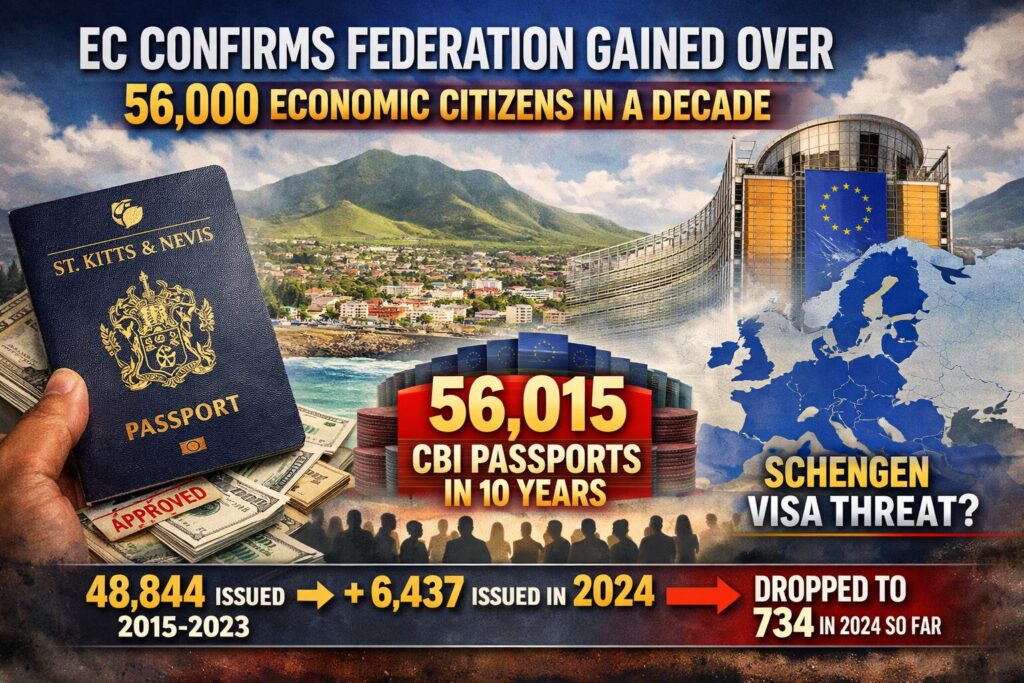
EC CONFIRMS FEDERATION GAINED OVER 56,000 ECONOMIC CITIZENS IN A DECADE

WASHINGTON, DC — Fresh disclosures by the have cast a stark spotlight on the sheer scale—and mounting scrutiny—of the Citizenship by Investment (CBI) programme in St. Kitts and Nevis, confirming that the Federation issued more than 56,015 economic citizenships over a ten-year period, cementing its position as the most prolific CBI jurisdiction in the Eastern Caribbean.
The data reveal that 48,844 passports were issued between 2015 and 2023, with a further 6,437 issued in 2024. By contrast, just 734 passports were issued up to the end of April this year, signalling a dramatic slowdown that regional leaders attribute to sweeping reforms and intensified international oversight.
Access to detailed CBI statistics has historically been opaque. However, in a rare window into the programme’s inner workings, the Commission’s figures corroborate statements made by Prime Minister during his Budget presentation, where he acknowledged that reform-driven tightening has sharply reduced application volumes across the region.
Yet despite the contraction, St. Kitts and Nevis remains the most sought-after CBI programme in the Eastern Caribbean. Between 2015 and 2023, the Federation recorded 19,655 applications. That figure collapsed to 223 applications in 2024, with 171 applications received up to April this year, underscoring how profoundly policy shifts and geopolitical pressure have altered the programme’s trajectory.
Rejection rates, however, remain comparatively low. The Commission reports 739 rejected applications between 2015 and 2023, followed by 98 in 2024 and 86 up to April this year—figures that continue to fuel debate about whether due-diligence thresholds were historically stringent enough for a programme of such scale.
Notably absent from official disclosures is a detailed country-by-country breakdown from local authorities. Nonetheless, the Commission’s regional overview paints a troubling picture. In 2024, among reporting states—including St. Kitts and Nevis, Dominica, Saint Lucia, and Antigua and Barbuda—the majority of successful applicants originated from countries requiring visas to enter the EU. The Commission disclosed approvals for 531 Syrian nationals, 365 Iraqis, and 333 Chinese nationals across the region.
In the specific case of St. Kitts and Nevis, successful applicants included nationals from Russia, Belarus, Iran, Iraq, North Korea, and Afghanistan—a revelation certain to intensify international concern.
These disclosures come amid sustained pressure from the and the , prompting regional governments to agree to a sweeping reform package. Measures include shared denial lists, mandatory applicant interviews, enhanced scrutiny by Financial Intelligence Units, annual independent audits, retrieval of revoked passports, and the suspension of applications from designated high-risk countries.
Despite these steps, the Commission has reiterated that CBI programmes pose inherent security risks. In a report published last week, it warned of the possible suspension of visa-free access to the , citing persistent concerns about monitoring CBI passport holders once they enter Europe.
“Investor citizenship schemes inherently carry security risks for the Schengen area,” the report stated. “No such scheme can be considered risk-free from a security and migration control perspective, and visa-free access remains a major incentive for beneficiaries who would otherwise be visa-required.”
As St. Kitts and Nevis confronts declining revenues, rising scrutiny, and existential questions about the future of its most lucrative programme, the Commission’s figures leave little doubt: the era of unchecked CBI expansion is over—and the reckoning is now firmly underway.
















Leave a comment
You must be logged in to post a comment.