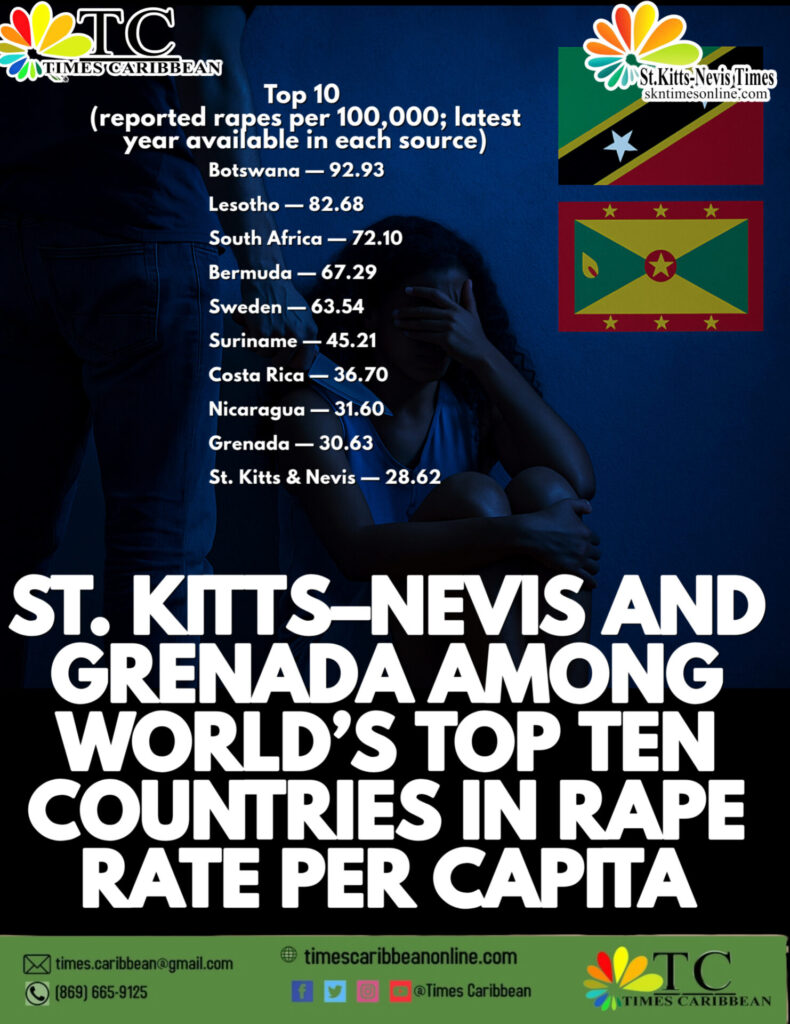
ST. KITTS–NEVIS AND GRENADA AMONG WORLD’S TOP TEN COUNTRIES IN RAPE RATE PER CAPITA

By Times Caribbean Newsroom
St. Kitts–Nevis and Grenada are appearing in multiple global league tables among the top ten countries by recorded rape rate per 100,000 people—a sobering reminder that the Caribbean must urgently strengthen survivor support, prevention, policing, and data systems. Aggregators that compile official criminal-justice statistics (primarily from the UN Office on Drugs & Crime and national police reports) have for years shown Grenada (~30.6 per 100,000) and St. Kitts & Nevis (~28.6 per 100,000) in the top tier of countries when ranked by reported rape rate, alongside Southern African states and a handful of high-reporting European and Atlantic jurisdictions. NationMaster
Top 10 (reported rapes per 100,000; latest year available in each source)
- Botswana — 92.93
- Lesotho — 82.68
- South Africa — 72.10
- Bermuda — 67.29
- Sweden — 63.54
- Suriname — 45.21
- Costa Rica — 36.70
- Nicaragua — 31.60
- Grenada — 30.63
- St. Kitts & Nevis — 28.62 NationMaster
Why the rankings look this way (and why they’re hard to compare)
- Different legal definitions & counting rules. Countries classify “rape” differently (e.g., inclusion of statutory rape, marital rape, repeated assaults counted as one vs. many cases), so cross-country comparisons are notoriously “apples to oranges.” Even data compilers stress this caveat. World Population Review
- “Higher rate” can sometimes mean better reporting. Nations with broader legal definitions, survivor-centered policing, and easier reporting often show higher recorded rates because more victims come forward and more behaviors are counted. Sweden is a classic example cited by statisticians and crime councils. World Population Review
- Small-population math. In micro-states like St. Kitts–Nevis (~53k people) and Grenada (~125k), a change of only a few dozen cases can swing per-capita ranks dramatically year-to-year—producing volatile and sometimes sensational league-table movements. (UNODC datasets and compilers flag these effects.) dataUNODC
- Mixed-vintage data. Popular rankings blend different reference years for different countries, depending on when a nation last submitted credible figures. That is why one widely cited comparison (NationMaster) still reflects values around the 2004–2010 reporting window for some states—including Grenada and St. Kitts–Nevis—even as newer compilations (e.g., World Population Review) pull later figures and sometimes show different positions and much higher rates. Interpreting any “Top 10” without the year attached can be misleading. NationMaster+1
The Caribbean picture: hard truths behind the numbers
- Underreporting remains profound. Global research suggests a majority of survivors never report to police; stigma, fear of retaliation, and weak case outcomes are key barriers. Rankings therefore reflect recorded crime, not true prevalence. World Population Review
- Gender-based violence (GBV) pressures are rising. Police and civil-society groups across the region describe spikes in sexual violence and intimate-partner abuse, particularly during and after pandemic periods—trends also echoed in UNODC regional overviews. dataUNODC
- Capacity constraints. Small islands face shortages of forensic nurses, trauma counselors, victim-witness advocates, and specialized prosecutors; case backlogs and low conviction rates erode trust.
What these figures do and do not mean
- They do highlight an urgent public-health and public-safety challenge that demands top-tier political attention and sustained funding.
- They do not prove that any listed country has the world’s “worst” rape problem in a true prevalence sense—only that, given each nation’s laws and reporting systems, recorded cases per capita are high. Even the compilers caution against simplistic country-to-country “scorecards.” World Population Review
Action agenda: how SKN, Grenada, and the region can respond—now
1) Make reporting safe & simple. 24/7 confidential hotlines; survivor-led reporting pathways; protection orders fast-tracked within hours; anonymous initial complaints to reduce fear of retaliation.
2) Survivor-first justice. Dedicated Special Victims Units, trauma-informed interviewing, independent victim advocates in every case; guaranteed access to post-rape care kits and emergency contraception in all public hospitals.
3) Evidence that stands up. Fund forensic nursing across islands; digital chain-of-custody and fast lab turnaround so cases don’t collapse.
4) Close the impunity gap. Specialized prosecutors for sexual offences; time-bound case management; publish charge-to-conviction metrics quarterly to rebuild trust.
5) Prevention that works. Age-appropriate consent education; offender treatment programs; nightlife and tourism-sector bystander training; safer public-transport and campus policies.
6) Data with integrity. Commit to annual UNODC submissions with harmonized definitions; release disaggregated national stats (age, relationship to perpetrator, case outcome) and a methodology note so the public can interpret numbers responsibly. dataUNODC
Bottom line
Whether one consults older comparative tables (which place Grenada and St. Kitts–Nevis in the top ten by reported rate) or newer aggregations with updated figures and cautionary notes, the signal is unmistakable: sexual violence is a regional emergency. The moral and policy response is not to argue about rankings, but to fund survivor services, fix the justice pipeline, and publish transparent data—so every Caribbean woman, man, and child can live free from sexual violence. NationMaster+1
Sources: NationMaster “Crime > Rape rate” (country comparisons and values for Grenada and St. Kitts–Nevis); World Population Review “Rape Statistics by Country” (methodology and cautionary guidance citing UNODC); UNODC Crime & Sexual Violence data portal (datasets and definitional notes).
















Leave a comment
You must be logged in to post a comment.