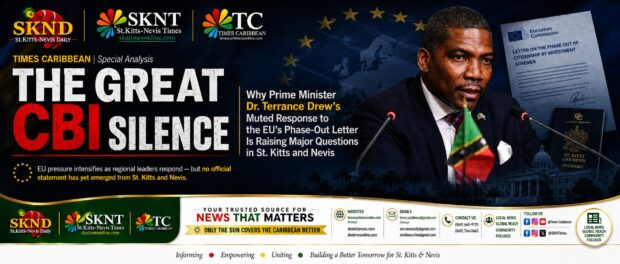
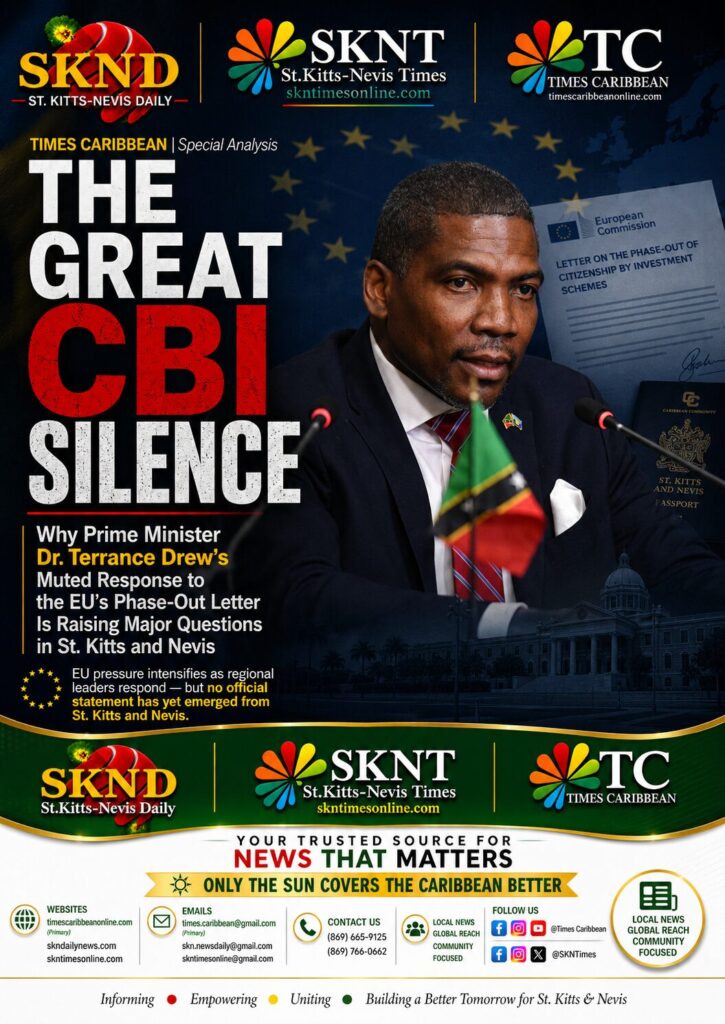
THE GREAT CBI SILENCE: Why Prime Minister Dr. Terrance Drew’s Muted Response to the EU’s Phase-Out Letter Is Raising Major Questions in St. Kitts and Nevis
TIMES CARIBBEAN | Special Analysis
BASSETERRE, St. Kitts — At a moment when the future of the Eastern Caribbean’s Citizenship by Investment industry appears to be facing its most serious international challenge in decades, one question is now echoing across political, financial and diplomatic circles in St. Kitts and Nevis: Where is Prime Minister Dr. Terrance Drew?
The European Commission has reportedly asked Antigua and Barbuda to phase out its Citizenship by Investment programme by June 1, 2028, with reports indicating similar correspondence was sent to other active Eastern Caribbean CBI states, including St. Kitts and Nevis, Dominica, Grenada and Saint Lucia. Antigua and Barbuda Prime Minister Gaston Browne has already gone public, firmly stating that his country’s programme will continue and that any transition must include credible replacement revenue for small island economies.
But in St. Kitts and Nevis — the birthplace of the global CBI industry and the country most historically identified with the model — there has been no comparable official national address, no detailed public response, and no clear acknowledgement from Prime Minister Drew, as of available public information at the time of writing. That silence is politically striking and economically consequential.
The issue is not routine. It is monumental. The CBI programme has been a major pillar of St. Kitts and Nevis’ public finances for more than a decade. Dr. Drew himself stated in October 2024 that, when his administration took office, CBI directly contributed between 60 and 70 percent of federal revenue. He also listed CBI revenues of EC$443 million in 2019, EC$271 million in 2020, EC$543 million in 2021, EC$669 million in 2022, EC$620 million in 2023, and EC$218 million up to September 2024.
Those numbers tell a dramatic story. They show that the programme reached some of its strongest publicly cited revenue levels during the 2021–2022 period, including the final years of the Dr. Timothy Harris-led Team Unity administration. Yet, after taking office in August 2022, Dr. Drew sharply criticized the former administration’s management of the programme, alleging that previous practices had placed the country’s UK and EU visa-free access in “grave jeopardy.”
Dr. Drew then moved to overhaul the CBI framework. The government introduced new regulations, a Board of Governors, a Technical Committee, anti-underselling rules, mandatory interviews, higher minimum investment thresholds and the Sustainable Island State Contribution. The administration presented these changes as necessary reforms to protect the credibility and long-term survival of the programme.
However, the economic impact has been severe. The IMF reported that St. Kitts and Nevis’ CBI revenue fell sharply, with 2024 revenue dropping to 8 percent of GDP from 22 percent of GDP in 2023, while CBI applications also reportedly declined significantly following tighter due diligence and pricing changes. A more recent IMF report stated that CBI revenue fell further to 5.3 percent of GDP, from 8.6 percent in 2024 and almost 26 percent at the peak in 2022.
Now comes the European Union’s pressure. And this is where the political contradiction becomes unavoidable.
For nearly two years, the Drew administration argued that its reforms had saved the programme. In March 2026, the St. Kitts and Nevis Citizenship by Investment Unit described the Federation as the world leader in responsible citizenship governance, while Prime Minister Drew declared that “St. Kitts and Nevis does not follow the global standard — we set it.”
Yet the EU’s position appears to go far beyond whether St. Kitts and Nevis has improved due diligence. The European Commission’s 2025 Visa Suspension Mechanism report stated that investor citizenship schemes in visa-free countries pose inherent security risks and that the operation of such programmes may itself be grounds for suspending visa-free access. The same report identified the five Eastern Caribbean CBI states and estimated that around 107,000 passports had been issued through their programmes, with 13,113 applications in 2023 and 10,573 in 2024.
That means the issue is no longer only about reform. It is about whether Europe is prepared to tolerate the existence of “golden passport” programmes at all.
Antigua and Barbuda has understood the gravity of the moment. Prime Minister Browne’s government has framed CBI as a critical pillar of non-tax revenue and has said it will not accept a unilateral phase-out without viable replacement income. It has also indicated a willingness to continue enhanced vetting and diplomatic engagement with the EU.
Saint Lucia’s Prime Minister Philip J. Pierre has also been publicly on record defending CBI as a development financing tool, arguing that it must support jobs, infrastructure and opportunity while meeting stronger regulatory expectations in a changing global environment.
St. Kitts and Nevis, however, remains in an uncomfortable space: historically the pioneer, economically one of the most exposed, politically deeply invested in the claim that reforms “saved” the programme, but publicly quiet at the very moment when Europe is reportedly asking for the programme’s eventual discontinuation.
The silence raises several unavoidable questions.
Did the Drew administration receive the EU letter? If so, when? What exactly did the European Commission request of St. Kitts and Nevis? Does the government intend to comply, negotiate, resist, or coordinate a regional response? What is the fiscal replacement plan if CBI continues to shrink or is eventually forced into a phase-out? What happens to national projects, debt management, public spending, housing, infrastructure and social programmes that have depended directly or indirectly on CBI inflows?
These are not opposition talking points. They are national economic questions.
For St. Kitts and Nevis, the CBI debate is not abstract. It touches the budget, investor confidence, passport strength, international relations, public sector financing, development planning and the country’s entire post-sugar economic model.
The Drew administration may have reasons for caution. Diplomacy is often conducted behind closed doors. Premature statements can weaken negotiating leverage. A regional approach through the OECS may still be emerging. But silence, in a moment this large, carries its own political cost.
If the government believes its reforms have placed St. Kitts and Nevis in a stronger position, the public deserves to hear that case. If the EU request changes the rules of the game despite those reforms, the public deserves to know that too. And if the country is now facing a future in which CBI can no longer be relied upon as a dominant revenue engine, citizens deserve a clear, credible and urgent national economic transition plan.
For now, Antigua has spoken. Saint Lucia has positioned itself. Europe has sharpened its stance. The IMF has documented the revenue decline. The CBI market has shifted.
And St. Kitts and Nevis waits.
The country that invented Citizenship by Investment now faces perhaps the most defining question in the programme’s 42-year history: Was the programme saved — or merely slowed on its way to a historic reckoning?
















Leave a comment
You must be logged in to post a comment.