From the Waters of 1737 to the Fires of 1935: How an Early Act of Slave Resistance Foretold the Buckley’s Riots in St. Kitts
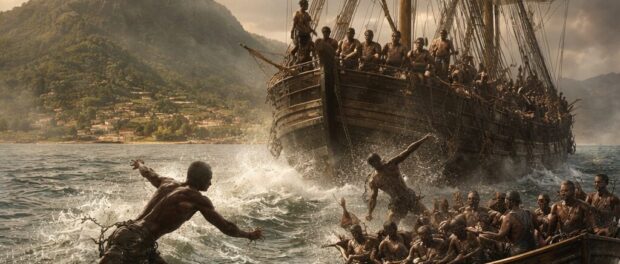
The history of resistance in St. Kitts did not erupt suddenly in the 20th century. It was not born at Buckley’s in 1935, nor did it begin with organized trade unions or political mobilization. Long before sugar workers marched, clashed with colonial forces, and forced constitutional change, resistance was already etched into the island’s historical DNA—sometimes silently, sometimes violently, and sometimes beneath the waves.
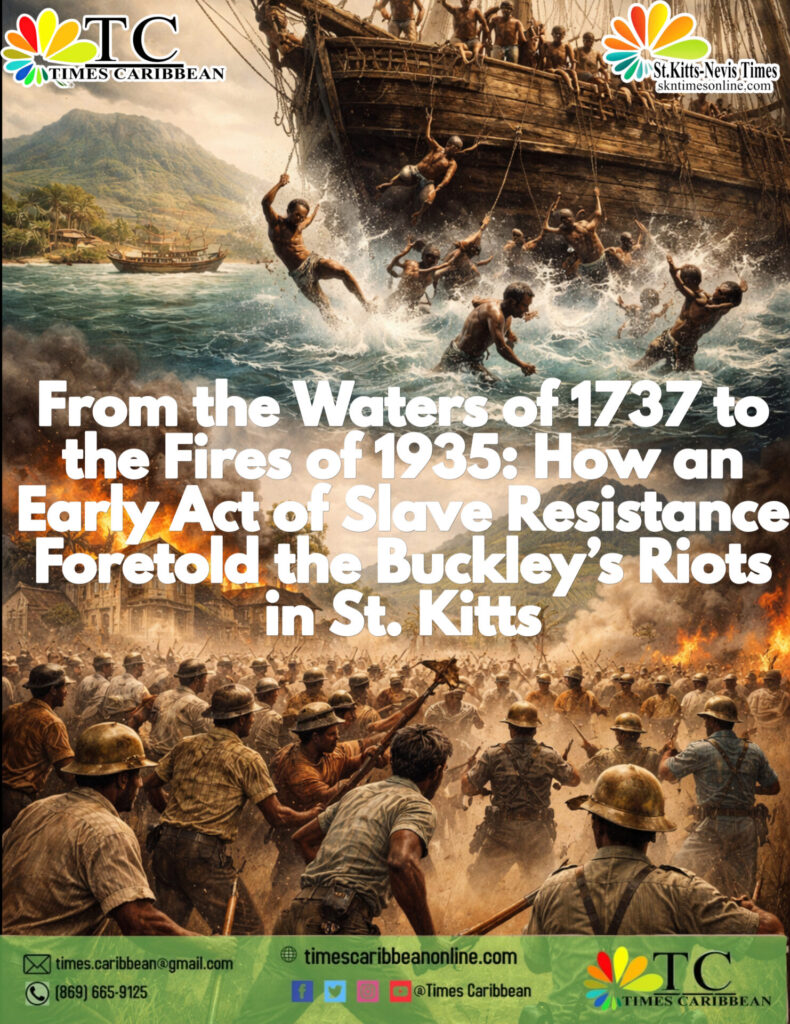
On 14 March 1737, when dozens of enslaved African men leapt from the Prince of Orange into the sea rather than submit to plantation slavery, they performed one of the earliest recorded acts of mass resistance in Kittitian history. Nearly two centuries later, in 1935, the labouring masses at Buckley’s Estate would ignite a revolt that permanently altered the political and social trajectory of the island.
Separated by 198 years, these two moments are not isolated tragedies or coincidences. They are connected chapters in a single, long struggle against exploitation, dispossession, and dehumanization.
1737: Resistance Before Enslavement Was Complete
The mass leap from the Prince of Orange occurred before the enslaved Africans were sold, branded, or assigned to plantations. This is crucial.
It means resistance in St. Kitts predates plantation life itself. The men who jumped understood—through knowledge, memory, and shared experience—what awaited them on the sugar estates. Whips. Endless labour. Social death. A system designed to extract wealth while extinguishing humanity.
Their choice was radical and uncompromising: death over bondage.
This act shattered the colonial assumption that Africans, once delivered alive, would submit. It exposed a truth the slave system feared—that control was never complete, and domination was always contested.
1935: Buckley’s and the Breaking Point of Colonial Labour
Fast forward to January 1935. Slavery had been legally abolished for nearly a century, yet its economic architecture remained intact. Sugar estates still dominated land ownership. Workers were paid starvation wages. Living conditions were appalling. Political power remained firmly in colonial hands.
At Buckley’s Estate, simmering frustration exploded.
What began as labour unrest escalated into widespread confrontation between workers and colonial authorities. Buildings were damaged. Fires were set. Troops were deployed. Several people were killed, and many more injured. The Buckley’s Riots of 1935 sent shockwaves through the colonial system, forcing Britain to confront the unsustainability of its Caribbean labour model.
The riots directly contributed to:
- The rise of organized labour movements
- The emergence of working-class political consciousness
- Constitutional reforms that would eventually lead to universal adult suffrage and self-government
Buckley’s was not merely a riot—it was a historic rupture.
A Line of Continuity: Resistance Across Centuries
What connects the men of 1737 to the workers of 1935 is not method, but motive.
- In 1737, resistance took the form of collective suicide, denying enslavers profit and asserting spiritual and human autonomy.
- In 1935, resistance manifested as collective rebellion, challenging wages, land ownership, and political exclusion.
Both were responses to systems that treated Black lives as expendable tools of production.
The 1737 resistance was existential—a refusal to enter slavery.
The 1935 resistance was structural—a refusal to continue living under its economic afterlife.
Together, they illustrate a powerful truth: emancipation without justice is not freedom.
From Silent Defiance to Open Revolt
The act aboard the Prince of Orange was largely invisible to public memory because it left no monuments, no leaders, no speeches—only a captain’s complaint about “lost cargo.” Buckley’s, by contrast, erupted in public, documented violence that could not be ignored.
Yet Buckley’s did not come from nowhere.
It was the culmination of:
- Generations of plantation exploitation
- Landlessness rooted in slavery
- Wages depressed by colonial priorities
- A population long denied voice and power
In this sense, Buckley’s was the loud echo of centuries of quiet resistance.
Reframing National Memory
Too often, St. Kitts’ story of resistance is taught beginning in the 1930s, as though consciousness suddenly awakened. The truth is far deeper and far older.
The men who chose the sea in 1737 and the workers who chose confrontation in 1935 were engaged in the same moral struggle—to reclaim dignity in a system built to deny it.
Buckley’s was not the beginning.
It was the breaking point.
And the waters off St. Kitts in 1737 remind us that resistance did not wait for permission, organization, or legality. It existed from the moment oppression arrived.
Conclusion: One Struggle, Many Forms
From the hold of an 18th-century slave ship to the cane fields of a 20th-century estate, the people of St. Kitts resisted in every way available to them. Sometimes with fire. Sometimes with marches. Sometimes with silence. Sometimes with their lives.
The Buckley’s Riots of 1935 stand as a milestone in the march toward political freedom.
But the 1737 act of resistance aboard the Prince of Orange stands as its moral ancestor.
Together, they tell a single, uninterrupted story:
The people of St. Kitts have always resisted.
















Leave a comment
You must be logged in to post a comment.