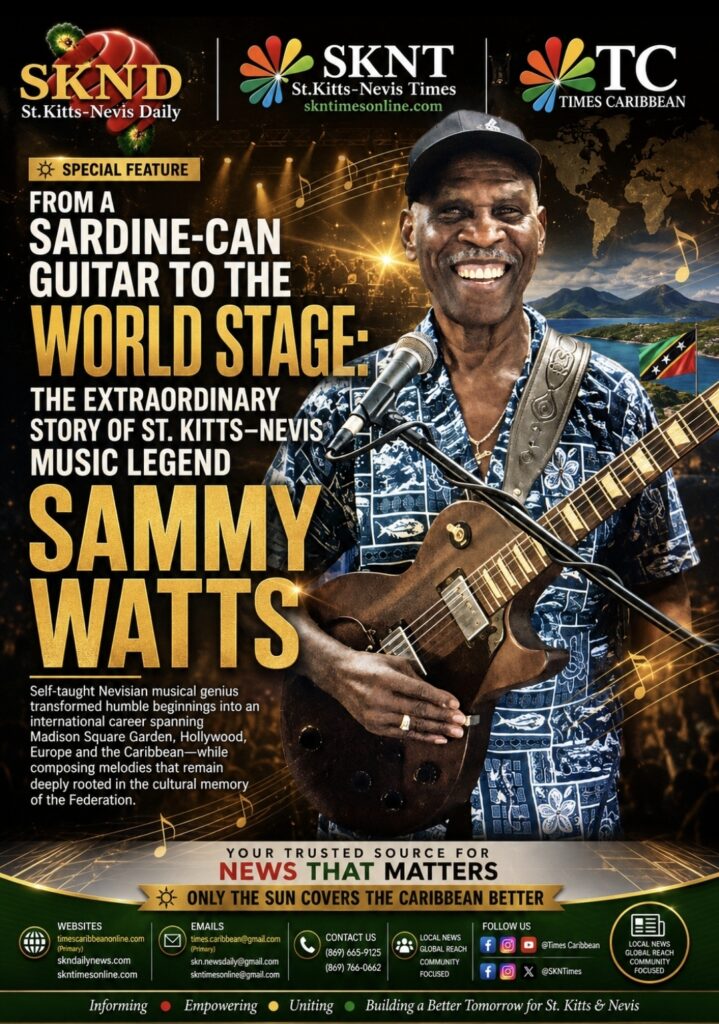
FROM A SARDINE-CAN GUITAR TO THE WORLD STAGE: THE EXTRAORDINARY STORY OF ST. KITTS–NEVIS MUSIC LEGEND SAMMY WATTS
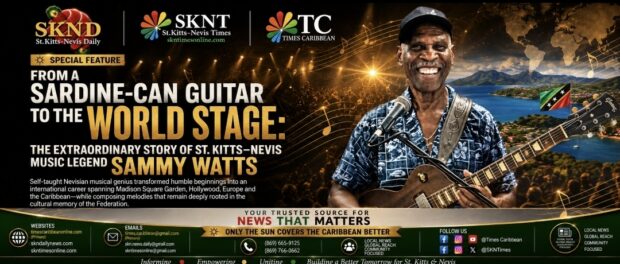
Self-taught Nevisian musical genius transformed humble beginnings into an international career spanning Madison Square Garden, Hollywood, Europe and the Caribbean—while composing melodies that remain deeply rooted in the cultural memory of the Federation.
BASSETERRE, ST. KITTS–NEVIS — Long before the international performances, recording studios, luxury resort engagements and encounters with some of the biggest names in global entertainment, there was a young boy in Nevis with an extraordinary dream—and an instrument fashioned from a sardine can.
That boy was Sammy Watts, the celebrated calypso vocalist, guitarist, composer, arranger and multi-instrumentalist whose remarkable musical journey has carried the sound and spirit of St. Kitts and Nevis across the Caribbean, North America and Europe.
Armed initially with little more than natural talent, determination and an unshakable love for music, Watts reportedly constructed his first stringed instrument using a sardine can, nylon fishing line and a wooden shingle.
It was an unlikely beginning for a career that would eventually take him from the villages of Nevis to St. Kitts, St. Thomas, Memphis, Canada, Paris, Rome, Cannes, Hollywood and Madison Square Garden.
MUSIC WAS IN THE FAMILY
Watts’ earliest musical influence came from his father, who played a homemade fife. Music in those days was often reserved for Christmas celebrations, masquerades and other special community occasions, but the limited exposure only intensified the young musician’s curiosity.
By the age of 14, Watts was already exploring melodies and rhythms on his handmade instrument.
After moving to St. Kitts, he began playing the quattro, a four-stringed instrument given to him by an experienced musician who recognised his potential. Although he admired the quattro’s strong baritone sound, it was the guitar—with its deeper bass strings—that ultimately became his signature instrument.
Watts has often expressed his love for music with a powerful “bottom,” and the guitar gave him the range, rhythm and depth he desired.
At approximately 18 years old, he was invited to join a band. The bandleader reportedly preferred the disciplined young musician from the countryside over some of the more confident town-based performers of the era.
Once the band began attracting engagements, Watts relocated to Basseterre—and his professional journey was underway.
FROM BASSETERRE TO THE INTERNATIONAL CIRCUIT
During the early 1970s, Watts toured extensively throughout the United States, Canada and Europe.
His career reportedly included appearances and musical engagements connected to major entertainment productions, including jam sessions involving legendary soul musician Isaac Hayes, work associated with the concert film Save the Children, and participation in television productions featuring prominent entertainers of the period.
The international touring schedule was demanding.
At one point, Watts was based in Memphis but could perform in Little Rock one evening before travelling by train or bus for another engagement in Rhode Island, New York or California.
It was a relentless period of movement, performance and discovery.
Europe offered a more relaxed pace. Paris, Rome and Cannes became memorable stops, with Watts developing a special affection for Cannes. Its waterfront atmosphere, he recalled, gave him a familiar West Indian feeling.
Through it all, Watts remained grateful that music had allowed a young man from Nevis to experience parts of the world he once could only imagine.
BUILDING A MUSICAL HOME IN ST. THOMAS
Watts eventually settled in St. Thomas in the United States Virgin Islands, where he became an enduring and beloved figure within the territory’s entertainment industry.
He partnered with Bolongo Bay Beach Resort in 1977 and became closely associated with performances at the popular Iggies Beach Bar and Grill.
Over the decades, he performed at venues across St. Thomas, including Pirates Parlor, Bluebeard’s Castle, The Boardroom, Hillside and Sapphire.
He also led and performed with several musical groups, including Soul Sides, Unity and Soul and the Sammy Watts Combo.
Known affectionately as the “Sweet Island Man,” Watts became renowned for vibrant live performances blending calypso, soca, reggae, rock ballads and Latin influences.
His musical arsenal expanded far beyond the traditional guitar. He mastered acoustic and electric guitars, steelpan, guitar synthesizers, sequencing and other modern musical technologies that allowed him to reproduce the sounds of multiple instruments during live performances.
A STUDENT OF CARIBBEAN RHYTHM
Watts’ musical brilliance was not built solely on natural ability. It was strengthened by his willingness to listen, learn and adapt.
When he arrived in St. Thomas, he performed with local bands and carefully studied the territory’s distinctive rhythmic patterns. He understood that syncopation—the placement and emphasis of musical beats—differed from island to island.
His music therefore became a rich Caribbean conversation: Nevisian and Kittitian traditions meeting Virgin Islands quelbe, calypso, soca, reggae, European folk influences and the unmistakable foundation of African drumming.
Watts frequently reflected on the relationship between the masquerade music of St. Kitts and Nevis and the early quelbe traditions of the Virgin Islands.
In St. Kitts, much of the music he remembered from his youth was driven by fife and drum during masquerade performances. When he arrived in St. Thomas, he was surprised by the wider variety of instruments used in local traditional music.
He recognised strong European—particularly Irish—influences across Caribbean folk music, but always heard the African drum beneath it all.
THE COMPOSER BEHIND THE MUSIC
Watts eventually moved beyond performing other people’s work and immersed himself in composing, arranging and producing his own music.
He once offered a fascinating observation about the creative process: lyrics were easier because language was endless, but composing music was more challenging because musicians had only 12 musical notes from which to create limitless possibilities.
That challenge never slowed him down.
Watts became a prolific writer of both music and lyrics, creating songs that captured romance, celebration, struggle, resilience and the infectious energy of Caribbean life.
His work includes the album “Party Mood,” a musical collection blending soca, reggae, rock ballads and Latin flavour.
Among its titles were “Nothing Good Comes Easy,” “Rhythm in Meh Head” and “Dance.” Watts wrote, arranged and produced the album’s original material and performed much of the guitar synthesizer, sequencing, acoustic guitar and electric guitar work himself.
The project was recorded at Doghouse Studio, with Wayne Samuel serving as engineer.
Watts also recorded interpretations of internationally recognised songs, including Barbra Streisand’s “Evergreen” and Aerosmith’s “I Don’t Want to Miss a Thing.”
However, the song he identified as his personal favourite was “The Impossible Dream.”
In many ways, that selection perfectly reflects his own life.
A MUSICIAN WHO LOVED THE ART—NOT THE BUSINESS
Despite possessing enough material to release albums consistently, Watts admitted that he disliked the commercial side of the industry.
Writing, arranging, recording and performing brought him joy. Distribution, promotion, piracy and the complications of selling music did not.
He once suggested that he had enough compositions to produce several albums annually for many years.
His frustration reflected a struggle shared by countless Caribbean musicians: tremendous creative output, but limited institutional support, difficult distribution networks and widespread unauthorised copying of their work.
Yet those obstacles never diminished his passion.
Music was not simply Sammy Watts’ occupation. It was his identity.
“I don’t do anything other than music,” he declared in an earlier interview. “I love doing it.”
A DEFENDER OF LIVE PERFORMANCE
As the entertainment industry evolved, Watts also expressed concern about the decline of live musicians in hotels, restaurants and nightlife venues.
He observed that karaoke and disc jockeys were increasingly replacing full bands and musicians who had spent years developing their craft.
“The hotels don’t even build stages anymore,” he lamented.
For Watts, live music was more than background entertainment. It was discipline, pride, interaction, musicianship and cultural preservation.
Every live performance carried the personality of the musician and the energy of the audience—something that no pre-recorded track could fully reproduce.
A SON OF NEVIS WHO CARRIED THE FEDERATION WITH HIM
Sammy Watts’ story is not merely the biography of a talented entertainer.
It is the story of Caribbean ingenuity.
It is the story of a child who did not wait for an expensive instrument, formal lessons or ideal circumstances. He used what was available—a sardine can, fishing line and a piece of wood—and began creating music.
From that humble homemade instrument came a life of performance, international travel, composition and cultural influence.
He carried the rhythms of Nevis and St. Kitts wherever he went. Whether performing in a Caribbean beach bar, a European city, an American concert venue or an international production, the musical foundation laid during his childhood remained present.
His career stands as proof that extraordinary talent can emerge from the most modest beginnings.
A LIVING CARIBBEAN LEGEND
Today, Sammy Watts deserves recognition among the great musical ambassadors produced by St. Kitts and Nevis.
His journey stretches across generations, islands and continents. His performances have entertained visitors and residents alike, while his compositions have added to the vast and colourful catalogue of Caribbean music.
He is a guitarist, vocalist, steelpan player, songwriter, arranger, producer, bandleader and cultural historian whose life connects the traditional sounds of fife, drum and masquerade with synthesizers, modern production and international stages.
From a homemade sardine-can instrument in Nevis to a lifetime of music heard around the world, Sammy Watts has lived a story more powerful than fiction.
It is a story of courage, creativity, endurance and Caribbean excellence.
And perhaps, after all, the self-taught boy from Nevis truly did achieve his own “Impossible Dream.”
© Times Caribbean | St. Kitts–Nevis Times | St. Kitts–Nevis Daily
















Leave a comment
You must be logged in to post a comment.