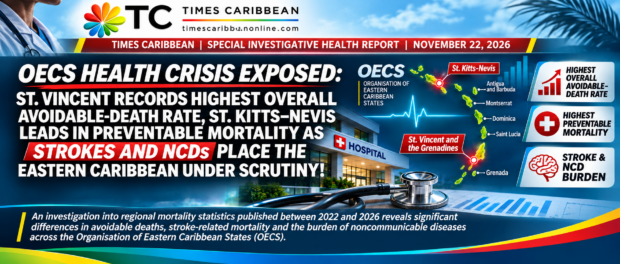
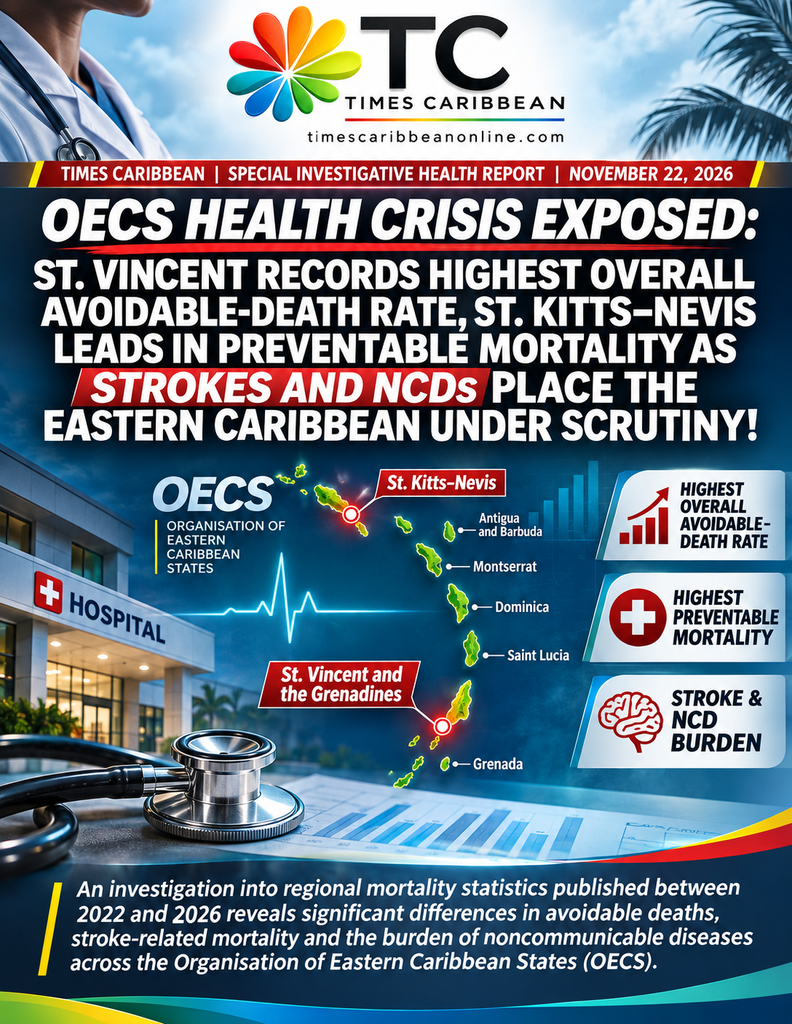
OECS HEALTH CRISIS EXPOSED: ST. VINCENT RECORDS HIGHEST OVERALL AVOIDABLE-DEATH RATE, ST. KITTS–NEVIS LEADS IN PREVENTABLE MORTALITY AS STROKES AND NCDs PLACE THE EASTERN CARIBBEAN UNDER SCRUTINY!
TIMES CARIBBEAN | SPECIAL INVESTIGATIVE HEALTH REPORT | NOVEMBER 22, 2026
An investigation into regional mortality statistics published between 2022 and 2026 reveals significant differences in avoidable deaths, stroke-related mortality and the burden of noncommunicable diseases across the Organisation of Eastern Caribbean States (OECS).
The findings raise serious questions about prevention, early diagnosis, timely medical intervention and the effectiveness of chronic-disease management across the region.
And the figures deserve attention.
An examination of the OECD, World Health Organization (WHO), Pan American Health Organization (PAHO) and international disease-burden research shows that no single country leads every measure of the health crisis.
But several findings stand out.
1. Avoidable deaths: What the latest international comparison reveals
The 2026 edition of Health at a Glance: Latin America and the Caribbean, published by the OECD, Inter-American Development Bank and World Bank, provides an important comparison of mortality from causes considered preventable or treatable.
The report uses 2023 figures or the latest available year, with mortality rates adjusted for population age differences.
For the six independent OECS countries covered, the figures are revealing.
Avoidable mortality per 100,000 population — age-standardised rates, 2023 or latest available year
| OECS country | Preventable | Treatable | Combined |
|---|---|---|---|
| St. Vincent & Grenadines | 216 | 217 | 433 |
| St. Kitts & Nevis | 221 | 163 | 384 |
| Grenada | 174 | 169 | 343 |
| Dominica | 173 | 163 | 336 |
| Antigua & Barbuda | 166 | 117 | 283 |
| Saint Lucia | 156 | 115 | 271 |
Source: OECD/IDB/World Bank, Health at a Glance: Latin America and the Caribbean 2026, Table 1.1. Combined figures are calculated by adding the published preventable and treatable components. OECD +1
These findings establish three important distinctions.
St. Vincent and the Grenadines records the highest combined avoidable-mortality rate among the six countries, at approximately 433 deaths per 100,000 population.
St. Kitts and Nevis records the highest preventable-mortality rate, at 221 per 100,000, slightly exceeding St. Vincent and the Grenadines at 216.
St. Vincent and the Grenadines also records the highest treatable-mortality rate, at 217 per 100,000, compared with Grenada’s 169 and the 163 recorded by both St. Kitts and Nevis and Dominica.
The differences matter. Preventable deaths are associated with conditions that effective public-health measures could substantially reduce, while treatable deaths involve illnesses for which timely and appropriate healthcare could substantially improve survival.
These are population-level indicators. They do not establish that every individual death was preventable or that medical negligence occurred. Nor do they establish which government or institution was responsible for a particular outcome.
Still, the numbers provide a measurable basis for asking whether enough is being done to keep people healthy and improve their prospects of survival.
2. Stroke-related deaths: Where is the burden greatest?
Stroke remains one of the most significant causes of mortality and long-term disability across the Eastern Caribbean.
The WHO’s 2023 country estimates provide the following stroke death rates for three OECS countries with clearly retrievable figures.
Estimated stroke deaths per 100,000 population, 2023 — WHO country dashboards
These are population-level death rates, not age-standardised estimates. They should not be used to declare an overall OECS leader while comparable figures for other members remain unverified. datadot +2
In Saint Lucia, stroke was the leading individual cause of death in WHO’s 2023 estimates, at 107.9 deaths per 100,000.
The 2026 OECD report also finds that cerebrovascular diseases accounted for at least 35% of cardiovascular deaths in Saint Lucia. This is significant because it points to the central role stroke plays in that country’s cardiovascular disease burden. datadot +1
St. Vincent and the Grenadines recorded an even higher estimated population stroke death rate, at 124.8 per 100,000, with ischaemic heart disease, diabetes and hypertensive heart disease also prominent among leading causes of death.
But can St. Vincent be declared the OECS country with the highest stroke mortality rate?
Not conclusively from these figures alone.
Comparable 2023 estimates for every independent OECS country must be examined using the same age-standardisation method before making that determination. Published data from different systems may use different definitions, populations and estimation procedures.
Stroke incidence versus stroke fatality: A critical distinction
There are three separate questions that must not be confused.
A country’s stroke incidence rate measures how many new strokes occur within its population.
Its stroke mortality rate measures deaths attributed to stroke relative to the population.
Its stroke case-fatality rate measures the proportion of stroke patients who die, generally within a specified period following diagnosis or hospital admission.
The distinction is essential.
The OECD’s 2026 analysis includes 30-day hospital case-fatality figures for ischaemic stroke, but its published country comparison does not provide those figures for the six independent OECS countries.
Consequently, the available comparison cannot establish which OECS country’s hospitals recorded the highest percentage of stroke patients dying within 30 days of admission between 2022 and 2026. OECD +1
A higher stroke death rate may reflect greater disease incidence, delayed presentation, poorer access to emergency care, underlying population health risks, or some combination of these factors. It cannot independently establish poorer hospital treatment.
3. NCDs: Which country faces the greatest premature mortality risk?
Noncommunicable diseases include cardiovascular disease, diabetes, cancer and chronic respiratory illnesses.
A separate WHO indicator estimates the probability that a person aged 30 will die before reaching 70 from one of these four major disease groups, assuming the prevailing age-specific mortality rates.
The 2023 WHO-derived figures available for four OECS countries are:
24.0%
St. Vincent & Grenadines
21.8%
Grenada
20.1%
Saint Lucia
12.5%
Antigua & Barbuda
WHO indicator: probability of dying between ages 30 and 70 from cardiovascular disease, cancer, diabetes or chronic respiratory disease, 2023, reproduced in the Acuitas Health Analytics public-data dashboard. Acuitas Health Analytics +3
Among these four reporting countries, St. Vincent and the Grenadines shows the highest estimated probability of premature NCD mortality.
The available consolidated comparison does not establish equivalent 2023 values for St. Kitts and Nevis and Dominica, preventing a definitive six-country conclusion.
Another important distinction concerns the percentage of all deaths caused by NCDs.
WHO’s 2023 country profiles estimate that NCDs accounted for 85.3% of deaths in Antigua and Barbuda, 81.5% in Saint Lucia, and 81.1% in St. Vincent and the Grenadines. Those percentages are substantial, but a high share of deaths from NCDs does not necessarily mean a country has the highest age-standardised NCD mortality rate. datadot +2
4. St. Kitts and Nevis: Why the figures require particular attention
The 2026 OECD findings raise two separate concerns for the Federation.
First, St. Kitts and Nevis records 221 preventable deaths per 100,000 population, above the corresponding rates of the other five independent OECS countries in the report.
Second, the OECD’s cardiovascular disease analysis identifies St. Kitts and Nevis among the Latin American and Caribbean countries with particularly elevated cardiovascular mortality among women.
That measure covers cardiovascular diseases collectively, not stroke alone. OECD +1
There is another finding worth examining.
The OECD’s 2026 report states that between 2019 and 2023, age-standardised all-cause mortality increased by approximately 24.1% in St. Kitts and Nevis. Dominica recorded an increase of 27.1%, while Jamaica registered 25.9%.
Those changes encompass deaths from all causes, including the influence of the COVID-19 period, and cannot automatically be attributed to NCDs, hospital services or any particular administration. OECD
The challenge for health policymakers is to determine how much of the preventable-mortality burden can be reduced through earlier intervention, reliable chronic-disease management, improvements in emergency care and stronger follow-up after hospital discharge.
5. What is happening inside the healthcare systems?
Regional studies suggest that the challenge is not simply identifying people with high blood pressure or diabetes. Keeping patients in effective, continuous treatment is equally important.
World Bank assessments of NCD care in Dominica, Grenada and Saint Lucia have identified concerns involving inconsistent treatment protocols, gaps in diagnosis, medication availability and weaknesses in patient information systems.
The assessments also describe initiatives already under way, including stronger primary healthcare services and efforts to standardise NCD management. World Bank
These findings highlight why effective prevention and effective treatment must operate together.
A patient with hypertension who receives an early diagnosis but experiences interruptions in medication may remain at risk. A person experiencing stroke symptoms may have a better outcome when assessment, brain imaging and appropriate treatment are available without unnecessary delay.
For small island health systems, referral arrangements, specialist access, medical transport and rehabilitation services deserve particular examination.
6. The unanswered questions that demand public-health transparency
The figures published during 2022–2026 provide an important foundation, but they do not constitute a complete, verified record of every death occurring throughout those five calendar years.
To establish which country has had the highest stroke case-fatality rate, a regional investigation would require comparable annual hospital data detailing the number of patients admitted with stroke, the type and severity of those strokes, deaths within 7 and 30 days, transfers, and outcomes following discharge.
Health ministries and public-health authorities should also be able to report how many patients with hypertension and diabetes achieve sustained disease control; the proportion receiving timely investigations; and the availability of stroke rehabilitation.
Publication of those indicators would permit stronger public accountability without assigning blame based on incomplete evidence.
The most recent international figures are already sufficient to demonstrate a substantial avoidable-mortality challenge. They are not sufficient to establish medical negligence in individual cases.
The Times Caribbean findings
The evidence establishes a differentiated picture rather than one universal result.
St. Vincent and the Grenadines records the highest combined avoidable-mortality rate and the highest treatable-mortality rate among the six independent OECS countries in the OECD’s 2026 comparison.
St. Kitts and Nevis records the highest preventable-mortality rate in that comparison.
St. Vincent and the Grenadines also has the highest 2023 premature NCD mortality probability among the four OECS countries for which the WHO-derived figures were verified in this investigation.
For stroke mortality and stroke case-fatality across the entire OECS, the available figures do not support a definitive overall country designation for 2022–2026.
That distinction must be preserved.
The regional issue is larger than a statistical comparison. Every avoidable death represents the possibility that prevention, earlier diagnosis or more effective care might have changed an outcome.
For the OECS, the evidence makes a strong case for more transparent mortality reporting, better chronic-disease management and wider access to timely emergency and specialist care.
And the central question remains: How much measurable progress are Eastern Caribbean healthcare systems making in preventing premature deaths and improving patient survival?
Principal research sources
- OECD/IDB/World Bank — Health at a Glance 2026: Avoidable Mortality
- OECD — Cardiovascular Mortality, 2026
- WHO — Global Health Estimates 2023, published 2026
- OECD — In-hospital Stroke Case-Fatality Indicators
- World Bank — NCD Care in the Eastern Caribbean
Research note: The primary statistical comparisons use 2023 observations or the latest reported year from sources published through November 22, 2026. They should not be interpreted as complete 2024, 2025 or 2026 mortality statistics. Montserrat and the OECS associate territories are outside the six-country comparison because equivalent data were not established.
TIMES CARIBBEAN | INDEPENDENT REGIONAL HEALTH REPORTING
















Leave a comment
You must be logged in to post a comment.