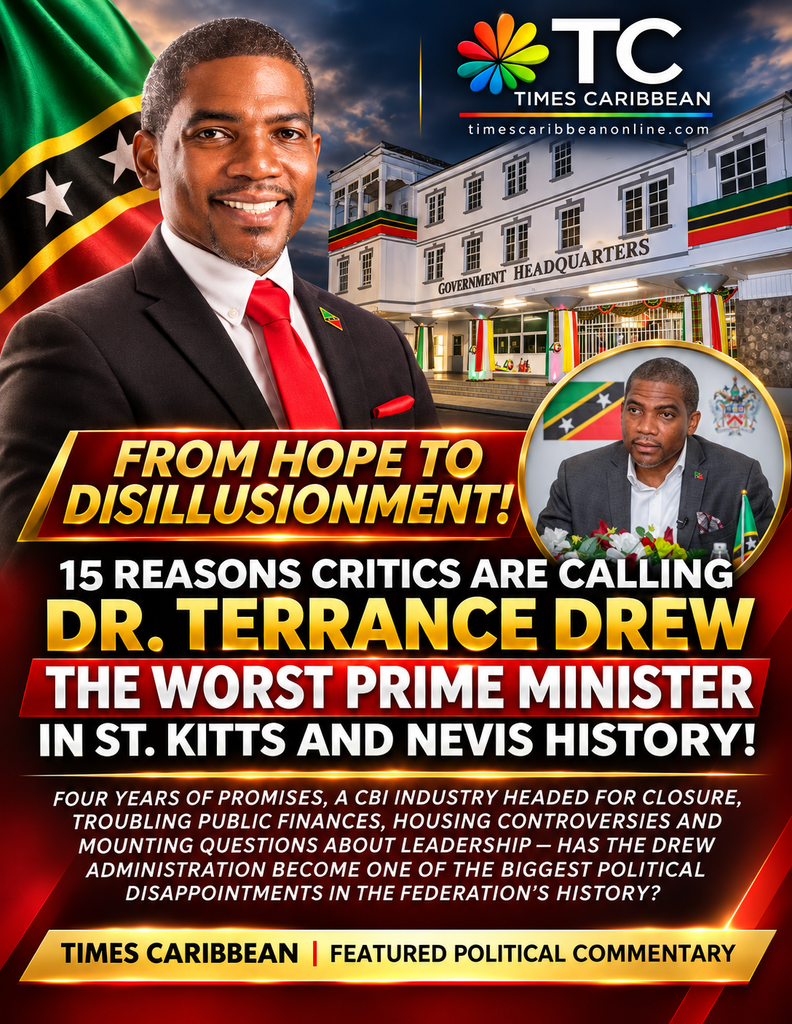
FROM HOPE TO DISILLUSIONMENT! 15 REASONS CRITICS ARE CALLING DR. TERRANCE DREW THE WORST PRIME MINISTER IN ST. KITTS AND NEVIS HISTORY!
FOUR YEARS OF PROMISES, A CBI INDUSTRY HEADED FOR CLOSURE, TROUBLING PUBLIC FINANCES, HOUSING CONTROVERSIES AND MOUNTING QUESTIONS ABOUT LEADERSHIP — HAS THE DREW ADMINISTRATION BECOME ONE OF THE BIGGEST POLITICAL DISAPPOINTMENTS IN THE FEDERATION’S HISTORY?
TIMES CARIBBEAN | FEATURED POLITICAL COMMENTARY
BASSETERRE, ST. KITTS — Saturday, November 21, 2026
When Dr. Terrance Drew swept into office in August 2022, he arrived carrying enormous expectations. The Labour Party promised better governance, economic opportunity, improved healthcare, affordable housing and a new direction for St. Kitts and Nevis.
Four years later, the political conversation has changed dramatically.
For some critics, disappointment has turned into outright rejection of his leadership. They are asking whether the administration that promised so much has delivered far too little.
And an especially harsh judgment is emerging in opposition commentary: Could Terrance Drew be the worst prime minister St. Kitts and Nevis has ever had?
That is a political opinion, not an established historical ranking. No representative public opinion survey has been identified here to establish how many citizens share it.
But the criticisms deserve examination.
Not because every accusation against the Prime Minister is justified. Not because previous governments were without shortcomings. And certainly not because every national difficulty began in August 2022.
The question is whether his administration has responded effectively to the responsibilities it inherited and the challenges that developed during its term.
Here are 15 reasons critics believe Drew’s leadership has fallen dangerously short of expectations.
1. THE CBI REVERSAL: FROM “SAVED” TO AN ANNOUNCED WIND-DOWN!
Perhaps no issue has done more damage to confidence in the Drew administration than the dramatic change in its public position on Citizenship by Investment.
On October 17, 2024, Prime Minister Drew declared that the Federation’s CBI programme had been saved.
The message was unmistakable. The government presented its reforms as measures to restore confidence and secure the programme’s future.
Yet on November 13, 2026, that same Prime Minister announced that St. Kitts and Nevis would wind down its historic CBI programme on a timeline being negotiated with the European Union.
Two years. Two strikingly different announcements.
The European Union’s changing rules unquestionably contributed to the decision. But that does not eliminate the obligation to explain why the government’s earlier assurances proved so short-lived.
Critics are entitled to ask whether the 2024 declaration was overly optimistic, whether the administration underestimated the international threat, and why citizens were not given a clearer picture of the programme’s long-term vulnerability.
A prime minister cannot claim the political credit for saving an industry and then expect no difficult questions when its closure is announced.
2. THE CBI REVENUE COLLAPSE UNDER HIS WATCH!
The International Monetary Fund’s 2026 assessment provides uncomfortable evidence of how dramatically the Federation’s financial position has changed.
CBI fees represented approximately 25.8 percent of GDP in 2022. By 2025, the figure had fallen to approximately 6 percent under the IMF’s reported fiscal series.
This is an extraordinary decline in a revenue source that once supported a substantial share of government activity.
The Drew administration increased CBI investment thresholds in 2023 and strengthened due-diligence requirements. The IMF documented these changes alongside the subsequent revenue decline.
Were the reforms necessary? Some certainly addressed legitimate international concerns.
But were they properly calibrated? Did higher prices weaken competitiveness? Could additional diplomatic or commercial measures have helped preserve revenue?
Those questions remain important.
It would be inaccurate to attribute the entire decline to Drew, given international pressure, changing investor demand and problems inherited from earlier administrations.
Nevertheless, the financial consequences developed during his premiership, and he must account for his government’s policy choices.
3. THE GREAT CBI TRANSPARENCY QUESTION!
The European Commission communicated its proposed phase-out to affected Caribbean governments in June 2026.
The Federation’s formal wind-down announcement came on November 13.
What should citizens have been told during the intervening months?
This was not a minor administrative matter. It concerned the future of a multibillion-dollar industry and revenue that helped finance public services.
Critics argue that such a consequential national decision warranted earlier disclosure, a fuller parliamentary discussion and a more extensive consultation with citizens and businesses.
The government maintains that its negotiations were intended to protect international banking relationships and visa-free travel.
Those are serious considerations.
But diplomacy and public accountability should not be treated as mutually exclusive.
The people should never feel that they are merely spectators when the economic foundations of their country are being redesigned.
4. A FEDERATION DIVIDED OVER ITS ECONOMIC FUTURE!
The November 2026 disagreement between Prime Minister Drew and Nevis Premier Mark Brantley has exposed a fundamental difference in their approaches to the CBI transition.
Brantley publicly opposed winding down the programme and questioned the proposed European timetable.
Drew defended the decision as necessary to protect the country’s international financial and travel relationships.
The disagreement itself does not establish misconduct by either leader.
But it raises an important federal question: Was there sufficient national consensus before the government committed to such a consequential direction?
CBI revenue has implications for both islands.
And a decision of this magnitude demands more than competing public statements from Basseterre and Charlestown.
A federation needs consultation, not just announcements.
5. ECONOMIC DIVERSIFICATION THAT HAS NOT YET MATCHED THE SIZE OF THE PROBLEM!
The Drew administration frequently promotes its Sustainable Island State Agenda, renewable energy, tourism, technology, agriculture and other emerging industries.
Diversification is necessary.
But the distinction between promising an economic transformation and delivering one is enormous.
The IMF’s May 2026 projections placed real GDP growth at approximately 2 percent for 2026, following estimated growth of 1.5 percent in 2025.
Meanwhile, CBI revenue had already declined sharply.
Critics want to see how many permanent jobs new industries have created, how much additional export revenue they are generating and how quickly they can replace declining CBI receipts.
There are projects in development. That should be acknowledged.
But a collection of planned initiatives is not yet a fully functioning replacement economy.
The country needs industries generating income now, not simply attractive visions of what might happen by 2030.
6. TROUBLING FISCAL DEFICITS THAT DEMAND SERIOUS EXPLANATIONS!
The IMF estimated St. Kitts and Nevis recorded a fiscal deficit equivalent to 11.7 percent of GDP in 2025 and projected another substantial deficit in 2026.
These figures matter.
They indicate that government expenditure is significantly exceeding available revenue.
It is true that major spending pressures existed before Drew became Prime Minister, and that the decline in CBI receipts created an enormous adjustment challenge.
But four years into an administration, voters have every right to assess its fiscal strategy.
Where are the sustainable savings?
How effectively is expenditure being prioritised?
What protections exist for vulnerable households if revenue deteriorates further?
A responsible government cannot indefinitely rely on yesterday’s financial reserves to pay for today’s commitments.
7. RISING DEBT RISKS AND SHRINKING FINANCIAL BUFFERS!
The IMF’s 2026 projections suggested that public debt could rise from approximately 58.4 percent of GDP in 2025 to 64 percent in 2026 and 68.7 percent in 2027.
Government deposits were also projected to decline substantially.
Those are forecasts, not final outcomes. And St. Kitts and Nevis is not uniquely exposed to fiscal pressures.
Nevertheless, the direction is concerning.
A country losing a historically important revenue source needs stronger reserves, careful expenditure control and a credible long-term fiscal plan.
Critics see the combination of weaker CBI receipts, recurring deficits and declining financial buffers as one of the most troubling economic developments of the Drew era.
The question is no longer simply how much government spends. It is how the country intends to pay for its future.
8. THE COST OF LIVING: WHEN GOVERNMENT ANNOUNCEMENTS DON’T MATCH HOUSEHOLD EXPERIENCE!
Ordinary people judge economic management through everyday experience.
Can they comfortably buy groceries? Pay rent? Keep electricity connected? Meet transportation expenses? Save something at the end of the month?
The administration has increased the minimum wage, provided temporary assistance through programmes such as Budget Boost and subsidised certain energy costs.
These initiatives deserve recognition.
But they have not eliminated the affordability concerns being raised by households and opposition representatives.
In November 2026, Drew acknowledged the need to examine supermarket pricing and the pressures facing consumers.
That is an important admission of a continuing challenge.
Critics argue that temporary assistance cannot substitute for a sustainable improvement in household purchasing power.
People cannot pay the supermarket cashier with a government press release.
They need an economy in which their earnings stretch further.
9. THE 2,400-HOME PROMISE THAT BECAME A MAJOR HOUSING CONTROVERSY!
In 2023, the government promoted an agreement with East Coast Housing Development to deliver 2,400 affordable smart homes over four years.
The announcement generated considerable expectations among families seeking homeownership.
But the East Coast initiative subsequently became entangled in disputes and reported litigation.
The developer has publicly raised allegations concerning the government’s handling of the arrangement. Those claims remain contested and should not be treated as judicial findings.
The government has separately reported hundreds of homes completed or under construction through National Housing Corporation programmes, as well as support for first-time homeowners.
That progress matters.
But it does not erase questions about the original 2,400-home arrangement.
What went wrong? What commitments were made? What is the financial exposure? And how many homes will ultimately emerge from that specific project?
A housing promise is not fulfilled by a groundbreaking ceremony. It is fulfilled when families receive their keys.
10. HEALTHCARE: A DOCTOR-PRIME MINISTER FACING HIGHER EXPECTATIONS!
Terrance Drew entered the premiership with a professional medical background.
Naturally, expectations for healthcare improvement were particularly high.
His administration has reported significant investments, including ambulances, new diagnostic equipment, specialist services, hospital repairs and digital health records.
Those improvements should not be dismissed.
But public discussion about patient experiences, waiting times, access to specialist care and the availability of advanced medical services continues.
The appropriate test is not how many healthcare announcements have been made.
It is whether patients are receiving timely, reliable and affordable treatment.
The government should publish comprehensive performance indicators, including emergency response times, specialist availability, referral delays and patient outcomes.
For a Prime Minister who also holds the health portfolio, improving healthcare must be demonstrated through measurable patient results.
11. WATER SHORTAGES IN A COUNTRY PROMISING SUSTAINABILITY!
Water insecurity remains one of the Federation’s most visible infrastructure challenges.
The government’s own public information confirmed that projected daily water demand in 2025 considerably exceeded traditional supply.
Water schedules and drought-related restrictions have affected communities.
Climate variability, ageing infrastructure and historical underinvestment are legitimate contributing factors. It would be unfair to place responsibility for the entire problem on one administration.
The government has invested in desalination, new wells and distribution improvements.
But critics are asking whether these interventions have moved quickly enough to meet the needs of households and businesses.
For families living with unpredictable water access, explanations about future improvements offer limited immediate comfort.
Sustainability must begin with dependable essential services.
12. FARMERS RAISING CONCERNS ABOUT THE GOVERNMENT’S OWN AGRICULTURAL STRATEGY!
The controversy surrounding the government’s agricultural production initiatives has produced growing public criticism.
In April 2026, the St. Kitts Consortium of Farmers and Food Producers publicly questioned whether government-operated farming activities were creating unfair competition for independent producers.
On November 16, farmers protested outside a government-operated agricultural facility in Cayon, raising concerns about competition and the state’s involvement in agricultural production.
These concerns deserve substantive answers, not political dismissal.
Government involvement in agriculture can strengthen food security. But the design of state-supported production must be fair, transparent and sensitive to the survival of private farmers.
Are local producers receiving adequate market access?
Are pricing arrangements fair?
Is the government facilitating private enterprise or inadvertently making it more difficult for independent farmers to compete?
A national agricultural strategy cannot succeed while the people growing the food feel excluded from the process.
13. THE ENERGY TRANSFORMATION: BIG AMBITIONS, QUESTIONS ABOUT DELIVERY!
The government has repeatedly emphasised its goal of transforming St. Kitts and Nevis into a renewable-energy economy.
Solar development, geothermal power and electricity interconnection between the islands all offer genuine possibilities.
But major projects require substantial capital, technical preparation and implementation time.
As of November 2026, significant elements of the transition remain under development.
Critics are entitled to demand clear information about project financing, electricity costs, completion schedules, commercial viability and potential risks to taxpayers.
The administration deserves credit for pursuing renewable energy investment.
But ambition alone is not evidence of successful implementation.
Citizens need to know when the promised energy transformation will translate into demonstrably lower costs and more reliable service.
14. PUBLIC SAFETY: WHY CONFIDENCE MUST BE BUILT THROUGH RESULTS!
As Minister of National Security, Drew also carries responsibility for the country’s public safety strategy.
Official police reporting has recorded reductions in overall major crime, including a decline in the first half of 2026.
That progress must be recognised.
Nevertheless, the police have acknowledged continuing concerns about serious interpersonal incidents, while some residents remain worried about community safety and property-related offences.
Critics argue that improvements in headline statistics must be accompanied by sustained prevention, youth development, rehabilitation and public confidence in law enforcement.
The challenge is not simply announcing that overall crime has fallen.
It is ensuring that residents feel secure and trust the institutions responsible for protecting them.
Public safety requires consistent leadership, transparent reporting and long-term community investment.
15. THE BIGGEST LEADERSHIP CRITICISM: TOO MUCH POLITICAL DEFENCE, NOT ENOUGH PUBLIC ACCOUNTABILITY!
Perhaps the most damaging criticism of Drew is not about any single project.
It is about his governing approach.
When questions arise over CBI, the administration frequently points to the record of its predecessors and external pressures.
When healthcare performance is challenged, the Prime Minister has accused political opponents of misrepresenting improvements.
And when national projects encounter controversy, the government’s response often emphasises its achievements and inherited obstacles.
Some of those explanations may be justified.
Previous administrations are legitimately subject to scrutiny, and criticism is not always fair.
But the present government was elected to govern, not merely to explain what others did wrong.
After more than four years in office, responsibility increasingly belongs to those currently making the decisions.
The public needs detailed answers, independent performance assessments and genuine engagement with criticism.
Leadership is not measured by how effectively a Prime Minister defends his reputation. It is measured by how effectively he protects the interests of the people who entrusted him with office.
THE VERDICT: IS DR. TERRANCE DREW REALLY THE WORST PRIME MINISTER IN OUR HISTORY?
That judgment ultimately belongs to the people of St. Kitts and Nevis and to history.
Comparing Drew with previous prime ministers requires consistent evidence about economic management, healthcare, housing, national security, democratic governance and the circumstances each administration inherited.
It would be dishonest to ignore the Drew administration’s achievements, including minimum-wage increases, healthcare investments, infrastructure improvements and efforts to strengthen international financial compliance.
It would be equally irresponsible to ignore the serious concerns now confronting his government.
The CBI wind-down is real.
The deterioration in important fiscal indicators is documented.
The housing controversy is real.
Farmers have publicly protested.
And questions about diversification, affordability and the quality of public services deserve answers.
This is the central argument of Drew’s harshest critics: the administration promised transformational leadership, but its most consequential economic test has arrived before the promised transformation has been fully delivered.
The Prime Minister can dispute that interpretation. His supporters can point to achievements and inherited challenges. Both are entitled to do so.
But citizens are equally entitled to conclude that his administration has not met their expectations.
Four years after the promise of a new beginning, the government faces a defining question.
WHERE ARE THE RESULTS THAT JUSTIFY THE CONFIDENCE THE PEOPLE PLACED IN IT?
Not another slogan.
Not another argument about the past.
Not another distant promise.
A clear economic recovery plan. Measurable improvements in public services. Transparent financial management. And a convincing explanation of how St. Kitts and Nevis will prosper beyond CBI.
That is the standard against which Drew’s premiership should be judged.
And until his administration can demonstrate that its policies are producing the promised transformation, critics will continue asking whether his leadership represents one of the Federation’s greatest political disappointments.
The historical verdict remains open. The questions demanding answers do not.
TIMES CARIBBEAN — POLITICAL COMMENTARY
















Leave a comment
You must be logged in to post a comment.