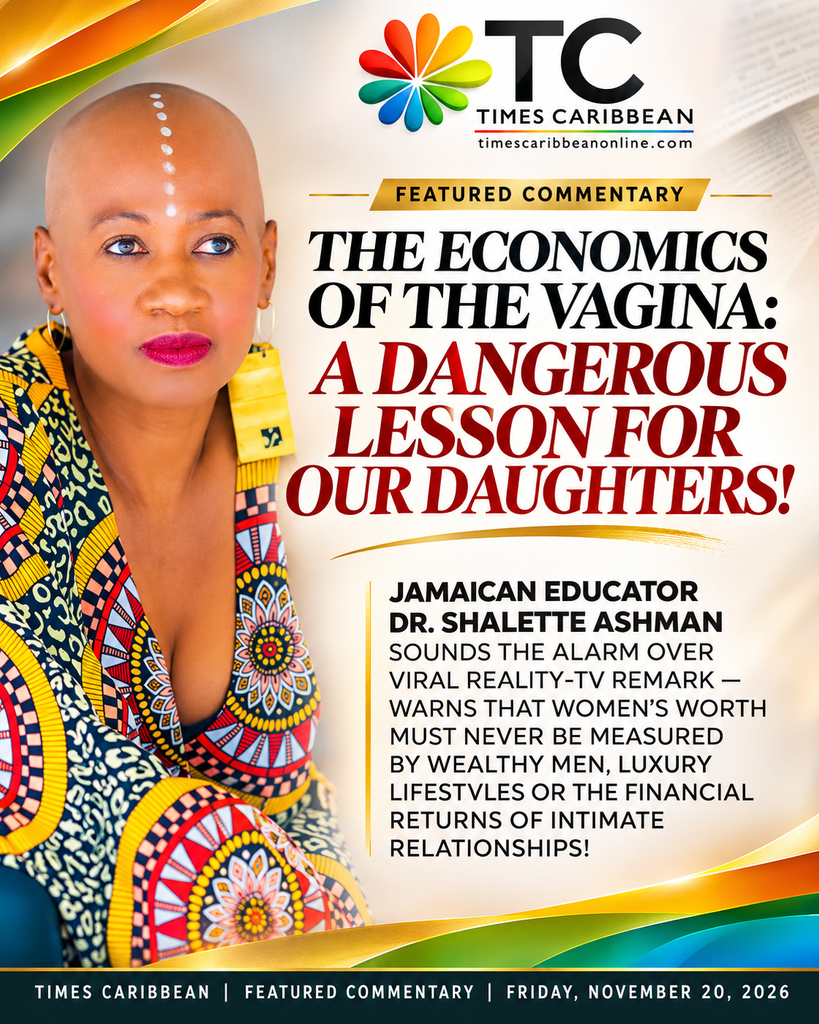
THE ECONOMICS OF THE VAGINA: A DANGEROUS LESSON FOR OUR DAUGHTERS!

JAMAICAN EDUCATOR DR. SHALETTE ASHMAN SOUNDS THE ALARM OVER VIRAL REALITY-TV REMARK — WARNS THAT WOMEN’S WORTH MUST NEVER BE MEASURED BY WEALTHY MEN, LUXURY LIFESTYLES OR THE FINANCIAL RETURNS OF INTIMATE RELATIONSHIPS!
TIMES CARIBBEAN | FEATURED COMMENTARY | FRIDAY, NOVEMBER 20, 2026
Based on a commentary by Dr. Shalette Ashman, Jamaican educator, author and CEO of LearningHub Group
KINGSTON, JAMAICA — A viral reality television exchange has sparked laughter, countless online reactions and an uncomfortable conversation about womanhood, wealth, relationships and the messages Caribbean society is sending to its daughters.
And one respected Jamaican educator is asking a question that deserves serious attention.
When did a woman’s intimate relationships become a financial investment strategy, and when did her personal worth become something measured by the wealth she acquires from men?
Dr. Shalette Ashman, educator, entrepreneur, author and CEO of LearningHub Group, has delivered a powerful social commentary titled “The Economics of the Vagina: A Dangerous Lesson for Our Daughters,” challenging the troubling philosophy she believes may be hiding beneath one of social media’s latest viral moments.
Her intervention follows a widely circulated confrontation involving Jamaican-born Karen Loderick-Peace and Amanda Cronin during a reunion episode of The Real Housewives of London.
During the exchange, Loderick-Peace reportedly contrasted her property ownership with Cronin’s financial circumstances while making allegations about the latter’s relationships with wealthy and influential men.
The confrontation culminated in the now-famous remark:
“Low-budget vagina, Amanda.”
Millions have watched. Thousands have laughed.
But Dr. Ashman is asking Caribbean families to look beyond the entertainment.
WHEN A VIRAL JOKE BECOMES A DANGEROUS MESSAGE
Returning to social media after approximately three months away, Ashman acknowledged that she initially found the exchange amusing.
Then the educator in her began questioning its deeper implications.
Her concern is not about policing the private relationships of consenting adults. Nor is she suggesting that women should be criticised for accepting financial support, marrying wealthy partners or building prosperous households with their spouses.
Her concern is considerably bigger.
What happens when young girls begin believing that their bodies, rather than their brains, are their greatest economic assets?
The underlying suggestion in the televised argument, as Ashman interprets it, is that a woman who has relationships with wealthy men should have accumulated substantial property and financial assets.
And if she has not?
Society is invited to laugh at her supposed financial failure.
But that raises a troubling question: Are we now judging intimate relationships according to the material benefits they produce?
Would the same alleged relationships suddenly become admirable if they resulted in luxury homes, expensive cars and substantial bank accounts?
Ashman’s commentary exposes a contradiction that deserves careful examination.
If money makes questionable behaviour socially acceptable, then perhaps our society has become more concerned with wealth than values.
FROM SELLING GUINEPS TO BUILDING AN EDUCATIONAL ENTERPRISE
What makes Ashman’s intervention especially compelling is her own journey.
She recalls growing up selling guineps, suck-suck and agricultural produce in Grants Pen, Jamaica.
Later, her family lived in Stony Hill, where she experienced financial hardship, carried water and lived without some basic household conveniences.
Her circumstances were modest.
Her ambitions were not.
Through education, discipline, entrepreneurship, sacrifice and faith, she built a career that eventually placed her at the forefront of Caribbean educational innovation.
Today, she leads LearningHub Group, an education-focused enterprise serving learners across multiple regions.
For Ashman, the central message is simple.
A girl’s circumstances at birth must never become the ceiling on her future.
And financial independence should be built on knowledge, skills, opportunity, enterprise and personal determination rather than dependence on romantic relationships.
THE REAL DANGER: FINANCIAL DEPENDENCE DISGUISED AS SUCCESS
One of the strongest arguments in Ashman’s commentary concerns the vulnerability that can accompany complete financial dependence on a romantic partner.
A luxury lifestyle may appear enviable from the outside.
But expensive gifts, designer clothing and beautiful homes do not automatically guarantee security, independence or personal freedom.
A woman who cannot independently provide for her basic needs may face difficult choices if a relationship deteriorates, particularly where controlling behaviour or financial abuse is involved.
Ashman is careful to distinguish between healthy financial cooperation within relationships and the belief that a woman’s prosperity must depend entirely on keeping a wealthy partner interested.
There is dignity in homemaking.
There is dignity in raising children.
There is dignity in building a family through shared responsibilities, whether one partner earns most of the household income or both contribute financially.
But there must also be dignity in a woman’s right to pursue her own ambitions, establish financial security and make decisions about her future.
A woman’s success cannot be reduced to the financial status of the person she loves.
SOCIAL MEDIA IS TEACHING OUR CHILDREN — WHETHER WE LIKE IT OR NOT
Perhaps the most important dimension of Ashman’s argument concerns the influence of social media on young people.
Across Jamaica, St. Kitts and Nevis and the wider Caribbean, teenagers are constantly exposed to curated displays of wealth, designer lifestyles, celebrity relationships and apparent overnight success.
They see the results.
But they rarely see the sacrifices, education, business decisions and years of effort that may have produced them.
And increasingly, reality television personalities and social media influencers can shape attitudes about money, relationships and success as powerfully as parents, teachers and traditional institutions.
That influence carries responsibility.
If a young girl repeatedly encounters the message that wealth is best obtained through romantic access to powerful or financially successful men, what happens to her motivation to develop her own talents?
What happens to the dream of becoming an engineer, entrepreneur, doctor, educator, architect or business leader?
And what happens to the young woman who believes she has little value because she does not possess conventional beauty, celebrity status or access to influential social circles?
These are not insignificant questions.
They go directly to the future of women’s economic empowerment throughout the Caribbean.
A MESSAGE EVERY CARIBBEAN DAUGHTER NEEDS TO HEAR
Ashman’s commentary is particularly relevant in societies where economic inequality can make visible displays of wealth especially attractive to young people seeking opportunities for advancement.
There is nothing shameful about starting small.
Nothing shameful about selling produce, learning a trade, working an ordinary job, returning to school later in life or slowly saving toward home ownership.
Indeed, Caribbean communities have been built by generations of women who transformed modest beginnings into extraordinary accomplishments.
Market vendors who educated children.
Single mothers who established businesses.
Teachers who invested in communities.
Women who worked, saved, sacrificed and created opportunities that previous generations could scarcely imagine.
Their achievements may never attract millions of social media views.
But their contribution to Caribbean development is immeasurable.
In one of the most memorable passages of her commentary, Ashman delivers a message that deserves to be repeated in classrooms, homes and youth development programmes throughout the region:
“There is a gold mine between your ears. Dig there.”
That single statement captures the central philosophy of her argument.
Education matters.
Financial literacy matters.
Entrepreneurship matters.
Skills development matters.
And perhaps most importantly, young women must understand that their potential is not dependent on the approval, affection or financial resources of a wealthy partner.
BEYOND MARRIAGE, DIVORCE AND THE EXPECTATIONS OF SOCIETY
Ashman’s advocacy for women’s independence will continue beyond this viral debate.
She is scheduled to participate as a panellist at The Restored Woman Experience Jamaica, planned for December 6 at the S Hotel in Kingston.
Speaking on the theme “Beyond Divorce,” she is expected to address reclaiming personal identity, rediscovering purpose, strengthening financial independence and recognising that a woman’s future need not be defined by the continuation or ending of a romantic relationship.
Her message reflects a broader reality.
Relationships can change.
Marriages can end.
Economic circumstances can shift.
But a woman’s knowledge, determination, professional abilities and capacity for reinvention can remain powerful resources throughout her life.
TIMES CARIBBEAN COMMENTARY: WE MUST CHANGE THE CONVERSATION
The viral confrontation between two reality television personalities may eventually fade from public attention.
Another video will emerge.
Another argument will dominate the headlines.
Another memorable phrase will circulate across social media.
But the questions raised by Dr. Shalette Ashman should remain.
What exactly are we teaching our daughters about success?
Are we encouraging them to develop the abilities necessary to create wealth, or are we unintentionally suggesting that access to wealth is more important than the capacity to produce it?
Are we celebrating women for their achievements, contributions and resilience, or principally for the lifestyles and relationships they display?
And are we preparing young Caribbean women to become economically independent decision-makers?
The answers matter.
Because genuine empowerment is not measured by the price of a handbag, the value of a car or the financial standing of a romantic partner.
It is reflected in a woman’s freedom to make informed choices, develop her abilities and pursue the life she wishes to build.
There is nothing wrong with love.
Nothing wrong with partnership.
And nothing wrong with building considerable wealth together.
But the ultimate lesson for Caribbean daughters must remain clear:
YOUR BODY IS NOT YOUR BUSINESS PLAN. YOUR BEAUTY IS NOT YOUR BANK ACCOUNT. AND YOUR FUTURE MUST NEVER DEPEND ENTIRELY ON SOMEONE ELSE’S FORTUNE.
INVEST IN YOUR MIND. DEVELOP YOUR SKILLS. BUILD YOUR OWN FUTURE.
That is a lesson worth teaching.
And it is a conversation worth having.
ABOUT DR. SHALETTE ASHMAN
Dr. Shalette Ashman is a Jamaican educator, author, speaker, entrepreneur, Caribbean eLearning pioneer and Chief Executive Officer of LearningHub Group.
She is the author of Limitless, Volume 1 and God Is Still in the Miracle Working Business.
Her books and educational resources are available through www.learninghubgroup.com and the LearningHub Bookstore at Manor Centre, Kingston, Jamaica.
Details about The Restored Woman Experience Jamaica can be found at www.therestoredwomanexperience.com.
Editorial note: This Times Caribbean article examines and summarises the social commentary supplied by Dr. Shalette Ashman. The views discussed are attributed to Dr. Ashman; allegations made during the reality television exchange are not presented as independently established facts.
TIMES CARIBBEAN | CARIBBEAN PERSPECTIVES • SOCIAL COMMENTARY • WOMEN’S EMPOWERMENT
















Leave a comment
You must be logged in to post a comment.