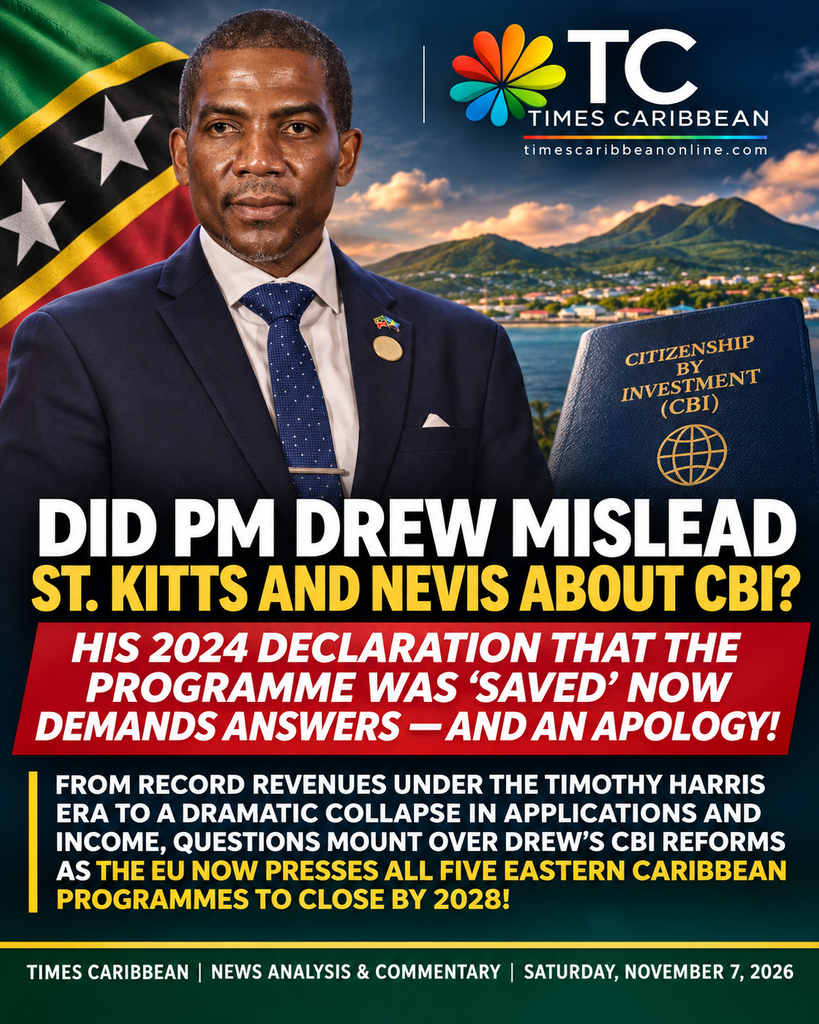
DID PM DREW MISLEAD ST. KITTS AND NEVIS ABOUT CBI? HIS 2024 DECLARATION THAT THE PROGRAMME WAS “SAVED” NOW DEMANDS ANSWERS — AND AN APOLOGY!

FROM RECORD REVENUES UNDER THE TIMOTHY HARRIS ERA TO A DRAMATIC COLLAPSE IN APPLICATIONS AND INCOME, QUESTIONS MOUNT OVER DREW’S CBI REFORMS AS THE EU NOW PRESSES ALL FIVE EASTERN CARIBBEAN PROGRAMMES TO CLOSE BY 2028!
BASSETERRE, ST. KITTS AND NEVIS — Prime Minister Dr. Terrance Drew owes the people of St. Kitts and Nevis a full explanation of his administration’s handling of the Citizenship by Investment (CBI) Programme. And given the striking contrast between his earlier public assurances and the serious uncertainty now confronting the industry, there is a compelling argument that he also owes the nation an apology.
The facts raise uncomfortable questions.
For years, Dr. Drew presented his administration’s sweeping CBI reforms as necessary measures to rescue the Federation’s most important revenue-generating programme from the consequences of alleged mismanagement under former Prime Minister Dr. Timothy Harris.
The message was unmistakable. The previous administration had supposedly placed the programme in danger, and the new government had stepped in to save it.
But developments in 2026 have exposed a major weakness in that political narrative.
The European Union is now seeking the phase-out of all five Eastern Caribbean citizenship-by-investment programmes, including those operated by Antigua and Barbuda, Dominica, Grenada, Saint Lucia, and St. Kitts and Nevis.
This is not an action directed exclusively at St. Kitts and Nevis. Nor is it simply a verdict on how Dr. Harris administered the Federation’s programme.
It is part of a broader European policy against investor citizenship arrangements that grant nationality without a genuine connection to the issuing country.
That distinction matters enormously.
THE EU WAS TARGETING AN INDUSTRY — NOT SIMPLY ONE FORMER GOVERNMENT
The European Union’s revised visa-suspension framework identifies the operation of certain investor citizenship programmes as grounds for potentially suspending visa-free access.
In other words, even a programme operating with strengthened due diligence and regulatory safeguards can face European objections because of the nature of the citizenship arrangement itself.
To be clear, European authorities have also expressed concerns about screening standards, transparency and security risks. Those issues cannot simply be dismissed.
But the current regional pressure demonstrates that no amount of domestic political blame directed at Dr. Harris could guarantee the programme’s long-term acceptance by Europe.
That raises a fundamental question.
Was the nation given a sufficiently accurate picture of the international threat, or was a much broader European policy challenge presented through a narrow domestic political narrative?
Prime Minister Drew should answer that question directly.
THE 2024 DECLARATION THAT NOW DEMANDS EXPLANATION
On October 17, 2024, Prime Minister Drew delivered a major national address on the state of the CBI Programme.
He confidently announced:
“The Saint Kitts and Nevis CBI programme has been saved.”
Those were his words.
He credited his government’s reforms with safeguarding the programme, strengthening international confidence and establishing a more sustainable future.
Yet barely two years later, the Federation is confronting European pressure for a complete phase-out of the very industry he publicly declared rescued.
What exactly was saved?
Was the Prime Minister describing a temporary improvement in international relations? Was he claiming the programme’s long-term survival had been secured? Or did his administration underestimate the European Union’s wider policy intentions?
These questions deserve answers.
The Prime Minister cannot reasonably expect the public to disregard his earlier declaration simply because the international situation has become more difficult.
Political leadership demands accountability for public assurances, especially when the economic future of an entire country is involved.
THE HARRIS-ERA REVENUE RECORD CANNOT BE ERASED
Whatever political disagreements exist over the management of the CBI Programme, its financial performance during the Timothy Harris administration deserves recognition.
Official figures subsequently presented by Dr. Drew himself documented the scale of that success.
- 2019: EC$443 million in CBI revenue.
- 2021: EC$543 million.
- 2022: EC$669 million.
- 2023: EC$620 million.
The 2022 revenue figure covers a year in which the Harris administration governed until August 5, before the Drew administration assumed office. The strong 2023 figure also demonstrates that substantial CBI inflows continued after the transition.
Nevertheless, the wider record establishes that the Federation entered the change of government with a highly productive CBI industry, generating hundreds of millions of dollars for the national economy.
Those revenues supported public finances, economic activity and national development.
Dr. Harris presided over a period of exceptional financial performance. That is an important part of the programme’s history, regardless of subsequent political criticisms.
The question is whether the incoming government could have protected that commercial strength while introducing necessary safeguards.
Instead, sweeping regulatory changes were followed by a severe downturn.
THE COLLAPSE IN APPLICATIONS AND REVENUE IS DOCUMENTED
The figures are startling.
According to European Commission data, St. Kitts and Nevis recorded 1,987 CBI applications in 2023, compared with just 223 in 2024.
That represents a decline of nearly 89 percent in a single year.
The financial picture is similarly troubling.
The International Monetary Fund reported that CBI revenue fell from approximately 22 percent of GDP in 2023 to around 8–9 percent in 2024, with a further decline in 2025.
The IMF specifically identified tightened application requirements, strengthened due diligence and increased pricing as contributing to a structurally lower level of applications.
The Drew administration has argued that these changes were necessary to improve programme integrity and satisfy international expectations.
That explanation deserves consideration.
But necessary reform and effective commercial management are not automatically the same thing.
Could the government have adopted a more measured approach? Were the price increases and other changes properly assessed against the likely loss of applications? Did policymakers adequately anticipate the financial consequences?
And perhaps most importantly, did the administration sacrifice substantial economic benefits in pursuit of assurances that the European Union was never prepared to provide?
These are legitimate questions. Not political distractions.
DID THE REFORMS SAVE THE PROGRAMME — OR ACCELERATE ITS COMMERCIAL DECLINE?
The argument that Dr. Drew’s reforms contributed to the programme’s commercial deterioration is supported by evidence of falling demand following the policy changes.
The IMF’s analysis makes that relationship difficult to ignore.
What cannot yet be established is that those reforms caused Europe’s broader decision to seek an end to regional CBI programmes. European policy now reaches all five operating countries, regardless of their individual governments.
That is precisely why the Prime Minister’s earlier political messaging deserves scrutiny.
The public was repeatedly told that difficult reforms were essential to saving CBI.
Yet the reforms coincided with a dramatic reduction in revenue and applications, while the larger European challenge remained unresolved.
For critics, the outcome raises the possibility that St. Kitts and Nevis endured severe financial consequences without securing the long-term protection that the government had promised.
That possibility demands a detailed explanation, supported by evidence rather than political rhetoric.
NOW THE PRIME MINISTER SAYS ST. KITTS AND NEVIS MUST PREPARE TO LIVE WITHOUT CBI
During his November 5, 2026, media roundtable, Dr. Drew acknowledged the seriousness of the emerging international situation.
He also raised concerns about the possibility of wider financial consequences for countries operating CBI programmes and said his government was preparing the Federation to become less dependent on citizenship revenues.
Economic diversification is a sensible national objective.
Indeed, reducing excessive reliance on one unpredictable income source is a responsibility that successive governments should take seriously.
But diversification does not eliminate the need to explain what happened to the substantial revenue stream that once supported the country’s finances.
Nor does it settle whether the government’s reforms achieved their stated objectives.
The nation deserves to know what alternative revenue sources, investment projects and economic measures are sufficiently advanced to replace the income that has already been lost.
AN APOLOGY WOULD BE AN ACT OF ACCOUNTABILITY
There is an important distinction between making an incorrect prediction and deliberately misleading the public. The available evidence does not, by itself, establish that Prime Minister Drew intentionally deceived the nation.
But political accountability does not require proof of deliberate dishonesty.
If the Prime Minister presented the 2024 reforms as having secured the CBI Programme’s future without adequately explaining the wider European threat, he should acknowledge that his assurances were overstated.
If his administration underestimated the economic effects of its policy changes, it should say so.
And if the public was left with an impression that the programme had been permanently rescued when that outcome was far from guaranteed, a sincere apology would be appropriate.
Indeed, asking the people of St. Kitts and Nevis for their understanding and forgiveness would demonstrate far greater political maturity than attempting to defend every past decision regardless of the outcome.
ST. KITTS AND NEVIS DESERVES THE FULL TRUTH
The European Union has requested that affected Caribbean countries phase out their CBI programmes by June 1, 2028, with a November 12, 2026 deadline reportedly set for agreeing to the proposed closure process.
The stakes could hardly be higher.
Prime Minister Drew must now explain what negotiations are taking place, what concessions are being sought, whether a longer transition is possible and what financial protections can be secured for the Federation.
He must also confront the contradiction between his 2024 declaration of success and the present uncertainty.
The financial achievements of the Harris administration cannot simply be dismissed. The sharp declines that followed the Drew administration’s reforms cannot be explained away. And the European Union’s regional policy cannot credibly be reduced to a problem created by one former Prime Minister.
Dr. Drew told the nation he had saved CBI.
Now he must explain what that declaration actually meant, what his reforms accomplished and why the programme faces such an uncertain future.
And if the assurances given to the nation went beyond what the evidence justified, the proper response is straightforward.
Acknowledge it. Explain it. Apologise.
The people of St. Kitts and Nevis deserve nothing less.
TIMES CARIBBEAN — NEWS ANALYSIS & COMMENTARY | NOVEMBER 7, 2026
This article presents an editorial assessment of government CBI policy, official financial data and European regulatory developments. Assessments of political responsibility are opinions, not findings of intentional misconduct.
















Leave a comment
You must be logged in to post a comment.