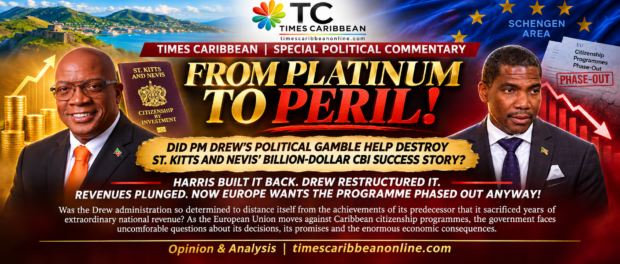
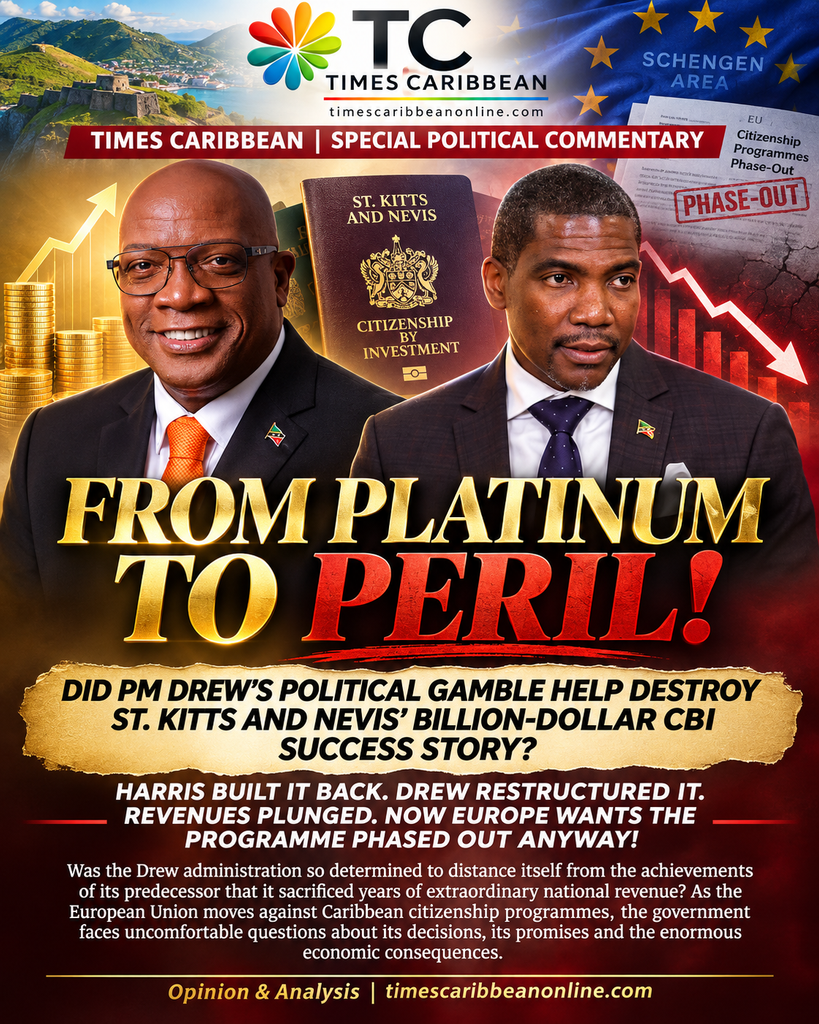
FROM PLATINUM TO PERIL! DID PM DREW’S POLITICAL GAMBLE HELP DESTROY ST. KITTS AND NEVIS’ BILLION-DOLLAR CBI SUCCESS STORY?
TIMES CARIBBEAN | SPECIAL POLITICAL COMMENTARY | NOVEMBER 3, 2026
HARRIS BUILT IT BACK. DREW RESTRUCTURED IT. REVENUES PLUNGED. NOW EUROPE WANTS THE PROGRAMME PHASED OUT ANYWAY!
Was the Drew administration so determined to distance itself from the achievements of its predecessor that it sacrificed years of extraordinary national revenue? As the European Union moves against Caribbean citizenship programmes, the government faces uncomfortable questions about its decisions, its promises and the enormous economic consequences.
BASSETERRE, ST. KITTS — Tuesday, November 3, 2026
There are political mistakes. There are costly policy miscalculations. And then there are decisions whose consequences may haunt a country for generations.
The handling of St. Kitts and Nevis’ once-celebrated Citizenship by Investment (CBI) Programme under the administration of Prime Minister Dr. Terrance Drew deserves serious examination in that final category.
Because what was once internationally promoted as the Platinum Brand of the global investment migration industry has experienced a staggering financial reversal.
And the most troubling question is not simply how the programme declined.
It is whether the Drew administration, in its determination to dismantle the policies and political legacy of former Prime Minister Dr. Timothy Harris, accelerated that decline unnecessarily.
Did political rivalry take precedence over economic preservation?
That is a question worth asking. And the figures make it impossible to dismiss.
THE FIRST DISASTER: 2014 AND THE DOUGLAS ADMINISTRATION
To understand the magnitude of the current predicament, we must revisit one of the most damaging chapters in the programme’s history.
In 2014, under the administration of then Prime Minister Dr. Denzil Douglas, St. Kitts and Nevis suffered two devastating international setbacks.
On May 20, 2014, the United States Financial Crimes Enforcement Network (FinCEN) issued an advisory warning financial institutions about abuse of the Federation’s CBI Programme by certain foreign individuals.
Then came November 22, 2014.
Canada abruptly removed visa-free access for citizens of St. Kitts and Nevis, citing concerns about passport issuance and identity-management practices associated with the CBI Programme.
These were not minor embarrassments.
They were serious blows to the credibility of the country’s most internationally significant revenue-generating initiative.
At the centre of the passport controversy was the decision to issue passports without the place-of-birth field, a practice subsequently reversed as authorities worked to address international concerns.
The damage was substantial.
The country’s reputation had been questioned, its passport had lost an important travel privilege, and the programme’s management had come under intense international scrutiny.
The 2014 FinCEN advisory was eventually rescinded on February 24, 2026, but that does not erase the seriousness of the original warning. FinCEN.gov+2
ENTER TIMOTHY HARRIS: THE GREAT CBI RECOVERY
When Dr. Timothy Harris assumed office in February 2015 at the head of the Team Unity administration, he inherited a CBI Programme facing substantial international reputational challenges.
The task was enormous.
Rebuild confidence. Restore credibility. Reposition the product. Reassure international stakeholders.
And, critically, transform a programme damaged by controversy into a globally competitive economic powerhouse.
The Harris administration spent its formative years pursuing that recovery, addressing passport concerns, repositioning the programme and rebuilding its international profile.
The subsequent revenue performance was extraordinary.
By the latter years of the Team Unity administration, CBI receipts had become a dominant source of government income, helping provide St. Kitts and Nevis with fiscal resources that many neighbouring countries could only envy.
The International Monetary Fund recorded approximately EC$442.6 million in CBI budgetary receipts in 2019, EC$542.6 million in 2021 and an estimated EC$678.2 million in 2022.
The programme’s 2022 performance represented a remarkable financial achievement, with CBI receipts accounting for roughly one-quarter of national GDP. IMF eLibrary+1
The CBI financial story
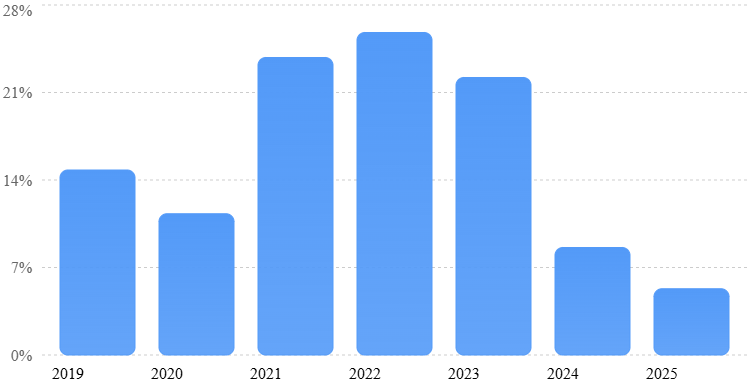
Source: IMF country reports. 2019–2022 figures are budgetary receipts; 2023–2025 figures are approximate CBI-fee ratios from the IMF’s 2026 series. GDP ratios are not the same as revenues in EC dollars.
CBI income as a share of GDP. The 2025 figure comes from the IMF’s 2026 Article IV assessment. IMF eLibrary+1
This was no ordinary recovery.
A programme that had faced damaging international scrutiny in 2014 had developed into one of the strongest contributors to the Federation’s national finances.
Under Harris, the programme reached what its advocates proudly described as platinum status.
Its success was reflected not merely in international marketing campaigns, but in hundreds of millions of dollars flowing into the national treasury.
That is a record worthy of recognition, regardless of political allegiance.
And that is precisely why what happened after August 2022 deserves such intense scrutiny.
THEN CAME DREW. AND EVERYTHING CHANGED.
The change of government in August 2022 brought a new Prime Minister, a new policy direction and a dramatically different public narrative about the CBI Programme.
Prime Minister Drew presented his administration’s reforms as essential to strengthening the programme’s integrity, ensuring regulatory compliance and protecting the country’s international relationships.
Those objectives were legitimate.
No responsible administration should dismiss genuine due-diligence concerns or the possibility of restrictions imposed by powerful international partners.
But there is an enormous difference between correcting weaknesses in a successful programme and pursuing changes whose economic consequences may prove devastating.
And this is where the Drew administration must face difficult questions.
Was the programme genuinely in such a precarious condition that sweeping reforms were the only reasonable course?
Were alternative approaches considered?
Was the likely loss of revenue properly assessed?
And did the administration’s repeated criticism of previous management undermine confidence in an industry whose greatest asset was its international reputation?
The impression created by the new government’s public messaging was deeply troubling to supporters of the Harris-era programme.
A product previously celebrated for its financial success was increasingly discussed in terms of controversy, regulatory weaknesses and the danger of international sanctions.
Critics contend that the administration appeared more eager to distance itself from Harris’ achievements than to preserve the full economic value of what it inherited.
That interpretation remains political opinion, not an established finding about the Prime Minister’s motives.
But the economic reversal that followed is undeniable.
THE REVENUE COLLAPSE: NUMBERS THAT DEMAND ANSWERS
Forget the political speeches for a moment.
Look at the numbers.
According to the IMF’s 2026 assessment, CBI revenue declined from approximately 25.8% of GDP in 2022 to 8.6% in 2024 and 5.3% in 2025.
That is a dramatic reversal.
The IMF specifically identified tighter application requirements, enhanced due diligence and changes to programme pricing as important factors contributing to the decline. It also acknowledged that these changes were intended to strengthen programme integrity. IMF eLibrary+1
But good intentions do not automatically produce good economic outcomes.
And policy reform cannot be judged solely by how impressive it sounds at an international conference.
It must also be assessed by what it costs the country.
How much potential revenue did St. Kitts and Nevis sacrifice between 2023 and 2025?
Hundreds of millions? Possibly more?
The exact amount cannot be established without a credible assessment of what would have happened under alternative policies. But the scale of the decline makes an independent economic review entirely reasonable.
Consider the lost opportunities.
How many roads could have been rehabilitated? How many schools modernised? How much investment could have gone into healthcare, housing, water infrastructure and national debt reduction?
These are not imaginary concerns.
They are questions about the opportunity cost of government policy.
Every dollar of sustainable public revenue that disappears represents one less dollar potentially available for national development.
And while the administration has repeatedly defended its reform agenda, the people of St. Kitts and Nevis deserve to know whether the same international objectives could have been pursued with less economic disruption.
THE EUROPEAN UNION BOMBSHELL: SO WHAT DID ALL THE SACRIFICE ACHIEVE?
Then came the development that made the entire controversy even more extraordinary.
In June 2026, the European Commission formally requested that five Eastern Caribbean countries operating CBI programmes phase them out by June 1, 2028.
The consequences of refusing could include suspension of visa-free access to Europe’s Schengen area.
Here is the critical detail.
The EU’s revised framework allows the existence of a citizenship-by-investment programme itself to become grounds for suspending visa-free travel, regardless of how well that programme is managed. Antigua and Barbuda Government+1
Read that again.
Regardless of how well it is managed.
That changes everything.
For years, Caribbean governments were encouraged to improve due diligence, strengthen transparency, increase investment thresholds and tighten programme administration.
St. Kitts and Nevis undertook sweeping changes.
The country experienced a severe revenue decline.
And now, despite those reforms, the European Union is seeking the eventual phase-out of the very industry those reforms were supposed to help protect.
So what exactly did St. Kitts and Nevis gain?
That is the uncomfortable question.
Of course, it would be inaccurate to suggest that reforms had no value. Stronger due diligence can protect a country’s reputation and security relationships.
But if the European position has shifted from demanding better management to opposing the very existence of the programmes, surely the economic cost of earlier reforms deserves a fresh assessment.
GASTON BROWNE IS NEGOTIATING. WHAT IS ST. KITTS AND NEVIS’ LONG-TERM PLAN?
The developments in Antigua and Barbuda have made the regional predicament even clearer.
Prime Minister Gaston Browne has signalled his government’s willingness to negotiate a managed conclusion to its Citizenship by Investment Programme, while seeking an extension until December 2030.
He has also requested financial assistance and a comprehensive assessment of the economic consequences.
Importantly, Antigua has not announced an immediate November 12, 2026 closure. That date concerns its response to the EU, and negotiations remain ongoing. Today Antigua+1
Browne is effectively arguing that if Caribbean nations are being asked to surrender a significant source of development financing to preserve visa-free access, their international partners must recognise the economic consequences.
It is a reasonable position.
And it raises another question.
What concrete concessions, transition arrangements or economic assistance can St. Kitts and Nevis secure?
Prime Minister Drew has addressed the EU issue publicly. In July 2026, he defended his administration’s strategy to reduce dependence on CBI and confirmed continued engagement with European and regional partners. SKNIS+1
But defending diversification is not the same as accounting for the revenue already lost.
Nor does it answer whether earlier policy decisions were economically proportionate.
The Federation needs more than assurances that everything will eventually work out.
It needs a clear, measurable transition strategy.
THE BILLION-DOLLAR QUESTION: DID WE SACRIFICE THREE YEARS OF POTENTIAL REVENUE?
Here lies the central argument.
Suppose the Drew administration had adopted a more gradual reform strategy, maintaining the programme’s competitiveness for as long as internationally acceptable while addressing legitimate regulatory concerns.
Could St. Kitts and Nevis have preserved significantly more of its CBI earnings during 2023, 2024 and 2025?
Could those additional resources have been invested in infrastructure, productive industries and economic diversification?
Could the country have entered the present EU negotiations with a stronger financial cushion?
Nobody can responsibly claim those outcomes were guaranteed. The international CBI market was changing, and the European Union’s evolving position presented risks beyond the control of any Caribbean government.
Yet these are precisely the questions that policymakers should have anticipated.
The administration must explain not only why it reformed the programme, but why its particular combination of measures, timing and pricing decisions represented the best economic option available.
Because if the programme’s eventual phase-out was becoming increasingly likely, preserving legitimate revenue during the remaining years was itself an important national interest.
The alternative deserves examination: St. Kitts and Nevis may have endured a significant decline in revenue earlier than was strictly necessary, only to face the same existential European pressure as its regional neighbours.
That possibility should concern every citizen.
THIS WAS NEVER HARRIS’ MONEY. IT WAS THE PEOPLE’S MONEY.
And perhaps this is the most important point of all.
The CBI Programme did not belong to Timothy Harris.
It does not belong to Terrance Drew.
It does not belong to the People’s Labour Party, the St. Kitts-Nevis Labour Party or any political organisation.
It belongs to St. Kitts and Nevis.
Its revenue is national revenue.
Its success is national success.
And its setbacks have national consequences.
A responsible incoming government should be prepared to retain what works, correct what does not and build upon the achievements of previous administrations.
That is the essence of institutional continuity.
Yet too often in Caribbean politics, a change of administration seems to require a complete rejection of the predecessor’s accomplishments.
A successful initiative becomes politically inconvenient because the wrong person gets the credit.
An established policy becomes unacceptable because it carries the fingerprints of a former government.
And the country risks paying the price for political score-settling.
Whether that mentality influenced the Drew administration’s approach to CBI cannot be established merely from the revenue figures. But the perception is sufficiently serious to warrant public accountability.
The Prime Minister should be willing to demonstrate that each major reform was supported by sound economic analysis rather than political considerations.
THE FINAL VERDICT: PLATINUM STATUS LOST, BUT WHO MUST ANSWER?
The historical contrast is striking.
In 2014, the programme suffered serious international reputational damage under the Douglas administration.
Under the Harris-led Team Unity government, it recovered and went on to generate extraordinary levels of revenue.
Under Drew, sweeping reforms were introduced, followed by a substantial decline in receipts.
And now the European Union is pressing the entire region to move towards an eventual end to citizenship-by-investment schemes.
This sequence does not, by itself, prove that Drew caused the collapse. But neither does it absolve his administration of responsibility for the consequences of its decisions.
The decline happened on his watch.
His government chose its reform strategy.
His administration must account for the results.
And if the programme ultimately faces closure because of the EU’s broader policy position, the public will have every right to ask whether St. Kitts and Nevis unnecessarily surrendered valuable years of earning potential before reaching that point.
The Prime Minister may argue that he protected the Federation from even greater international consequences. That argument deserves to be heard and tested against the evidence.
But he cannot expect the public to ignore the massive revenue decline simply because his administration describes its policies as necessary.
A government does not earn a passing grade merely for declaring its intentions were good. It must demonstrate that its decisions served the national interest.
The people deserve a full accounting.
Not political slogans.
Not selective comparisons.
Not another round of finger-pointing.
A clear explanation of what changed, why it changed, what it cost and what measurable benefits the country obtained in return.
Because history will not judge this administration solely by its promises to protect the CBI Programme.
It will judge the decisions made when the programme was still capable of generating extraordinary national revenue.
And it will ask one question above all others:
DID ST. KITTS AND NEVIS LOSE ITS PLATINUM CBI ADVANTAGE BECAUSE OF UNAVOIDABLE INTERNATIONAL PRESSURE — OR DID ITS OWN GOVERNMENT HELP SURRENDER THAT ADVANTAGE YEARS TOO SOON?
That question deserves an answer.
And the country deserves nothing less.
EDITORIAL NOTE: This article is political opinion and analysis. Allegations about political motivation are presented as questions and criticism, not established facts. IMF revenue figures, the EU’s phase-out proposal and public government statements are distinguished from interpretations of responsibility. The programme’s future remains subject to regional diplomacy and EU decisions.
















Leave a comment
You must be logged in to post a comment.