HAMILTON RESERVE BANK CHAIRMAN ACCUSES JUSTICE IAIN MORLEY OF ABUSING JUDICIAL POWER AS CONTROVERSY DEEPENS OVER NEVIS BANKING RULING
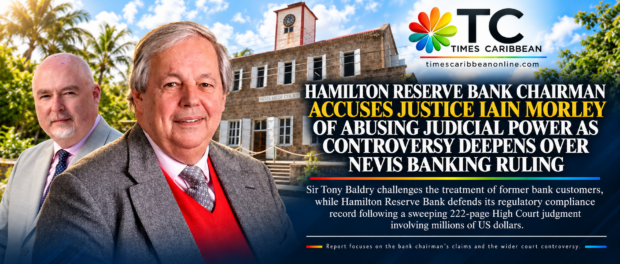
Sir Tony Baldry challenges the treatment of former bank customers, while Hamilton Reserve Bank defends its regulatory compliance record following a sweeping 222-page High Court judgment involving millions of US dollars.
CHARLESTOWN, NEVIS — A major judicial controversy is unfolding in Nevis after Hamilton Reserve Bank Chairman, the Right Honourable Sir Tony Baldry, publicly challenged Justice Iain Morley KC over his handling of proceedings involving the international financial institution.
According to an October 12 report published by SKN Pulse, the bank’s chairman disputed the standing of claimants involved in the litigation, maintaining that their banking relationships had been terminated years earlier and their account balances remitted.
The bank has also sharply criticised Justice Morley’s September 15, 2026, judgment, alleging that his approach failed to give proper weight to internationally recognised banking compliance requirements.
These are serious allegations. However, they remain the bank’s position and do not constitute an established finding of judicial misconduct.
The court ruling at the centre of the dispute
The controversy stems from a 222-page judicial document involving 39 proceedings concerning Hamilton Reserve Bank and the Bank of New Innovation, formerly Bank of Nevis International.
Of those proceedings, 11 concerned Hamilton Reserve Bank, with approximately US$85.1 million connected to the disputes.
Justice Morley’s ruling included orders requiring specified deposits to be repaid by October 29, 2026, as well as recommendations for regulatory consideration.
The judgment brought questions of depositor rights, banking supervision and compliance responsibilities into national focus.
Bank chairman disputes claims
Sir Tony Baldry, a former British parliamentarian who chairs Hamilton Reserve Bank, has challenged the legitimacy of claims brought by certain former customers.
He maintains that the accounts in question had already been closed and the relationships terminated, disputing the basis upon which those claimants continued seeking relief through the Nevis courts.
The bank also argues that its anti-money-laundering obligations required it to take precautionary measures when suspicious transactions were identified.
According to Hamilton Reserve Bank, its compliance procedures include freezing questionable funds, notifying financial regulators, submitting suspicious transaction reports and cooperating with relevant authorities.
The bank insists that those measures reflect established regulatory responsibilities rather than misconduct.
Court documents present another perspective
The published judgment, however, provides important additional context.
Justice Morley’s decision records concerns about the bank’s failure to comply with certain court orders and addresses the evidence required to substantiate its explanations for withholding disputed funds.
The court also referred questions concerning Hamilton Reserve Bank to Nevis Premier Mark Brantley and the relevant banking regulator for consideration of possible licence suspension pending investigation.
Such a referral does not itself establish that the bank has committed a criminal offence, nor does it amount to an automatic revocation of its banking licence.
Wider implications for Nevis
The dispute now raises significant questions about how international banking institutions balance customer obligations, regulatory compliance and judicial authority.
Hamilton Reserve Bank has indicated its intention to challenge the judgment through the appellate process. The outcome of any appeal remains subject to the courts.
For Nevis, where international financial services form an important part of the economy, the proceedings carry implications for regulatory confidence, investor trust and the rights of depositors.
The central issue remains unresolved: whether the bank’s actions were justified under applicable financial regulations or whether the court correctly determined that existing obligations to depositors had not been met.
The allegations concerning Justice Morley’s conduct remain contested, and no independent finding establishing an abuse of judicial authority has been identified in the materials reviewed.
As the October 29 deadline approaches, further judicial and regulatory developments will be closely watched across the Caribbean financial services sector.
Sources: SKN Pulse, October 12, 2026; Hamilton Reserve Bank statement; September 15 High Court judgment.
















Leave a comment
You must be logged in to post a comment.