HAITI’S ASSASSINATION CASE MOVES TO MIAMI: 18 DEFENDANTS, FIVE YEARS OF DELAY AND A JUSTICE SYSTEM UNDER SIEGE
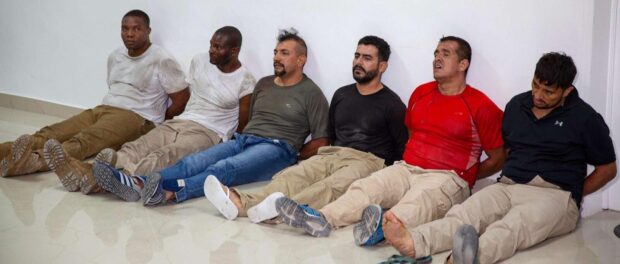
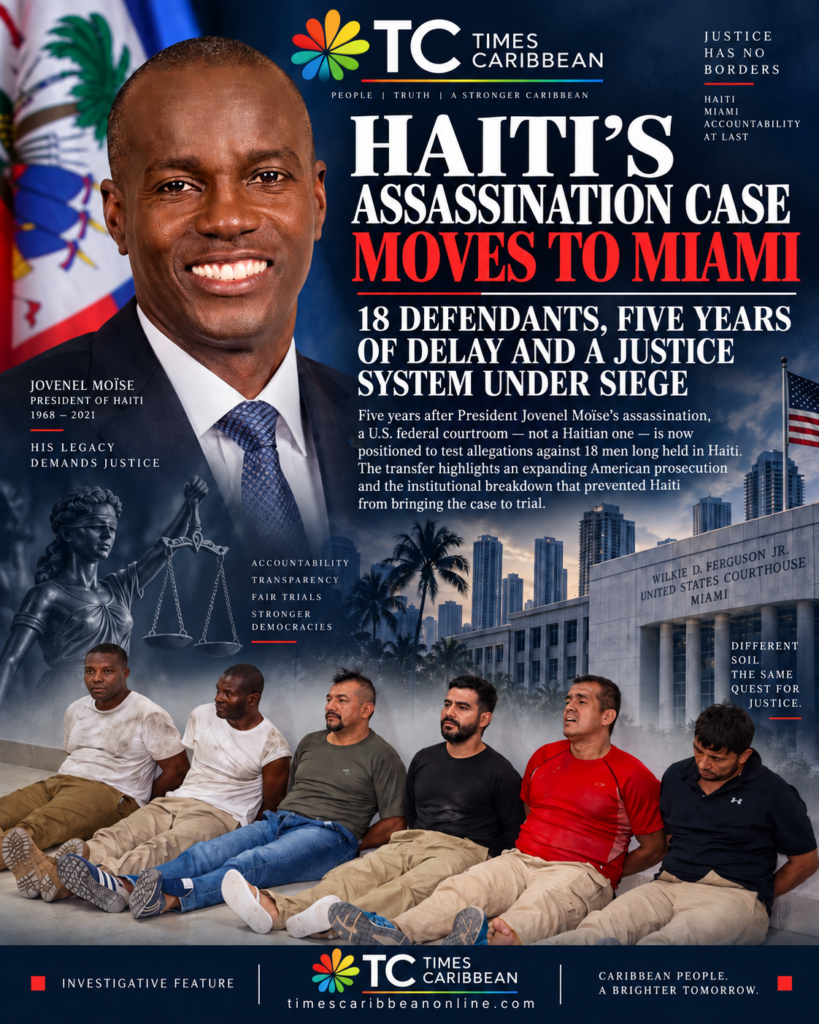
Five years after President Jovenel Moïse’s assassination, a U.S. federal courtroom — not a Haitian one — is now positioned to test the allegations against 18 men long held in Haiti. The transfer exposes two stories at once: an expanding American prosecution built around South Florida, and the extraordinary institutional breakdown that prevented Haiti from bringing one of the most consequential criminal cases in its modern history to trial.
TIMES CARIBBEAN INVESTIGATIVE FEATURE | HAITI / CARIBBEAN

MIAMI, Florida — They had spent years inside Haiti’s detention system waiting for a trial that never came.
Then, over a single weekend, everything changed.
Seventeen Colombian former soldiers and Joseph Félix Badio, a former Haitian Ministry of Justice employee who once worked with the country’s anti-corruption unit, were flown from Port-au-Prince to South Florida. On Monday, September 21, they appeared before U.S. Magistrate Judge Lisette Reid in Miami on federal charges connected to the July 2021 assassination of Haitian President Jovenel Moïse. Badio entered court in a wheelchair. The defendants were brought in groups, and many requested court-appointed attorneys through interpreters. (AP News)
They are accused, not convicted. The newly transferred defendants are entitled to the presumption of innocence, and the allegations against them must now be proved in federal court beyond a reasonable doubt. (Department of Justice)
But the significance of Monday’s hearing stretches far beyond the guilt or innocence of any individual defendant.
It forces an uncomfortable question.
How did the assassination of a sitting Caribbean president become a case in which American courts have moved faster toward judgments than the courts of the country where the president died?
And that question may ultimately tell us as much about the collapse of Haitian state institutions as the criminal case tells us about Moïse’s death.
AN EXTRAORDINARY TRANSFER
The operation that moved the defendants out of Haiti was itself a measure of the country’s security conditions.
The U.S. Justice Department said FBI Hostage Rescue Team personnel, FBI Miami investigators and Homeland Security Investigations agents participated in the mission aboard a military aircraft prepared for the possibility of armed disruption around Port-au-Prince’s airport. The 18 defendants were taken to Miami to face newly unsealed charges in an expanded federal prosecution that now names 30 defendants. (Department of Justice)
That detail matters.
This was not simply a case of U.S. authorities asking Haiti to hand over suspects in an ordinary cross-border criminal investigation. Haiti was transferring prisoners from one of the most politically sensitive cases in its history because its own proceedings had failed to produce a trial after more than five years.
Haitian Justice Minister Patrick Pelissier acknowledged precisely that contrast. In a government statement reported by Reuters, he said the American process had produced arrests, prosecutions and convictions, while Haiti’s case remained confronted by “major difficulties” and had still not reached trial. (Reuters)
Haiti said the defendants were surrendered so that proceedings could move forward in the United States. The countries also have a longstanding extradition convention dating to 1904; the treaty expressly identifies murder, including assassination, among extraditable crimes. (Office of the Historian)
But legality is only one dimension.
Politically and institutionally, the image is striking: men held for years over the assassination of Haiti’s president had to leave Haiti before their cases could reach a functioning trial court.
WHY MIAMI?
It would be misleading, however, to describe the federal prosecution as merely Washington stepping in because Haiti failed.
The United States claims its own direct jurisdictional interest.
Federal prosecutors allege that South Florida was a central location for the planning and financing of the operation against Moïse. The indictment includes allegations involving American financial institutions, U.S.-based conspirators, weapons and equipment, travel between Florida and Haiti, and money from federal pandemic-relief programs. (Department of Justice)
The latest indictment alleges an intertwined fraud and money-laundering scheme involving Paycheck Protection Program and other COVID-era business-relief funds. Prosecutors say money obtained from those programs was channelled into aspects of the operation. (Department of Justice)
That gives Miami something Haiti currently struggles to provide: not simply a courtroom, but financial records, electronic communications, cooperating witnesses, federal investigative capacity and enforceable U.S. criminal statutes tied to conduct prosecutors say occurred on American soil.
Among the principal federal counts are conspiracy to kill or kidnap a person outside the United States and providing material support for such a conspiracy resulting in death. Some defendants also face fraud, money-laundering, smuggling and export-related allegations. Certain counts carry potential life sentences upon conviction.
So Miami is not an accidental venue.
According to the government’s case, it is one of the places where the alleged conspiracy itself took shape.
FROM POLITICAL REMOVAL TO ASSASSINATION: THE PROSECUTION’S THEORY
The federal prosecution has gradually produced a much more detailed account of how authorities believe the operation evolved.
At the May 2026 trial of four earlier defendants, prosecutors presented evidence that a group operating across Haiti, Colombia and the United States initially explored several ways of removing Moïse from office. According to the Justice Department, plans discussed included abducting him, compelling him to resign and intercepting him following international travel.
Those plans changed.
Prosecutors told jurors that the group ultimately decided on an operation against Moïse at his residence and assembled former Colombian military personnel, Haitian associates, weapons, ammunition and tactical equipment. The government’s evidence included extensive digital communications and testimony from cooperating participants. (Department of Justice)
Four men — Arcangel Pretel Ortiz, Antonio Intriago, Walter Veintemilla and James Solages — were convicted by a Miami federal jury on May 8, 2026, following a lengthy trial. Other participants had previously entered guilty pleas. (Department of Justice)
The trial therefore established criminal liability for those particular defendants.
It did not establish guilt for the 18 men who arrived this week.
That distinction is critical.
Several of the Colombian detainees have maintained through lawyers over the years that they were recruited for what they believed was a different mission and were not fully informed of the ultimate plan. Those claims were never properly tested in Haiti because their cases never reached trial. They will now encounter a U.S. process in which prosecutors must establish each defendant’s knowledge, intent and conduct individually. (AP News)
For the accused as well as Moïse’s family and the Haitian public, getting to an actual trial is itself significant.
THE HAITIAN CASE DID NOT SIMPLY MOVE SLOWLY. IT KEPT BREAKING DOWN.
The history of Haiti’s investigation reads like a case study in what happens when a politically explosive criminal file collides with institutional collapse.
Investigating judges resigned or withdrew amid security fears. Judicial personnel faced threats. The principal courthouse in downtown Port-au-Prince was overtaken amid the expansion of armed groups. Proceedings were repeatedly relocated and postponed. Suspects remained incarcerated for years without trial. (AP News)
There was progress on paper.
In early 2024, investigating judge Walther Wesser Voltaire issued a sweeping order indicting more than 50 people. Among those named were former First Lady Martine Moïse, former Prime Minister Claude Joseph and former Haitian National Police chief Léon Charles. The allegations against those figures were disputed. (AP News)
But even that major development did not survive appellate review.
On October 13, 2025, Haiti’s Court of Appeal overturned the January 2024 investigative order and assigned another magistrate to restart the inquiry. The ruling effectively sent one of Haiti’s most important criminal investigations back for another round of judicial examination. (Digital Library)
Haitian officials subsequently sought assistance from the United States and Canada.
It was the third major investigative effort into Moïse’s assassination. (AP News)
Five years after the president’s death, Haiti still had not convened a criminal trial in the case.
THE PROBLEM IS BIGGER THAN THE MOÏSE FILE
It would be easy to treat the failed domestic prosecution as an exceptional breakdown caused by an unusually sensitive political case.
The evidence suggests something broader.
Human Rights Watch reported that only 241 people received criminal trials nationwide between October 2023 and October 2024, while major court buildings had been seized or rendered unusable and judicial activity had slowed dramatically. (Human Rights Watch)
A United Nations report covering early 2026 showed an equally severe problem inside Haiti’s prison system. As of April 8, Haiti had 7,551 inmates, of whom 6,262 — approximately 83 percent — were being held in pretrial detention. Prisons were operating at roughly 312 percent of intended capacity. (United Nations)
That statistic puts the Moïse defendants’ long detention into a larger national context.
Haiti’s justice crisis does not only deny victims timely accountability.
It also denies defendants timely adjudication.
Those are two sides of the same institutional failure.
A functioning criminal justice system is supposed to determine guilt or innocence. When cases remain suspended for years, neither the victim’s family nor the accused receives a final judicial determination.
GANG EXPANSION MADE AN ALREADY WEAK SYSTEM EVEN WEAKER
The assassination did not create all of Haiti’s problems. Political instability, weak institutions, corruption concerns, economic hardship and armed groups all predated July 2021.
But Moïse’s death removed the country’s elected head of state during an already fragile period. Reuters described the assassination as leaving a major political vacuum, after which armed groups expanded their influence. (Reuters)
The humanitarian numbers now illustrate the scale of that deterioration.
International Organization for Migration data recorded approximately 1.47 million internally displaced Haitians by May 2026. In June, the United Nations described Haiti as facing the Western Hemisphere’s most severe and rapidly deteriorating humanitarian crisis, with nearly 1.5 million people displaced. (IOM Data Tracking Matrix)
Courts cannot operate normally when judges cannot safely reach courthouses.
Evidence becomes harder to preserve.
Witnesses become harder to protect.
Police investigators are stretched across a national emergency.
Prisons themselves become security liabilities.
That is the environment in which the Moïse prosecution repeatedly stalled.
THE OTHER SIDE OF THE ACCOUNTABILITY STORY
Human-rights advocate Pierre Espérance has been sharply critical of what the transfer says about Haiti’s institutions, describing the inability of the domestic system to bring the case to trial as a disgrace for Haitian justice and arguing that the country needs institutions capable of handling major cases at home. (Reuters)
That criticism captures a genuine sovereignty problem.
A country normally expects to investigate and prosecute the assassination of its own president.
But sovereignty without functioning courts can become largely theoretical.
And there is another uncomfortable issue.
For the 17 Colombian former soldiers, years of detention without a completed trial also raised serious due-process questions. In January 2025, lawyers representing them went to court hoping to obtain their release. The hearing was postponed yet again. Attorneys had previously complained about detention conditions, while several defendants continued to dispute prosecutors’ characterization of what they knew before arriving in Haiti. (YouTube)
Miami therefore represents accountability in two directions.
The prosecution will finally have an opportunity to present its allegations before a trial court.
The defendants will finally have an opportunity to confront those allegations before judges operating inside a comparatively stable judicial system.
WHAT THE U.S. CASE MAY REVEAL
The expanded American prosecution could substantially deepen the public record.
Investigators now have a case touching multiple countries, financial transactions, travel records, encrypted communications, former military personnel, political aspirations, U.S.-based businesses and alleged pandemic-loan fraud.
And federal prosecutors have made clear that their inquiry is not limited to the men physically present during the final operation.
The Justice Department says it is examining those who allegedly financed, facilitated, supported or otherwise enabled the conspiracy. Its September indictment includes 30 defendants and says at least 22 newly named defendants were connected to financing, recruitment or logistical support. (Department of Justice)
That could matter greatly.
The central unanswered question around high-level political crimes is often not simply who was present, but who organized, financed and expected to benefit from the operation.
Those are precisely the areas the U.S. prosecution says it is examining.
But indictments remain allegations. The broader theory must be tested defendant by defendant.
WHAT MIAMI CANNOT DO
There is also a danger in treating a successful American prosecution as synonymous with a complete historical accounting of Moïse’s assassination.
A federal criminal trial has a narrower purpose.
It determines whether particular defendants committed particular violations of U.S. law.
It is not a truth commission.
It does not automatically answer every question about Haitian political institutions, the conduct of every security official, every alleged financial backer or every person who may have had knowledge before or after the assassination.
Nor does it repair Haiti’s courts.
Even a series of convictions in Miami would leave Haiti with the same institutional challenge that forced the transfers in the first place.
The country still needs judges who can work safely, functioning courthouses, credible investigations, usable prisons, witness protection, independent prosecutors and a justice system capable of bringing complex cases from arrest to judgment.
Without that, Haiti risks becoming dependent on foreign jurisdictions whenever crimes become too powerful, too political or too dangerous for its own institutions to handle.
A CARIBBEAN CASE WITH A CARIBBEAN WARNING
There is a wider regional lesson here.
Modern political and financial conspiracies do not respect borders.
Money may move through one jurisdiction. Planning may happen in another. Personnel may come from a third. The alleged operation against Moïse involved Haiti, South Florida and Colombian recruits, demonstrating how easily a national security crisis can become a transnational criminal investigation. (Department of Justice)
That means Caribbean governments need more than police capability.
They need resilient courts.
Reliable financial-intelligence systems.
Secure evidence management.
Independent prosecutors.
International legal cooperation.
And institutions strong enough to continue functioning when the defendant is powerful, the case politically sensitive or the security environment dangerous.
Haiti’s experience shows what happens when that chain fails.
FIVE YEARS LATER, THE CASE FINALLY ENTERS ANOTHER PHASE
The 18 men who entered federal court in Miami this week will now proceed through a legal system very different from the one in which they spent the previous five years.
Lawyers will be appointed.
Evidence will be disclosed and challenged.
Motions will be filed.
Witnesses may be cross-examined.
And eventually, unless cases are resolved through pleas or other legal proceedings, jurors may be asked to decide whether prosecutors have proved the charges beyond a reasonable doubt.
That is ordinary criminal procedure.
In this case, its ordinariness is what makes the moment extraordinary.
Five years after Jovenel Moïse’s assassination, Haiti has still not held a domestic trial over the crime. Its own Court of Appeal ordered the investigation restarted. Judges have faced insecurity. Court facilities have been lost. Most Haitian prisoners remain in pretrial detention. And the government ultimately surrendered 18 central defendants to another country so their cases could proceed. (Digital Library)
So the story unfolding in Miami is not simply about whether 18 men are guilty.
It is about where justice goes when the institutions responsible for delivering it can no longer reliably function.
The United States may now determine the criminal responsibility of many of the people accused of participating in the plot against Jovenel Moïse.
But the larger Haitian question remains unresolved:
Can the country rebuild a justice system strong enough that the next defining national case does not have to leave Haiti in order to reach a courtroom?
— TIMES CARIBBEAN INVESTIGATIVE DESK | September 22, 2026
















Leave a comment
You must be logged in to post a comment.