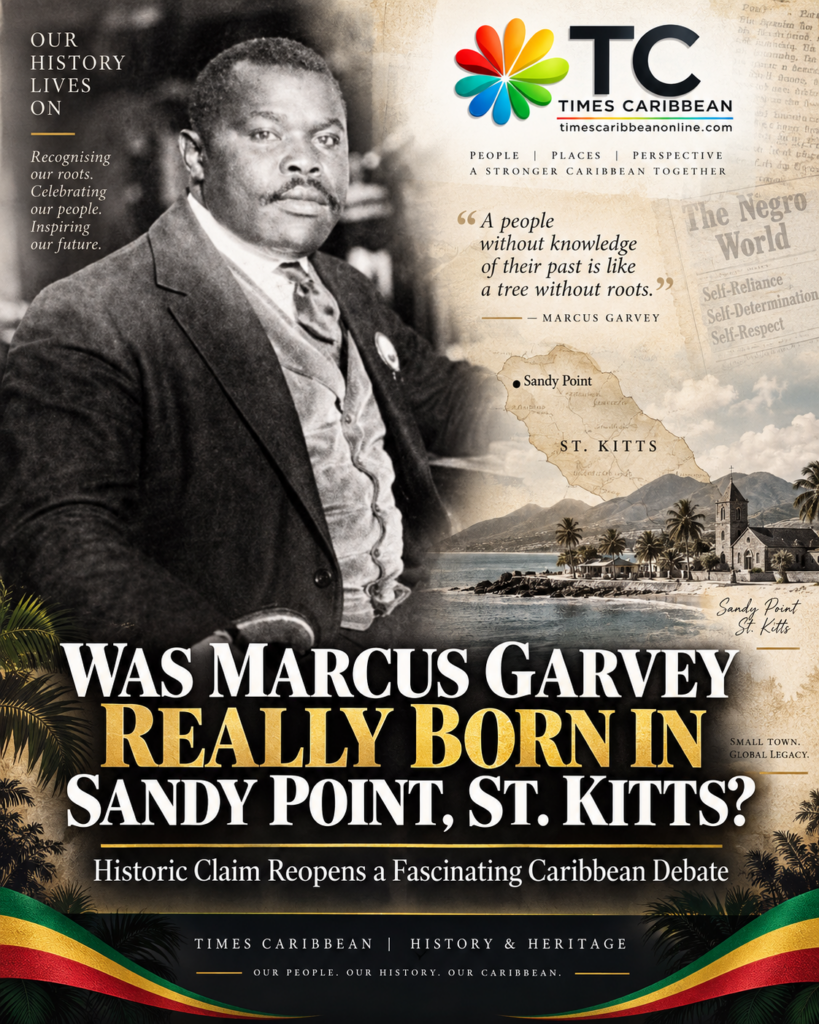
WAS MARCUS GARVEY REALLY BORN IN SANDY POINT, ST. KITTS? Historic Claim Reopens a Fascinating Caribbean Debate
TIMES CARIBBEAN | HISTORY & HERITAGE
A striking claim in a circulating video has revived one of the more intriguing questions surrounding Caribbean history: Was Marcus Mosiah Garvey, universally identified as Jamaica’s first National Hero, actually born in Sandy Point, St. Kitts?
The claim is not entirely new.
For years, a small but persistent body of local research in St. Kitts has argued that Garvey’s connection to Sandy Point went far deeper than his famous 1937 visit to the island. One published account even claims that the Pan-African leader was born at Garners Estate, Fig Tree, Sandy Point, under another name.
But that account runs directly against an extensive documentary tradition maintained by Jamaica’s principal heritage institutions, the United States National Archives, and the internationally recognised Marcus Garvey and Universal Negro Improvement Association Papers Project.
So what does the evidence actually show?
THE SANDY POINT CLAIM
One of the clearest published versions of the St. Kitts theory appeared in the May 15, 2020 edition of the St. Kitts-Nevis Observer, in an article titled Know More About Marcus Garvey by researcher Derrick Hazel.
Hazel presented a radically different genealogy.
According to his account, a child named John Joseph Warner Jr., whom he identified as the person later known as Marcus Mosiah Garvey Jr., was born on July 26, 1888 at Garners Estate, Fig Tree, St. Anne’s, Sandy Point, St. Kitts.
Hazel went further, writing that this was what was stated on a birth certificate.
The article also claimed that Garvey’s mother was Sariah Jane Richards-Woodley, connected to a Sandy Point family, and that she later travelled from St. Kitts to Jamaica with two children around 1900.
If authenticated, that would represent a dramatic rewriting of Garvey’s accepted biography.
There is another undeniable fact behind the local interest: Garvey had significant connections with St. Kitts and Sandy Point.
He visited St. Kitts in 1937, and historical material from Historic St. Kitts confirms that arrangements were being made for him to speak on the island that year.
The modern Government of St. Kitts and Nevis has also commemorated Garvey’s arrival at Pump Bay, Sandy Point, where a marker was unveiled in 2025 in the presence of his son, Dr. Julius Garvey.
St. Kitts was no stranger to Garveyism either. The published Marcus Garvey and UNIA Papers document an active movement in the Leeward Islands and specifically record UNIA-associated activity involving residents of Sandy Point and St. Kitts.
So the St. Kitts connection is genuine.
The disputed issue is birthplace.
THE DOCUMENTARY CASE FOR JAMAICA
Here the evidence becomes considerably stronger.
The National Library of Jamaica states that Marcus Garvey was born in St. Ann’s Bay on August 17, 1887. Its digital collection specifically identifies 32 Market Street, St. Ann’s Bay as Garvey’s birthplace.
The Jamaica Information Service, the government’s official information service, gives the same date and location and identifies his parents as Marcus Garvey and Sarah Richards.
The Jamaica National Heritage Trust goes even further. It formally recognises 32 Market Street as Garvey’s birthplace and records that he was born there on August 17, 1887. The site itself has been officially declared a Jamaican historic site.
And this is not simply a Jamaican national tradition.
The United States National Archives records Marcus Mosiah Garvey Jr. as having been born on August 17, 1887 in Saint Ann’s Bay, Jamaica, identifying his father as a stonemason and his mother as a domestic servant.
Perhaps even more significant is the Marcus Garvey and UNIA Papers Project at UCLA, one of the world’s major scholarly repositories devoted to Garvey’s life and movement.
Its biographical fact sheet identifies his parents as Malcus (“Marcus”) Mosiah Garvey and Sarah Jane Richards and gives his birthplace as St. Ann’s Bay, Jamaica, on August 17, 1887.
PBS’s detailed Garvey chronology, based substantially on scholarship associated with the Garvey Papers Project, says the same thing. It also records Garvey beginning an apprenticeship in St. Ann’s Bay around 1900.
That timeline creates an important difficulty for the Sandy Point version.
The St. Kitts theory published in 2020 says the young Garvey travelled from St. Kitts to Jamaica around 1900. The established scholarly chronology instead places him already growing up and beginning his printing apprenticeship in St. Ann’s Bay at approximately that time.
TWO COMPLETELY DIFFERENT IDENTITIES
There is an even bigger historical problem.
The two accounts are not merely arguing over whether the same baby was delivered in St. Kitts or Jamaica.
They provide substantially different biographical identities.
The internationally accepted record gives:
Marcus/Malcus Mosiah Garvey Jr.
Born: August 17, 1887
Place: St. Ann’s Bay, Jamaica
Parents: Malcus/Malchus Garvey and Sarah Jane Richards
The Sandy Point theory published by Hazel proposes:
John Joseph Warner Jr., later known as Marcus Mosiah Garvey Jr.
Born: July 26, 1888
Place: Garners Estate, Fig Tree, Sandy Point, St. Kitts
That is an eleven-month difference in birth dates, a different father, a different original surname and a different country of birth.
Such extraordinary differences require exceptionally strong primary documentation.
WHAT WOULD SETTLE THE QUESTION?
The most important missing element is straightforward: the original or officially certified St. Kitts civil-registration document said to identify John Joseph Warner Jr. as the future Marcus Garvey needs to be independently authenticated and linked conclusively to the historical Marcus Garvey.
Publishing an image of a certificate would be only the beginning.
Researchers would need to establish its registration number, archival provenance, parents, subsequent records, migration trail, name change and documentary continuity showing that John Joseph Warner Jr. and Marcus Mosiah Garvey were unquestionably the same individual.
That chain of evidence would then have to be reconciled with Jamaican records and more than a century of Garvey scholarship.
Based on the publicly accessible material reviewed for this article, that evidentiary chain has not yet been demonstrated.
SO — WAS MARCUS GARVEY BORN IN SANDY POINT?
The fairest historical assessment today is this:
There is a documented Sandy Point claim, and it deserves to be recorded and investigated rather than simply dismissed. But the overwhelming weight of presently accessible institutional and scholarly evidence identifies Marcus Mosiah Garvey as having been born on August 17, 1887 at St. Ann’s Bay, Jamaica.
That makes St. Ann’s Bay the established birthplace unless stronger primary evidence emerges.
Yet Sandy Point’s place in the Garvey story should not be understated.
Garvey came to St. Kitts. His movement had followers here. Sandy Point played a part in that history. Local researchers have also advanced claims of deeper family connections that could merit serious genealogical investigation.
And that may be where the real historical opportunity lies.
Rather than turning the question into a Jamaica-versus-St. Kitts dispute, historians could undertake a joint archival investigation involving Jamaican civil records, St. Kitts church and civil registers, estate records, Garvey family papers and the UCLA Marcus Garvey Papers collection.
If an authentic nineteenth-century Sandy Point record exists that can be conclusively connected to Marcus Garvey, it would be an extraordinary Caribbean historical discovery.
Until then, Marcus Garvey’s St. Kitts connection is historically significant — but a Sandy Point birthplace remains an intriguing, disputed claim rather than an established historical fact.
TIMES CARIBBEAN
Preserving Caribbean history. Questioning carefully. Following the evidence.
















Leave a comment
You must be logged in to post a comment.