2026 U.S. VISITOR VISA DATA: DOMINICAN REPUBLIC TOPS CARIBBEAN WITH MORE THAN 20,000 B1/B2 VISAS ISSUED IN FIRST TWO PUBLISHED MONTHS: Jamaica, Trinidad and Tobago, Guyana and The Bahamas also rank among the region’s leading recipients as new U.S. visa figures come under the microscope.
TIMES CARIBBEAN SPECIAL REPORT | IMMIGRATION & TRAVEL
BASSETERRE, ST. KITTS — Thousands of Caribbean nationals received new United States visitor visas during the opening months of 2026, with the Dominican Republic, Jamaica, Trinidad and Tobago, Guyana and The Bahamas recording some of the largest numbers in the region.
But there is an important catch.
A Times Caribbean review of the U.S. Department of State’s official Nonimmigrant Visa Issuance Statistics found that, as of September 15, 2026, the Department’s public FY2026 monthly database currently provides nationality-level figures only through February 2026. March, April, May and June figures are not presently listed on the official monthly statistics page. That means a verified January-to-June “first-half” total cannot yet responsibly be published from the State Department dataset.
The figures below therefore represent January and February 2026 only, not the entire first six months.
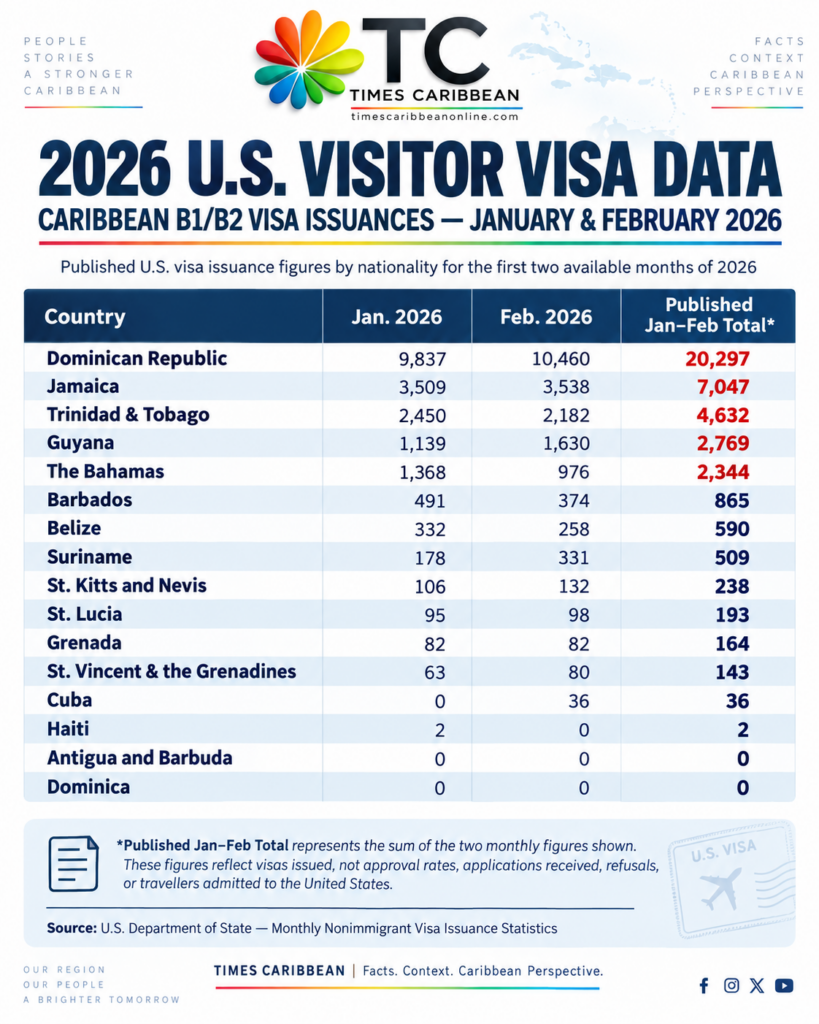
CARIBBEAN B-VISA ISSUANCES — JANUARY & FEBRUARY 2026
For this analysis, Times Caribbean counted visitor visas appearing under the B1, B2 and combined B1/B2 classifications. The vast majority are issued in the combined B1/B2 category.
*These are arithmetic sums of the published monthly figures, not an official State Department fiscal-year-to-date total.
The scale of the Dominican Republic’s numbers is striking. The State Department recorded 9,814 combined B1/B2 visas plus 23 standalone B1 visas in January, followed by 10,434 B1/B2 visas, 25 B1 visas and one B2 visa in February.
Jamaica was a distant second but still recorded significant demand. January produced 3,500 combined B1/B2 visas, eight B1 visas and one B2 visa. February brought another 3,527 combined B1/B2 visas, nine B1 visas and two B2 visas — approximately 7,047 visitor visas across the two published months.
Trinidad and Tobago followed with approximately 4,632, while Guyana recorded approximately 2,769. Trinidad alone received 2,449 combined B1/B2 visas in January and another 2,182 in February.
ST. KITTS AND NEVIS OUTPACED SEVERAL OECS NEIGHBOURS
For St. Kitts and Nevis, the official figures show 106 B1/B2 visas issued in January and 132 in February, giving an indicative two-month total of 238.
That was higher than St. Lucia’s approximately 193 and St. Vincent and the Grenadines’ approximately 143 during the same period. Grenada recorded 164.
The numbers are noteworthy because the Federation has a much smaller population than several of those countries. They should not, however, be interpreted as an approval rate: issuance totals tell us how many visas were issued, not how many people applied or were refused.
WHY ANTIGUA, DOMINICA, HAITI AND CUBA LOOK SO DIFFERENT
The near-zero figures for several Caribbean countries cannot be understood without looking at major U.S. policy changes that took effect at the beginning of 2026.
Effective January 1, the United States fully suspended most visa issuance to Haitian nationals, subject to limited exceptions. The same policy partially suspended B1/B2 visitor-visa issuance for nationals of Antigua and Barbuda, Cuba and Dominica, again subject to specified exceptions and waivers.
That policy shift helps explain why Antigua and Barbuda and Dominica show no ordinary B-category visitor visas in the January and February nationality tables, while Haiti recorded only two B-category issuances in January and none in February. Cuba recorded no B-category visas in January, while February included 36 standalone B1 issuances, which may reflect permitted exceptions or cases processed under the applicable rules.
There was another policy development. The State Department’s 2026 visa-bond programme included several countries relevant to the Caribbean, including Antigua and Barbuda, Cuba and Dominica from January 21, with Grenada added from April 2.
THE NUMBERS REQUIRE CAREFUL READING
The Department of State itself cautions that its monthly nonimmigrant visa statistics are preliminary and subject to change. It also warns that monthly reports beginning with FY2020 should not simply be treated as final fiscal-year cumulative totals because application statuses can be updated as the fiscal year progresses.
So these figures do not mean that 238 St. Kitts and Nevis citizens travelled to the United States in January and February. They mean that approximately 238 B-category visas were recorded as issued to persons of St. Kitts and Nevis nationality during those monthly reporting periods.
Nor do the figures reveal rejection rates. To determine which Caribbean country had the “best chance” of obtaining a U.S. visa, researchers would also need application and refusal data.
THE BIG PICTURE
Even with only two months officially available, the differences across the Caribbean are dramatic.
The Dominican Republic recorded more than 20,000 B-category issuances in January and February alone. Jamaica exceeded 7,000. Trinidad and Tobago surpassed 4,600, and Guyana approached 2,800.
At the smaller-country level, St. Kitts and Nevis recorded 238, St. Lucia 193, Grenada 164 and St. Vincent and the Grenadines 143.
But Times Caribbean cannot credibly label any of those figures a “first half of 2026 total.”
The official State Department page currently stops at February.
Until the March-to-June nationality statistics are published or otherwise officially released, any article claiming precise January-to-June totals for every Caribbean country would need another verifiable government dataset — or would risk presenting estimates as fact.
TIMES CARIBBEAN will update the regional ranking when the remaining official 2026 monthly data become available.
U.S. Department of State Monthly Nonimmigrant Visa Statistics
















Leave a comment
You must be logged in to post a comment.