CHRISTOPHE HARBOUR AND THE SOVEREIGNTY QUESTION: DID ST. KITTS GIVE AWAY TOO MUCH FOR TOO LITTLE RETURN?MILLIONS IN BANK DEBT, DECADES OF CONCESSIONS AND A MARINA SALE THAT DEMANDS ANSWERS
TIMES CARIBBEAN COMMENTARY
CHRISTOPHE HARBOUR AND THE SOVEREIGNTY QUESTION: WHEN DOES A DEVELOPMENT BECOME TOO POWERFUL FOR THE STATE THAT CREATED IT?
BASSETERRE, ST. KITTS — The deeper one examines the Christophe Harbour story, the harder it becomes to treat it as simply another tourism investment gone off course.
This is a sovereignty story.
Not sovereignty in the ceremonial sense. Not flags, Parliament or Independence Day speeches. This is about practical sovereignty — whether the State can tax, regulate, enforce, recover public money and protect national assets when confronted by a development carrying enormous contractual, financial and political leverage.
And that is where the Christophe Harbour debate becomes deeply uncomfortable.
The 2007 development agreement already reveals an extraordinary arrangement. It established a special Resort District, granted far-reaching concessions, created expedited approval mechanisms and provided protections extending across taxation, land ownership, employment, utilities, environmental regulation and development control. In certain circumstances, the agreement even provided that its terms and associated documents would prevail over conflicting laws applicable to the project.
That was powerful enough.
But critics now argue that what followed financially may be even more revealing.
THE DEBT QUESTION CANNOT BE IGNORED
At the centre of the controversy are substantial loans reportedly advanced by the St. Kitts-Nevis-Anguilla National Bank — including figures publicly discussed as approximately US$16 million and US$6 million.
Those are not ordinary commercial numbers in a federation of roughly 50,000 people.
National Bank is not some distant Wall Street institution. Its financial health matters directly to St. Kitts and Nevis.
So when a development benefiting from some of the most extensive concessions ever granted in the Federation reportedly becomes heavily indebted to a nationally significant financial institution, the matter stops being a private disagreement between banker and borrower.
It becomes a national issue.
Under the former Team Unity administration, National Bank pursued foreclosure proceedings connected to the Christophe Harbour debt. Public commentary surrounding those proceedings placed the claimed exposure at tens of millions of Eastern Caribbean dollars, with higher estimates once accumulated interest and other liabilities were considered.
Christophe Harbour resisted.
Lawyers became involved.
Proceedings dragged on.
And the central question became brutally simple:
Would National Bank eventually recover the money or enforce against the security?
THEN THE POLITICAL LANDSCAPE CHANGED
The St. Kitts-Nevis Labour Party returned to office in August 2022.
Subsequently, the foreclosure litigation was discontinued.
That sequence has inevitably raised questions.
There is no basis, without documentary evidence, to claim that the Government ordered National Bank to abandon the litigation or that political interference occurred. Any such allegation would require proof.
But the public is still entitled to ask why litigation involving substantial sums and assets of national significance was discontinued.
What settlement was reached?
How much was paid?
How much remained outstanding?
What security was released?
What did National Bank receive in return?
Who approved the settlement?
And was the final arrangement commercially superior to continuing foreclosure proceedings?
These are not partisan questions.
They are banking-governance questions.
If National Bank voluntarily concluded that settlement was financially preferable, the public record should be capable of demonstrating that.
If the debt remains substantially unresolved, taxpayers, shareholders and depositors deserve to know that too.
THE MARINA SALE CHANGED EVERYTHING
Then came another major development.
In May 2025, the Christophe Harbour marina changed hands in a transaction involving international marina operator Safe Harbor Marinas.
That sale matters because the marina was not some peripheral piece of the project.
It was Christophe Harbour’s signature asset.
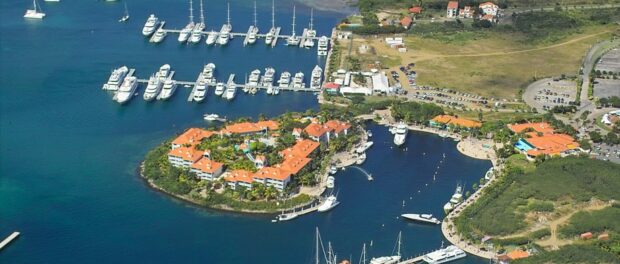
The marina represented the physical centrepiece of the original vision: luxury yachts, high-net-worth visitors, customs and immigration facilities, waterfront real estate and the ambition to establish St. Kitts as a premier Caribbean yachting destination.
The original development agreement gave the resort sweeping marina-related concessions, including favourable treatment on imported materials, fuel and vessels and commitments surrounding Customs and Immigration services.
So when that premier asset was ultimately monetised, a legitimate national question followed:
Where did the money go?
The current administration publicly highlighted approximately EC$25 million reportedly secured in connection with outstanding property taxes, stamp duties and other obligations associated with the transaction.
Recovering EC$25 million for the Treasury is not insignificant.
Government should receive credit for recovering public revenue where it is legally owed.
But that cannot automatically close the discussion.
If substantial National Bank liabilities remained unresolved when the marina was sold, the key question is whether proceeds from monetising one of Christophe Harbour’s most valuable assets were applied adequately to those liabilities.
That is where critics see the imbalance.
A developer benefits from extraordinary concessions.
Publicly connected financing assists development.
The project’s premier asset appreciates or becomes commercially saleable.
That asset is sold to a major international operator.
Government receives tax payments.
But if substantial bank debt remains behind, then the public deserves a detailed explanation of the total transaction.
Tax clearance is not necessarily debt settlement.
Those are two different things.
THIS IS WHERE “STATE WITHIN A STATE” STOPS SOUNDING LIKE RHETORIC
Nobody should interpret the phrase “state within a state” literally.
Christophe Harbour does not possess constitutional sovereignty.
It cannot make national foreign policy.
It does not control Parliament.
It cannot issue national currency.
But practical power is not always constitutional power.
Economic leverage can matter enormously.
The development agreement itself created a special regulatory environment.
Government committed to expedited approvals, and certain applications could be deemed approved when decisions were not issued within prescribed periods.
A Strategic Environmental Assessment could similarly become deemed approved if Government failed to issue a written decision within 45 days.
The agreement contemplated extensive tax exemptions lasting until 20 years after the second hotel opened, subject to contractual extensions.
Foreign purchasers received significant Aliens Land Holding concessions.
Expatriate employees and key personnel benefited from specially protected work-permit arrangements.
And the Government committed itself to an agreement binding upon successors and assigns.
None of those provisions independently eliminates sovereignty.
Together, however, they demonstrate something unmistakable:
the State deliberately surrendered significant policy flexibility in exchange for promised investment.
That was the bargain.
The real debate now is whether St. Kitts and Nevis received enough in return.
THE US$17 BILLION PROMISE MUST NOW FACE REALITY
The original agreement recorded projections of more than US$17 billion in tax and economic benefits over approximately 20 years.
That projection justified enormous optimism.
It also helped justify extraordinary concessions.
Nearly two decades later, citizens should not be expected to judge the development by projections.
They should judge it by outcomes.
Where is the US$17 billion economic activity?
How many hotels were completed?
How many permanent Federation jobs materialised?
How many local contractors became major players?
How much corporate tax was collected?
How much customs revenue was waived?
How much land appreciation accrued privately?
How much National Bank financing was recovered?
How much remains outstanding?
What was the total CBI-related value generated?
Those numbers should exist.
If Christophe Harbour ultimately produced enormous net value for St. Kitts and Nevis, publish the evidence.
That would settle much of the argument.
If it did not, then policymakers should also admit what failed.
THE REAL SOVEREIGNTY TEST IS ENFORCEMENT
This is the point too often missed.
A country can possess every legal power imaginable and still fail to exercise practical sovereignty.
Government may legally possess taxation authority.
But if concessions prevent its use, that authority has been contractually constrained.
Government may possess regulatory authority.
But if approvals are heavily predetermined, expedited or deemed granted, discretion is reduced.
Government may control a major financial institution.
But if a large borrower receives different treatment from an ordinary citizen or small business, public confidence suffers.
Government may possess foreclosure rights.
But rights that are never exercised are economically meaningless.
That is why this story goes beyond Christophe Harbour.
It is about the relationship between capital and the Caribbean state.
Small island economies desperately need investment.
That reality gives large investors enormous negotiating power.
Governments worry that if they demand too much, capital will go elsewhere.
Developers know it.
Lenders know it.
Governments know it.
And eventually entire national policies can become structured around keeping one investment alive.
That is how economic dependency can quietly become political leverage.
CHRISTOPHE HARBOUR VS. DESTINY: THERE IS A FUNDAMENTAL DIFFERENCE
The ongoing comparison with the proposed Destiny development should therefore be approached carefully.
Whatever concerns citizens may legitimately have about Destiny, one major distinction deserves emphasis.
Private landowners generally retain the choice to negotiate, sell or refuse to sell.
Christophe Harbour’s history includes land that Government itself acquired compulsorily.
The 2007 agreement confirms arrangements for Government-acquired parcels at Major’s Bay, Priddies Plateau and Black Coral/Little Salt Pond to be transferred into the development.
That means State power was directly involved.
Government was not merely regulating a transaction between private parties.
The State used public authority, facilitated land transfers and then created an extraordinary concessionary framework around the resulting mega-development.
That distinction matters profoundly.
WHAT ST. KITTS AND NEVIS NEEDS NOW IS DISCLOSURE
The public debate does not require conspiracy theories.
It requires documents.
National Bank should, within applicable banking and confidentiality rules, provide the fullest legally permissible explanation of the status of the Christophe Harbour loans and litigation.
Government should publish the fiscal consequences of the marina sale.
The current legal status of the Development Agreement should be explained.
Citizens should know whether amendments were subsequently signed.
The status of the Exemption Period should be disclosed.
Government should explain how much revenue has been generated — and how much was forgone.
And Parliament should consider whether future mega-development agreements should ever again provide such sweeping long-term guarantees without stronger periodic review provisions.
Because the core lesson is bigger than Christophe Harbour.
Investment must never become dependency.
A serious government welcomes capital.
It protects investors.
It honours lawful contracts.
But it must also protect the public balance sheet, preserve regulatory authority and ensure that citizens remain the ultimate beneficiaries of national development.
The defining question is therefore no longer whether Christophe Harbour was ambitious.
It certainly was.
The question is whether, somewhere between compulsory land acquisition, unprecedented concessions, major bank financing, protracted litigation and the eventual sale of its signature marina asset, St. Kitts and Nevis stopped behaving principally as regulator and sovereign — and began carrying too much of the risk of its own investor.
That question deserves an answer.
And this time, not another promise.
Show the country the accounts.
















Leave a comment
You must be logged in to post a comment.