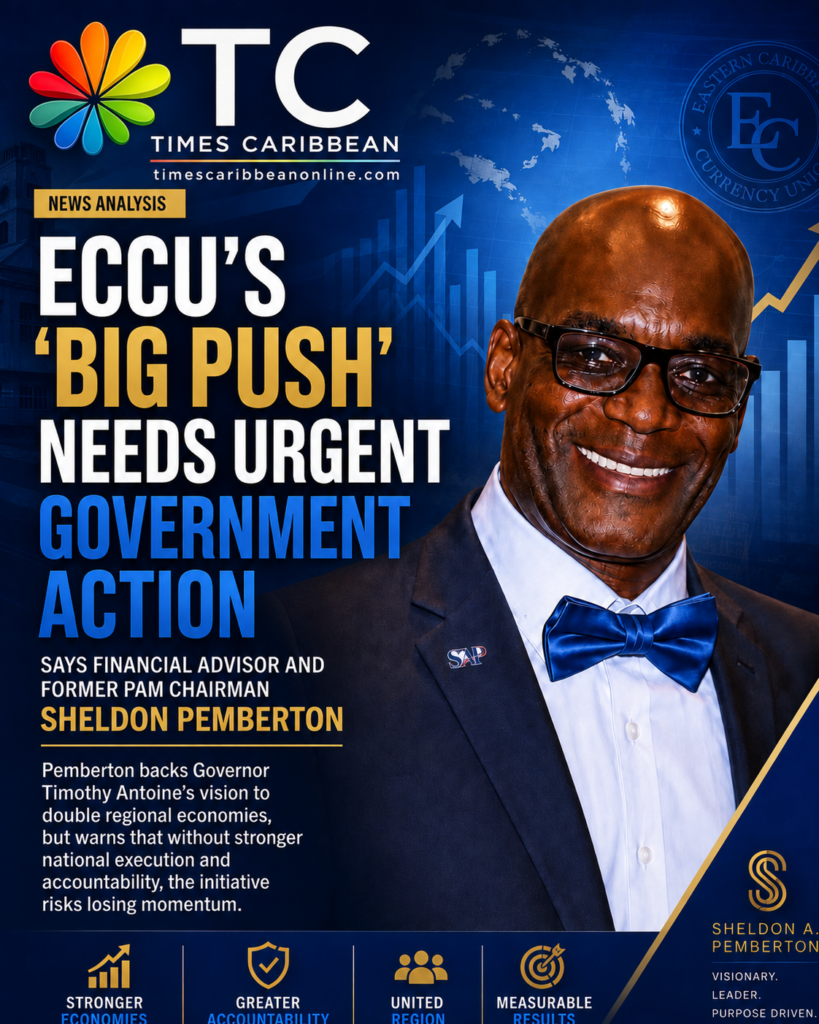
ECCU’S ‘BIG PUSH’ NEEDS URGENT GOVERNMENT ACTION, SAYS FINANCIAL ADVISOR SHELDON PEMBERTON

Pemberton backs Governor Timothy Antoine’s vision to double regional economies, but warns that without stronger national execution and accountability, the initiative risks losing momentum
BASSETERRE, ST. KITTS — Financial Advisor and Innovative Thinker Sheldon A. Pemberton has thrown his full support behind Eastern Caribbean Central Bank Governor Timothy Antoine’s “Big Push” vision, while issuing a strong call for governments across the Eastern Caribbean Currency Union to move faster from ambition to measurable action.
In an independent commentary, Pemberton described the initiative as exactly the kind of bold economic thinking the region needs, particularly as small island states confront limited domestic markets, fragmented economies and persistent development challenges. The central objective of the Big Push, as outlined in the commentary, is to double the size of ECCU economies over the next decade, a goal Pemberton says will require sustained growth and a fundamental rethink of the region’s development model.
But he argues that the vision has not yet been embraced with sufficient urgency.
According to Pemberton, although the initiative was launched approximately three years ago, ECCU member governments have not yet demonstrated the level of adaptability, collective determination and aggressive execution necessary to convert the concept into widespread economic transformation. He stressed that this should not be interpreted as criticism of Governor Antoine, but rather as a challenge to regional governments to take greater ownership of the agenda.
Pemberton’s central argument is that the Big Push cannot remain primarily an ECCB-driven initiative.
He says it must become a national development imperative, embedded across government policy, financial institutions, private-sector investment, education, entrepreneurship and household economic decision-making.
That distinction is important.
The ECCB can articulate a regional vision, establish monetary stability and encourage reform, but the actual transformation of economies depends heavily on what national governments, businesses, investors and citizens do with that vision.
Pemberton also challenges what he describes as a long-standing tendency in the Caribbean to allow the region’s small size to limit the scale of its ambition.
“Our populations may be small. Our landmass may be limited. Our markets may be fragmented. But our ambitions should never be,” the commentary argues.
For Pemberton, the Big Push is therefore about more than achieving a headline GDP target. He frames it as a change in economic mindset — one requiring governments, institutions, investors, businesses and ordinary citizens to move away from incrementalism and toward transformational action.
Among the major areas identified for transformation are wealth creation, expanded credit, food and nutrition security, tourism, energy security, digital transformation and human-capital development. Pemberton says each ECCU member state must now adapt those pillars to its own national circumstances and move decisively toward implementation.
One area he places particular emphasis on is wealth creation.
Pemberton argues that economic expansion means little if it does not translate into greater ownership, opportunity and prosperity for ordinary citizens. He says the region must produce more entrepreneurs, investors, homeowners, innovators and globally competitive businesses if the Big Push is to have genuine social and economic meaning.
His sharpest criticism is directed at the pace of implementation.
With the initiative now several years old, Pemberton says the key question should no longer be whether the Big Push is achievable, but why the region has not moved more aggressively to achieve it.
To address that gap, he proposes a formal accountability mechanism.
Pemberton is calling on ECCU Heads of Government to establish an annual Big Push progress report, publicly reviewed alongside the ECCB’s own assessment, with each member state measured against the Governor’s transformation pillars.
Without such a structure, he warns, there is a real danger that the initiative could become a vision that is repeatedly praised but never fully executed.
“Accountability, not just applause, is what will convert ambition into measurable transformation,” the commentary states.
Pemberton concludes that Governor Antoine’s Big Push should be seen as a challenge to rethink the economic future of the Eastern Caribbean, not simply manage existing limitations.
His message is concise but pointed:
Small islands. Big ambitions. Bigger possibilities.
And in his view, the region has already spent enough time discussing transformation.
Now comes the harder part — adoption, adaptation and action.
— TIMES CARIBBEAN
















Leave a comment
You must be logged in to post a comment.