THE LEGAL FORCE BEHIND PETRONA THOMAS’ LANDMARK WIN: SHARI-ANN WALKER LEADS FORMIDABLE FOSTERS TEAM TO SWEEPING HIGH COURT VICTORY
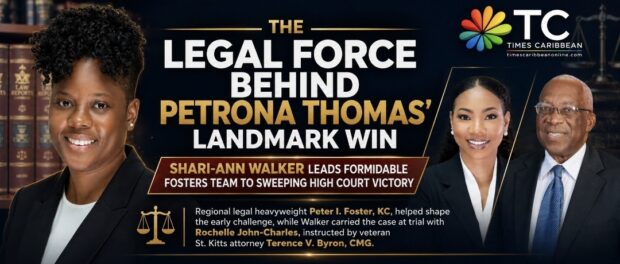
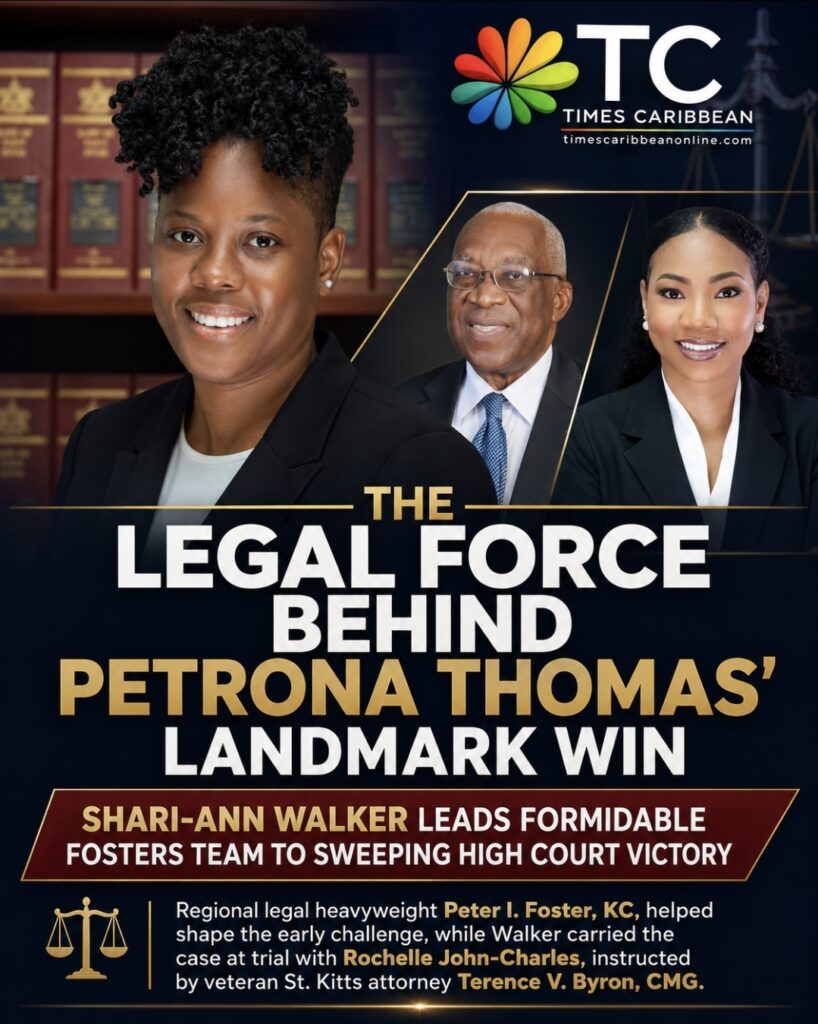
Regional legal heavyweight Peter I. Foster, KC, helped shape the early challenge, while Walker carried the case at trial with Rochelle John-Charles, instructed by veteran St. Kitts attorney Terence V. Byron, CMG
BASSETERRE, ST. KITTS, August 5, 2026 — Times Caribbean
Behind Petrona Thomas’ stunning High Court victory stood a formidable regional legal team that combined experience, constitutional expertise, disciplined research and forceful courtroom advocacy.
The judgment has already attracted widespread attention for Justice Tamara Gill’s finding that “vindictiveness and heavy-handedness have been proved.”
But the legal strategy that produced those findings deserves its own spotlight.
Thomas was represented at trial by Senior Associate Shari-Ann Walker, appearing with Senior Associate Mrs. Rochelle John-Charles, both of the Saint Lucia-based law firm FOSTERS. They were instructed by highly respected local senior attorney Terence V. Byron, CMG.
The appearances recorded on the first page of the judgment confirm that Walker and John-Charles appeared for Thomas under Byron’s instruction.
It was an impressive Caribbean legal alliance.
And it delivered.
WALKER TAKES THE LEAD
Although FOSTERS Head of Firm Peter I. Foster, KC, reportedly became involved during the early stages and initially wrote to the Government on Thomas’ behalf, it was Walker who led the claimant’s case during the High Court proceedings.
She was handed a difficult brief.
Thomas was challenging the actions of two major public-service authorities: the Public Service Commission and the Chief Personnel Officer.
The case required Walker to navigate constitutional law, administrative law, procedural fairness, public-service regulations, questions of institutional independence and the difficult legal distinction between an ordinary transfer, a demotion and removal from substantive office.
She did not merely argue that Thomas had been treated unfairly.
The claimant’s legal team constructed a detailed case showing how the chronology of letters, leave directions, PSC records, missing contemporaneous reasons and the reduction in Thomas’ responsibilities combined to produce an unlawful result.
The Court accepted the central pillars of that case.
Justice Gill declared Thomas’ transfer wrongful, unlawful, irrational, procedurally irregular, unfair, in breach of natural justice and void and of no effect.
The judge also found that the PSC abdicated its constitutional responsibility, that the Chief Personnel Officer purported to act for the Commission and that Thomas had suffered an unlawful demotion tantamount to removal from office.
That was no narrow technical success.
It was a sweeping legal victory.
A RISING REGIONAL LITIGATOR
Walker is listed by FOSTERS as a Senior Associate who joined the firm in 2022.
She earned her law degree from the University of the West Indies, Cave Hill Campus, and her Legal Education Certificate from the Norman Manley Law School. Her professional background includes civil, corporate and commercial litigation, employment law and intellectual-property matters.
She was called to the Bar in Barbados in 2016, Saint Lucia in 2022 and St. Kitts and Nevis in 2024.
In the Thomas case, Walker’s courtroom performance placed those skills squarely on display.
The arguments required the Court to look beyond the Government’s formal description of a “transfer” and examine what had actually happened.
The judgment ultimately accepted that Thomas’ move from supervising a major purchasing unit with broad national responsibilities to a substantially narrower logistics position amounted to a material reduction in status, responsibility and professional standing.
That conclusion reflected the legal team’s insistence that the Court examine substance—not simply labels, paperwork or salary bands.
Sharp argument.
Powerful result.
ROCHELLE JOHN-CHARLES BRINGS CONSTITUTIONAL DEPTH
Walker was ably supported by fellow FOSTERS Senior Associate Rochelle R. John-Charles.
John-Charles brings more than a decade of experience in constitutional, civil and appellate litigation. Her professional background includes service as Crown Counsel in Saint Lucia and as a Judicial Research Assistant at the Eastern Caribbean Court of Appeal.
Her profile also reflects experience in judicial review, human-rights litigation, public procurement, public international law and complex constitutional proceedings.
Those areas were directly relevant to the issues before the High Court.
The Thomas claim required a careful examination of the constitutional division of authority between the Public Service Commission and the Chief Personnel Officer.
It also required the team to demonstrate why administrative convenience could not override the Commission’s duty to exercise independent judgment.
Justice Gill ultimately found, on the evidence, that the PSC had failed to demonstrate that independence in Thomas’ transfer.
PETER I. FOSTER, KC: THE LEGAL HEAVYWEIGHT BEHIND FOSTERS
The team operated under a firm headed by one of Saint Lucia’s most prominent lawyers, Peter I. Foster, KC.
Foster founded the practice in 1988 and remains its Head of Firm. His published professional profile describes him as a leading civil and commercial litigator with extensive experience before the High Court, Court of Appeal and Judicial Committee of the Privy Council.
He is also a former Speaker of Saint Lucia’s House of Assembly, a role independently reflected in official Saint Lucia Government records.
Foster currently serves as a Justice of Appeal on Belize’s Court of Appeal. Belize Judiciary records and recent appellate judgments identify him as Justice Peter Foster, KC.
According to information supplied to Times Caribbean, Foster personally became involved at the correspondence stage and wrote to the Government on Thomas’ behalf before the matter proceeded to full litigation.
That early intervention, followed by Walker’s trial advocacy and John-Charles’ support, reflects the depth available within the FOSTERS team.
The firm currently lists Foster as Head of Firm and both Walker and John-Charles as Senior Associates.
TERENCE V. BYRON, CMG: 54 YEARS OF LEGAL EXPERIENCE
The regional team was instructed locally by Terence V. Byron, CMG, one of St. Kitts and Nevis’ longest-serving and most experienced attorneys.
Byron was called to the Bar of England and Wales in July 1972 and admitted in St. Kitts and Nevis later that year. That places his professional career at the remarkable 54-year mark in 2026.
His published biography records decades of civil litigation experience, appearances before every level of court in St. Kitts and Nevis and involvement in several matters reaching the Judicial Committee of the Privy Council.
He has also served on several occasions as Acting Attorney General of St. Kitts and Nevis and was awarded the CMG for service to the Federation.
In Thomas’ case, Byron provided the critical local instruction linking the Saint Lucian litigation team with the constitutional and public-service framework of St. Kitts and Nevis.
It was a powerful combination: regional advocacy backed by deep local experience.
THE ARGUMENTS THAT BROKE THROUGH
The legal team’s success rested on several connected arguments.
They challenged the authority behind the transfer process.
They questioned whether the PSC had exercised genuine independent judgment.
They highlighted the absence of contemporaneous reasons.
They argued that Thomas was excluded from her substantive duties without a meaningful pre-decision opportunity to respond.
And they demonstrated that the new position represented a major reduction in managerial responsibility and professional status.
The Court agreed on the central issues.
Justice Gill found that Thomas had been denied procedural fairness and described the situation as “a serious breach of the rules of natural justice.”
She concluded that the transfer decision was irrational and that the cumulative defects rendered it so unreasonable that no reasonable authority could have reached it.
Then came the words that made national headlines:
“I rule that vindictiveness and heavy-handedness have been proved.”
The judge said the conduct was “oppressive and disproportionate in effect.”
The Court did not find political victimisation proven, an important distinction that the legal record must preserve.
But the administrative and constitutional case advanced by Thomas’ lawyers succeeded decisively.
A VICTORY BUILT BY A TEAM
High-profile judgments often focus almost entirely on the claimant and the judge.
But behind every major constitutional decision is the legal work required to identify the issues, assemble the evidence, research the authorities and persuade the Court.
In this case, the record points to a coordinated team effort.
Peter I. Foster, KC, helped open the legal challenge.
Terence V. Byron, CMG, provided seasoned local instruction.

Rochelle John-Charles supplied valuable support and constitutional depth.
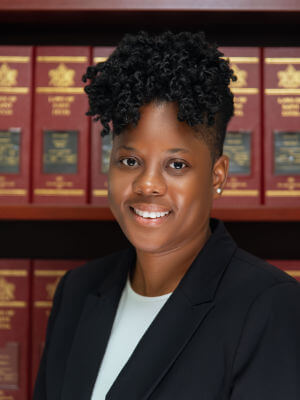
And Shari-Ann Walker stepped forward at trial and successfully argued the case that produced one of the most consequential public-service judgments in recent St. Kitts and Nevis history.

The result speaks loudly.
An unlawful transfer was struck down.
Constitutional responsibilities were reaffirmed.
Natural justice was defended.
And Petrona Thomas walked away with declarations, an injunction, vindicatory damages and costs.
That is what successful legal advocacy looks like.
And for Walker, John-Charles, Byron and the wider FOSTERS team, the Petrona Thomas judgment now stands as a major addition to an already distinguished Caribbean legal record.
















Leave a comment
You must be logged in to post a comment.