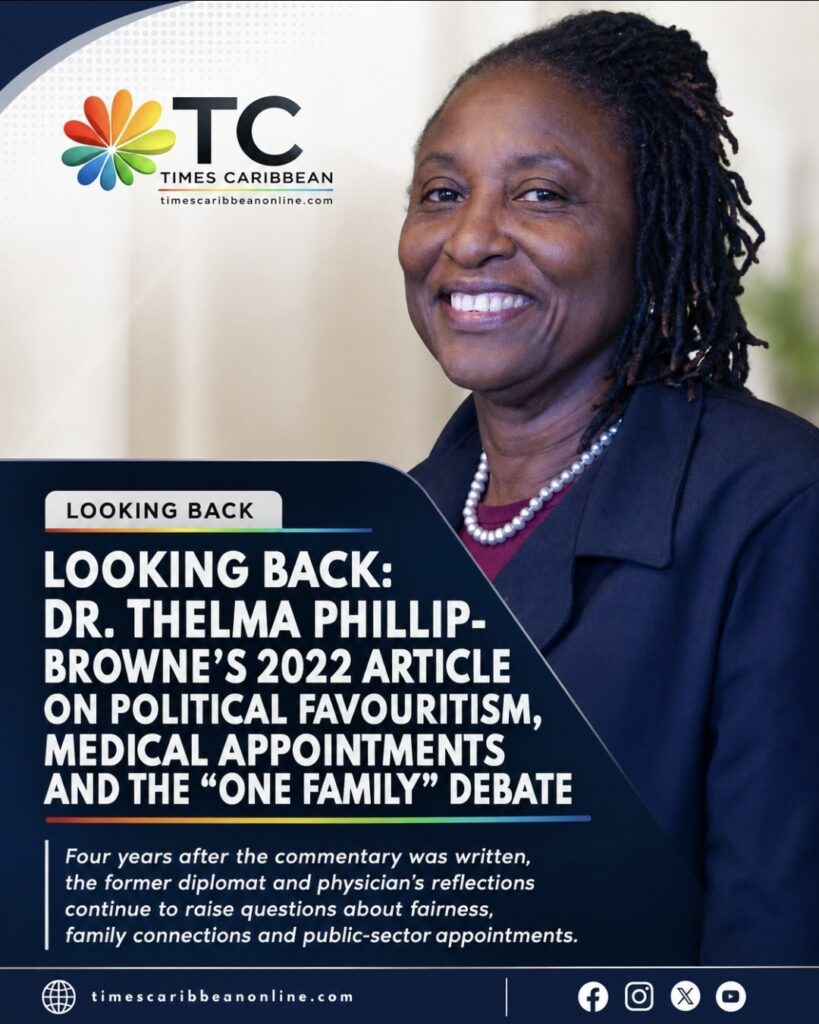
LOOKING BACK: DR. THELMA PHILLIP-BROWNE’S 2022 ARTICLE ON POLITICAL FAVOURITISM, MEDICAL APPOINTMENTS AND THE “ONE FAMILY” DEBATE.
Four years after the commentary was written, the former diplomat and physician’s reflections continue to raise questions about fairness, family connections and public-sector appointments
BASSETERRE, ST. KITTS — In a candid commentary originally published on August 3, 2022, Her Excellency Dr. Thelma Phillip-Browne reflected on her early career in the public health service and called for a more balanced national discussion about political connections, family relationships and government employment.
Drawing from her own experience after returning to St. Kitts at the end of 1979, Dr. Phillip-Browne said government was then, as it remains today, one of the country’s largest employers of medical professionals.
She recalled that government-employed doctors were permitted to operate private practices to supplement what she described as relatively modest public-sector salaries.
As the only female doctor serving at the time, and the mother of a five-year-old child with whom she wanted to spend more time after years of study, Dr. Phillip-Browne said she chose not to establish a private practice.
According to her account, then Minister of Health, the late Fitzroy Bryant, appointed her to the vacant position of Medical Officer of Health while she continued in her substantive role as a medical officer at the Joseph N. France General Hospital.
The additional assignment provided extra income, but Dr. Phillip-Browne said it also allowed residents of Basseterre to benefit from additional weekly clinics at the Basseterre Health Centre.
She acknowledged that some people could interpret the appointment as a minister helping a friend. However, she argued that the arrangement also provided a public benefit through expanded access to medical services.
Dr. Phillip-Browne said the situation changed following a change of government and the return of Dr. Ian Jacobs to the Federation.
According to her recollection, Dr. Jacobs was initially assigned to the Molyneux district, replacing Dr. Izben Williams, who had served that area for some time. Dr. Phillip-Browne said Dr. Williams was subsequently transferred to Basseterre and appointed to the Medical Officer of Health position, resulting in her immediate removal from that additional post.
She continued working at the JNF General Hospital without operating a private practice until 1994, when she completed further studies in dermatology.
Her commentary also examined the structure of medical appointments in districts such as Sandy Point and Molyneux.
She explained that these districts were considered financially attractive because doctors could potentially receive separate remuneration for serving as medical superintendent of a cottage hospital, district medical officer and physician for workers in the sugar industry. Doctors were also permitted to maintain private practices.
Dr. Phillip-Browne further recalled that Dr. Jacobs, a paediatric specialist, was later transferred to the Sandy Point district. She suggested that the move created space in Molyneux for one of the highly qualified siblings of then Prime Minister Dr. Kennedy Simmonds.
These statements represented Dr. Phillip-Browne’s personal recollection and interpretation of events. The commentary did not present documentary findings of wrongdoing by the officials or professionals mentioned.
Her broader concern centred on what she viewed as selective political outrage over allegations of nepotism, friendship and family connections in public employment.
Dr. Phillip-Browne said she was disappointed to hear a former prime minister and national hero repeatedly raising the issue, particularly because, in her view, political leaders from different administrations had assisted friends, relatives or associates at various points.
“Bryant looked out for me and Simmonds looked out for friend and family,” she wrote, summarising her view that political connections were not unique to any one administration or political organisation.
However, she drew a clear distinction between receiving an opportunity and engaging in misconduct.
Dr. Phillip-Browne said that where credible evidence exists of misappropriation, wrongdoing or improper conduct, the individuals involved should be investigated and treated like any other employee.
But she argued that people should not be subjected to continuous public criticism simply because they are related to, friendly with or associated with political figures.
Her message was direct. Public debate should focus on qualifications, performance, fairness and verified evidence—not assumptions based solely on family names or political relationships.
She also called for an end to what she described as repeated “One Family” attacks circulating within political echo chambers.
The commentary remains relevant to wider discussions about public-sector recruitment, political influence and perceptions of fairness in St. Kitts and Nevis.
It also raises an enduring question: should the public judge appointments primarily by personal connections, or by whether the individuals selected are qualified, productive and serving the national interest?
Dr. Phillip-Browne’s position was that connections alone should not amount to proof of wrongdoing.
And where serious allegations are made, evidence must lead the conversation.
















Leave a comment
You must be logged in to post a comment.