U.S. VISA SQUEEZE HITS ANTIGUA: 10-YEAR ACCESS CUT TO THREE-MONTH, SINGLE-ENTRY TERMS AS PM WARNS FAMILIES, STUDENTS AND TRADE ARE PAYING THE PRICE
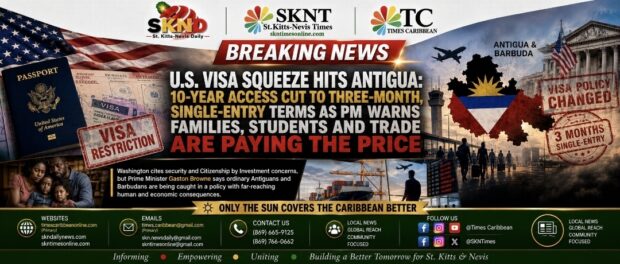
Washington cites security and Citizenship by Investment concerns, but Prime Minister Gaston Browne says ordinary Antiguans and Barbudans are being caught in a policy with far-reaching human and economic consequences
ST. JOHN’S, Antigua and Barbuda — July 11, 2026 — A sweeping change in United States visa policy has sharply reduced the travel privileges previously enjoyed by citizens of Antigua and Barbuda, replacing ten-year, multiple-entry visitor visas with single-entry visas valid for only three months.
The current United States Department of State reciprocity schedule lists B-1 business, B-2 tourism and combined B-1/B-2 visas for Antiguan and Barbudan nationals as valid for one entry over three months. Under the former arrangement, successful applicants could generally receive multiple-entry visas lasting up to ten years.
For ordinary families, the consequences extend far beyond politics or diplomatic language.
Future travellers without existing visas could face repeated applications, additional expenses, interviews and uncertainty simply to attend graduations, weddings, christenings, family reunions or moments of bereavement in the United States.
However, an important distinction must be made: valid United States visas issued before the restrictions took effect on January 1, 2026, were not automatically revoked. The U.S. State Department has stated that travellers who already held valid visas at the effective date are not covered by the proclamation while those visas remain valid.
The situation is also more severe than a simple reduction in visa duration. A December 16, 2025, White House proclamation suspended the entry of Antiguan and Barbudan nationals as immigrants and under several major non-immigrant categories, including B-1, B-2, student and exchange visas, subject to limited exceptions and case-by-case waivers.
BROWNE: TRADE, STUDENTS AND FAMILIES ARE FEELING THE PRESSURE
Prime Minister Gaston Browne has warned that the restrictions are affecting commerce, education and people-to-people relationships between Antigua and Barbuda and the United States.
Speaking to reporters during the recent CARICOM summit in Saint Lucia, Browne said students requiring visas to study in the United States were being affected, along with residents wishing to visit relatives.
“We also have individuals who like to visit their relatives in the United States, and they too are affected,” Browne said.
The Prime Minister described the United States as Antigua and Barbuda’s most important development partner. He stated that approximately 80 per cent of the goods consumed in the twin-island state come from the United States—not that 80 per cent of the entire economy is controlled by America—and noted that the U.S. is the country’s most significant tourism source market.
That economic dependence makes the dispute especially sensitive.
Air travel, imported goods, education, medical care, tourism and family relationships have connected Antigua and Barbuda to the United States for generations. Any prolonged reduction in mobility could therefore produce consequences far beyond the number of visas issued.
WASHINGTON POINTS TO SECURITY AND CBI
Washington says its policy is based on national-security, identity-management, screening and information-sharing concerns.
The White House specifically stated that Antigua and Barbuda had historically operated a Citizenship by Investment programme without a residency requirement. It argued more broadly that such programmes could potentially allow individuals to obtain a second passport and attempt to circumvent restrictions attached to their original nationality.
The Antigua and Barbuda Government strongly disputes the suggestion that its current programme has no residency requirement.
Browne said the country had strengthened its Citizenship by Investment framework through enhanced due diligence, transparency, information-sharing and enforcement measures. The Government also said legislation had introduced a mandatory 30-day physical residency requirement for qualifying applicants.
Antigua and Barbuda’s ambassador to the United States, Sir Ronald Sanders, previously said the country received no advance notice before the restrictions were publicly announced. He also clarified that a possible visa bond applies only to a narrow category of new applicants qualifying under limited exceptions—not to every Antiguan traveller or anyone already holding a valid visa.
SECURITY MEASURE OR DISPROPORTIONATE PRESSURE?
Washington maintains that country-based restrictions are necessary to improve cooperation, screening standards and compliance with American immigration requirements.
But the difficult question confronting the Caribbean is whether restrictions applied broadly by nationality are proportionate—particularly when most ordinary citizens had no involvement in creating, administering or benefiting from the Citizenship by Investment programme.
Antigua and Barbuda’s position is that it has cooperated with the United States, adopted reforms and attempted to address concerns through diplomacy. Yet families, students, businesspeople and legitimate travellers are now experiencing the practical consequences.
For Washington, the issue is framed as security.
For many Antiguans and Barbudans, it is whether they can conduct business, pursue an education, access services or stand beside loved ones during life’s most important moments.
The diplomatic dispute may have been born in government offices, but its deepest effects are being felt around family dinner tables, inside small businesses and among citizens wondering when normal travel access will be restored.
TIMES CARIBBEAN
















Leave a comment
You must be logged in to post a comment.