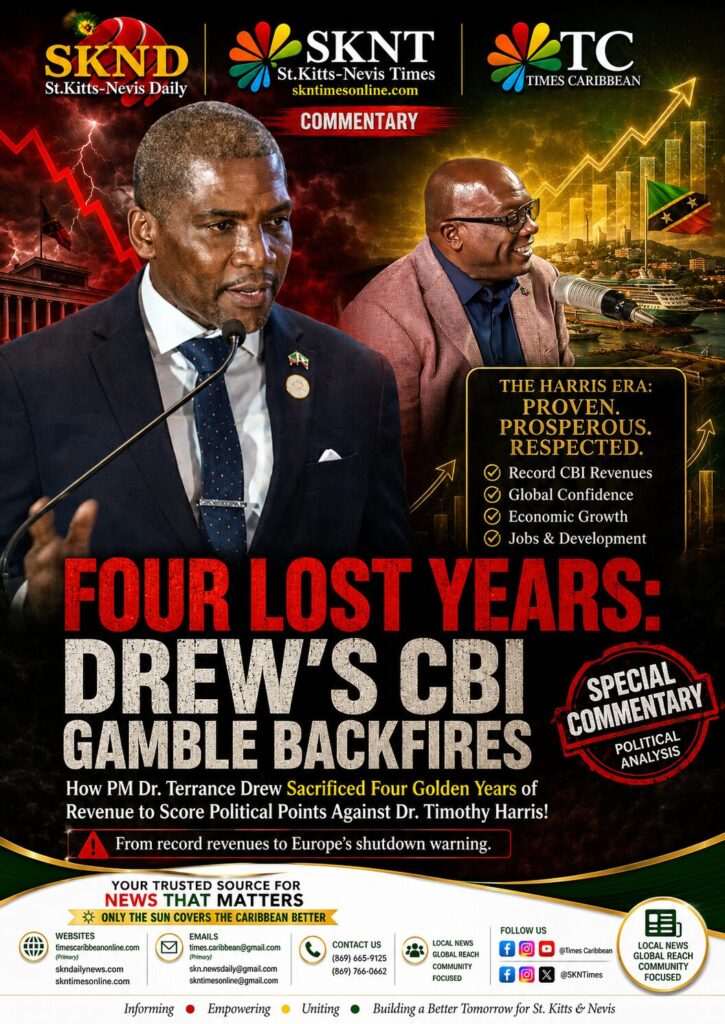
FOUR LOST YEARS: DREW’S CBI GAMBLE BACKFIRES: How PM Dr. Terrance Drew Sacrificed Four Golden Years of Revenue to Score Political Points Against Dr. Timothy Harris !

COMMENTARY
There are political miscalculations, and then there are national economic self-inflicted wounds. The St. Kitts-Nevis Citizenship by Investment Programme was once badly wounded in 2014 under the then Dr. Denzil Douglas-led Labour administration, when FinCEN issued its damaging advisory and Canada removed visa-free access over concerns tied to passport issuance and identity-management practices. Those were not minor setbacks. They were devastating international blows to the credibility of the Federation’s most important revenue engine.
Then came the Dr. Timothy Harris-led Team Unity administration. Whatever one’s politics, the record is difficult to ignore: the programme recovered, regained market confidence, and by 2022 CBI revenues reached EC$678.2 million — described by the Caribbean Development Bank as the highest since the programme’s inception and just over half of overall government revenue.
But instead of building on that unprecedented success, the Drew administration appeared determined to bury it under politics. Prime Minister Dr. Terrance Drew branded the programme’s past management as reckless, declared that his reforms had “saved” the CBI, and argued that without his intervention, visa-free access would have been lost. His own 2024 address stated that 2022 revenue stood at EC$669 million, before falling sharply to EC$218 million up to September 2024 — a decline he linked to “necessary reforms and market adjustments.”
Now comes the brutal reality check. The IMF has since pointed to low CBI inflows, lower applications, and a sharp decline in CBI revenue since 2024 as major headwinds for St. Kitts and Nevis. And the European Commission’s own Visa Suspension Mechanism report makes the bigger point even clearer: the mere operation of investor citizenship schemes by visa-free countries is now considered a serious security concern and a potential ground for suspending visa-free travel, pending discontinuation of such schemes.
So what exactly was “saved”?
If the Drew administration’s political argument was that its reforms would shield the programme from Europe, then Europe’s reported 2028 phase-out demand exposes a spectacular policy failure. According to reports citing Antigua and Barbuda’s response, the European Commission has requested a 24-month transition toward phasing out Caribbean CBI programmes by June 1, 2028.
That means the Drew administration may have achieved the worst of both worlds: less revenue, less confidence, less stability — and still no escape from Europe’s pressure.
The real tragedy is not that CBI faced international scrutiny. It always did. The tragedy is that St. Kitts and Nevis appears to have lost precious years of possible revenue because the Government seemed more interested in discrediting Dr. Harris than protecting a national asset. The Harris-era programme was not perfect, but it was productive. It generated historic revenues. It funded national priorities. It gave the country fiscal breathing room.
The Drew approach, by contrast, has looked like political demolition disguised as reform. It attacked the past, unsettled the market, weakened confidence, reduced inflows, and now stands confronted by the very European pressure it claimed to have neutralized.
Prime Minister Drew has some serious explaining to do.
Because if the programme was already facing an eventual European reckoning, then the responsible course was to maximize national benefit while preparing a real transition. Instead, the country was given political theatre, collapsing revenue, and now a looming shutdown clock.
This is more than a CBI story. It is a governance story. And the question is now unavoidable:
Did St. Kitts and Nevis lose four golden years because national economic strategy was sacrificed on the altar of political spite?
















Leave a comment
You must be logged in to post a comment.