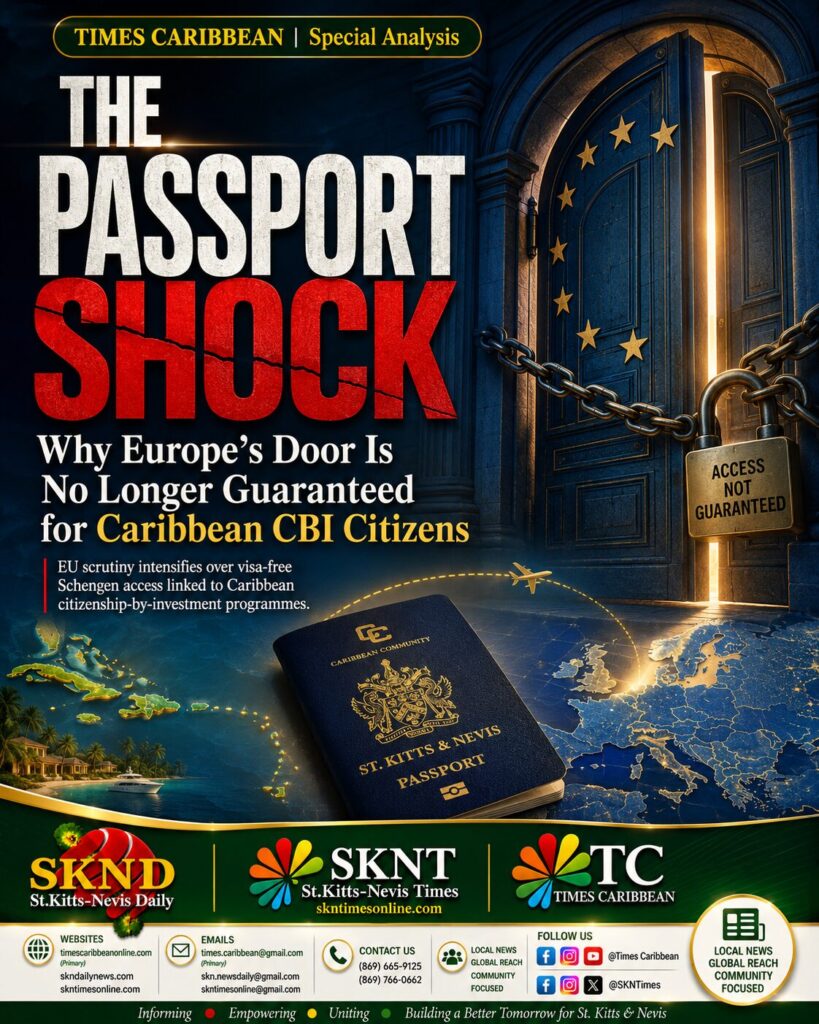
THE PASSPORT SHOCK: Why Europe’s Door Is No Longer Guaranteed for Caribbean CBI Citizens
TIMES CARIBBEAN | Special Analysis
For years, the promise was clear, powerful and easy to sell: invest in a Caribbean citizenship-by-investment passport and gain smoother access to Europe’s Schengen Area — no consulate queues, no lengthy visa uncertainty, no anxiety over delayed travel plans.
That promise has not disappeared. Citizens of Antigua and Barbuda, Dominica, Grenada, Saint Kitts and Nevis, and Saint Lucia still currently enjoy short-stay visa-free access to the Schengen Area for up to 90 days in any 180-day period. But the ground beneath that benefit is shifting — and Brussels is now sending its clearest message yet that the future of visa-free access can no longer be treated as automatic.
Europe’s New Message: The Programme Itself Is Now the Problem
The major change is not that Caribbean CBI passports have already lost Schengen access. They have not. The change is in how the European Union now frames the issue.
Previously, the EU’s concerns focused heavily on whether investor-citizens had a “genuine link” to the country granting citizenship, and whether screening systems were strong enough. But the EU’s revised Visa Suspension Mechanism has moved the discussion further: the operation of an investor citizenship programme may now, by itself, become a ground for suspending visa-free travel.
In its Eighth Visa Suspension Mechanism Report, dated December 19, 2025, the European Commission described the continued operation of Eastern Caribbean investor citizenship schemes as a serious security concern and a potential ground for visa suspension. That is a major policy signal. It means the debate has moved beyond isolated weaknesses and into the core question of whether passport-by-investment programmes are compatible with Europe’s border and mobility framework.
The Numbers Brussels Is Watching
The European Commission pointed to the scale of the sector, saying around 107,000 passports had been issued through the five Eastern Caribbean CBI programmes. It also highlighted application volumes and rejection rates it considered low, citing 2024 rejection rates of 1.7% for Antigua and Barbuda, 5.3% for Saint Lucia and 6.5% for Dominica.
At the same time, the report acknowledged reforms across the region, including efforts to harmonise minimum investment thresholds, strengthen screening, improve information-sharing and adopt common standards. But Brussels’ conclusion remained firm: the EU still considers the situation significant enough for continued monitoring and possible action.
That is the heart of the matter. The Caribbean has been reforming. Europe is still not satisfied.
Vanuatu Shows the Warning Is Real
This is no longer theoretical. Vanuatu has already lost its Schengen visa-free status following EU concerns over its citizenship-by-investment programme. The Council of the European Union removed Vanuatu from the visa-exempt list after its visa waiver had already been suspended since 2022.
For Caribbean governments, that precedent matters. It shows that the EU is willing to move from warning, to suspension, to full removal from the visa-free list when it believes citizenship-by-investment creates unacceptable policy risks.
The Caribbean is not Vanuatu. The Eastern Caribbean programmes are older, more established and economically central to small-island development. But Vanuatu proves one thing: visa-free access is not a permanent entitlement. It is a policy privilege that can be withdrawn.
The Pressure Is Not Only Coming From Europe
Other major partners have already acted against specific Caribbean passports.
Canada reimposed a visa requirement on Antigua and Barbuda nationals in 2017, stating at the time that Antigua and Barbuda no longer met Canada’s criteria for visa exemption.
The United Kingdom later imposed visa requirements on Dominica, and its current official travel guidance lists both Dominica and Saint Lucia among nationalities requiring visas for UK entry.
The United States also introduced partial visa-issuance restrictions from January 1, 2026 affecting nationals of Antigua and Barbuda and Dominica in several visa categories, with official U.S. guidance confirming that the measures apply to certain applicants outside the United States who did not already hold valid visas.
This pattern matters. Even when a passport remains legally valid, the practical value of that passport depends heavily on how major destination countries treat it.
Antigua’s Warning: 2026 Could Be a Turning Point
Antigua and Barbuda has publicly acknowledged the pressure. According to regional reporting, Prime Minister Gaston Browne warned that Antigua and Barbuda could lose EU visa-free access before the end of 2026, while also indicating that the country intends to continue its citizenship programme.
Separately, Antigua and Barbuda’s government said the EU had called for a phase-out of CBI by June 2028, while offering a 24-month transition period and interim safeguards. The government pushed back, stressing that CBI revenue has helped fund hospitals, schools, infrastructure, housing, disaster recovery and climate resilience.
That is the difficult truth at the centre of this regional showdown. For Europe, this is about Schengen integrity, screening standards and policy control. For small Caribbean states, CBI is not a luxury product — it is a major source of non-tax, non-debt revenue.
The Real Issue: Europe Is Repricing Caribbean Mobility
The Caribbean passport is not collapsing. But its European mobility value is being repriced.
For years, the sales pitch was simple: buy into citizenship and enjoy easier Europe access. Now, advisors, investors and governments must confront a more complicated reality: Schengen access attached to a CBI passport is politically vulnerable.
If Brussels decides that the continued existence of a CBI programme is enough to trigger suspension, then no amount of marketing language can remove that risk. The passport may still offer a second nationality, wider travel options, family security and commercial flexibility. But where Europe is the central objective, the investment case is no longer as simple as it once appeared.
What This Means for Applicants and Passport Holders
Current holders should not panic. Caribbean CBI passports remain meaningful assets. They still provide nationality diversification, global mobility benefits and long-term personal flexibility.
But prospective applicants should be clear-eyed. If the primary purpose is reliable long-term access to Europe, a Caribbean passport alone may no longer be enough. Families with serious European plans may need to examine lawful Schengen residence options, including properly structured residence routes in EU or Schengen countries, while carefully weighing cost, tax exposure, physical presence requirements and long-term compliance obligations.
This is not a one-size-fits-all decision. A family seeking occasional European travel has different needs from a business owner seeking long-term European presence, a parent planning education options, or a retiree seeking residency stability.
The Bottom Line
The Caribbean CBI industry is entering its most consequential period in years.
Europe has not yet closed the Schengen door on the five Eastern Caribbean programmes. But it has changed the lock, tightened the rules and made it clear that the key can be withdrawn.
For Caribbean governments, the challenge is urgent: defend a vital development tool while proving that their programmes meet the highest international standards.
For investors, the message is even clearer: do not wait for a border officer, airline desk or visa notice to reveal that the rules have changed.
The Caribbean passport remains powerful — but Europe is no longer a guaranteed promise. It is now a policy question, and Brussels is asking it louder than ever.
















Leave a comment
You must be logged in to post a comment.