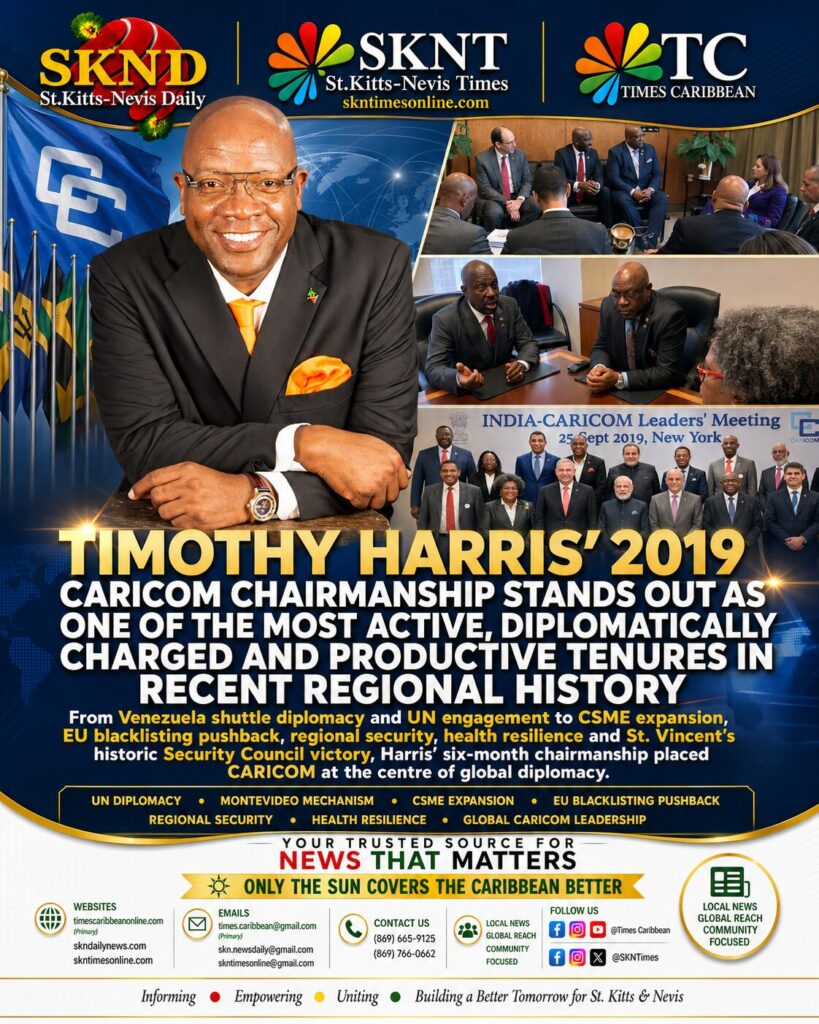
DR. HON. TIMOTHY HARRIS’ 2019 CARICOM CHAIRMANSHIP STANDS OUT AS ONE OF THE MOST ACTIVE, DIPLOMATICALLY CHARGED AND PRODUCTIVE TENURES IN RECENT REGIONAL HISTORY

From Venezuela shuttle diplomacy and UN engagement to CSME expansion, EU blacklisting pushback, regional security, health resilience and St. Vincent’s historic Security Council victory, Harris’ six-month chairmanship placed CARICOM at the centre of global diplomacy.
BASSETERRE, ST. KITTS — Times Caribbean News Feature — When Dr. the Hon. Timothy Harris assumed the Chairmanship of the Caribbean Community in 2019, few could have predicted that his six-month tenure would become one of the most intense, active and consequential periods of CARICOM leadership in recent memory.
From January 1 to June 30, 2019, St. Kitts and Nevis held the rotating CARICOM Chairmanship, with Harris presiding over the Community at a time of escalating hemispheric tension, growing international pressure on small-state financial systems, renewed urgency around regional integration, and rising demands for CARICOM to speak with one voice on the global stage. CARICOM’s official rotation schedule lists St. Kitts and Nevis as the incumbent chair for the January–June 2019 period.
The defining test came almost immediately: the Venezuela political crisis. Rather than allowing CARICOM to be reduced to a spectator in its own neighbourhood, Harris helped position the regional bloc as a principled, diplomatic “honest broker,” insisting on dialogue, non-interference, respect for sovereignty and a peaceful constitutional path. On January 27, 2019, CARICOM announced that Harris would lead a high-level delegation to meet UN Secretary-General António Guterres in New York to discuss Venezuela, accompanied by Prime Ministers Mia Mottley and Keith Rowley, Grenada’s Foreign Minister Peter David and CARICOM Secretary-General Irwin LaRocque.
That mission became one of the signature moments of his chairmanship. CARICOM’s 2019 Annual Report later recorded that high-level representatives, including the Prime Ministers of Barbados, St. Kitts and Nevis and Trinidad and Tobago, were designated to undertake mediation-related activities, held discussions with the UN Secretary-General, engaged with Venezuelan parties, and participated in the International Contact Group and the Montevideo Mechanism.
The Montevideo Mechanism became another major diplomatic achievement under Harris’ watch. CARICOM, Mexico, Uruguay and Bolivia promoted a dialogue-based framework to help foster negotiation among Venezuelan political sectors. CARICOM records show that Heads of Government endorsed the Montevideo Mechanism and agreed that Harris, Rowley and Mottley would represent the Community in meetings with interested parties to pursue an inclusive and peaceful resolution.
Harris’ chairmanship was not confined to foreign affairs. In February 2019, he hosted and presided over the 30th Inter-Sessional Meeting of CARICOM Heads of Government in Basseterre, a summit that produced a sweeping list of decisions across transportation, regional integration, security, finance, diplomacy, governance and institutional reform.
On the CARICOM Single Market and Economy, the Basseterre meeting advanced the Protocol on Contingent Rights and free movement discussions. Official decisions noted that all Member States had signed the Protocol on Contingent Rights, nine had signed the Declaration of Intent to provisionally apply it, and work on the Built-In Agenda was assigned to COTED under the oversight of the Prime-Ministerial Sub-Committee on the CSME.
The summit also moved forward the expansion of skilled-national categories, including agricultural workers and security guards, while calling on Member States to become compliant with existing free movement obligations. The record shows Heads agreed to revised timelines for administrative facilitation and legislative implementation and requested consultations through COHSOD Labour.
In transportation, Harris’ Basseterre summit tackled the long-standing challenge of regional air connectivity. CARICOM decisions called for Member States to consider cargo-related liberalisation, sign and implement the Multilateral Air Services Agreement, strengthen aviation capacity, and explore the reform of regional civil aviation oversight through a single airspace and single aviation authority framework.
On financial sovereignty, the Harris-led chairmanship placed CARICOM’s resistance to EU blacklisting squarely on the regional agenda. The 30th Inter-Sessional decisions described the EU tax governance process as one that could affect CARICOM states’ economic sovereignty and prospects, and Heads agreed to a “proactive, multi-dimensional” strategic response, including coordinated lobbying, technical tax reform support, AML/CFT engagement and possible legal and international advocacy measures.
Security was another major pillar. The Basseterre decisions recorded that Heads considered security issues and received a brief from CARICOM IMPACS. They agreed on measures to sustain regional security institutions, including IMPACS, RSS, CASSOS, CDEMA and CARPHA, while mandating IMPACS and the RSS to advise on a regional security and law enforcement response mechanism focused on human intelligence, crime prevention and integrity in law enforcement and security agencies.
Harris’ tenure also connected regional diplomacy with health resilience. CARPHA Executive Director Dr. James Hospedales publicly praised Harris’ contributions to regional health policy, especially on non-communicable diseases, noting that Harris had championed NCDs and their impact on Small Island Developing States. SKNIS also recorded that Harris was CARICOM’s Lead Head for Health and Human Development. During the same Basseterre Inter-Sessional Meeting, The UWI and CARPHA signed an MoU to strengthen research and training on regional public health priorities, with Harris witnessing the signing as Prime Minister of St. Kitts and Nevis and Chairman of CARICOM.
Globally, the chairmanship ended with a historic diplomatic triumph for the region: St. Vincent and the Grenadines’ election to the United Nations Security Council. Harris, as CARICOM Chairman, congratulated St. Vincent and the Grenadines on becoming the smallest country to hold a Security Council seat, calling it a crucial moment for international peace and security, particularly given Venezuela’s crisis. CARICOM’s 2019 Annual Report also described St. Vincent and the Grenadines’ successful bid as a major accomplishment for both that country and the region.
The record also shows that the 2019 chairmanship helped push CARICOM’s digital future. Estonia’s President Kersti Kaljulaid addressed the Basseterre Inter-Sessional Meeting, and Heads agreed on cooperation with Estonia in ICT and e-government to advance the CARICOM Single ICT Space and Digital Agenda 2025.
Comprehensive Achievement List: Harris’ 2019 CARICOM Chairmanship
- Led CARICOM during one of the region’s most intense diplomatic periods in recent memory.
- Headed the CARICOM delegation to the UN Secretary-General on the Venezuela crisis.
- Helped position CARICOM as a neutral advocate for dialogue, non-interference and peaceful resolution.
- Supported the creation and promotion of the Montevideo Mechanism.
- Participated in international diplomatic engagements involving the International Contact Group.
- Hosted and chaired the 30th Inter-Sessional Meeting of CARICOM Heads in Basseterre.
- Advanced the CSME agenda, including the Protocol on Contingent Rights.
- Pushed free movement discussions involving skilled CARICOM nationals.
- Advanced discussions on agricultural workers and security guards as free movement categories.
- Drove regional transportation discussions around MASA, aviation liberalisation and a single aviation authority.
- Helped mobilise CARICOM against EU blacklisting and financial-sector pressure.
- Secured a regional mandate for a strategic, multi-dimensional response to blacklisting.
- Supported regional AML/CFT risk-management coordination.
- Advanced regional security funding and institutional sustainability discussions.
- Mandated further IMPACS/RSS work on regional security cooperation.
- Supported regional health resilience through CARPHA, UWI and NCD advocacy.
- Strengthened CARICOM’s public health policy agenda as Lead Head for Health and Human Development.
- Helped elevate St. Vincent and the Grenadines’ successful UN Security Council bid.
- Advanced CARICOM digital cooperation with Estonia.
- Supported governance reform and the transition from CARICOM’s 2015–2019 Strategic Plan toward the next regional development framework.
In the final analysis, Harris’ CARICOM chairmanship was not merely ceremonial. It was diplomatic, strategic and action-heavy. While not every initiative could be fully implemented within a six-month window, the official record shows a chairmanship defined by movement, mandate, mediation and measurable regional decisions.
For St. Kitts and Nevis, it remains a powerful reminder that even the smallest states can lead the Caribbean with impact when the moment demands discipline, diplomacy and regional purpose.
















Leave a comment
You must be logged in to post a comment.