Skerrit Says U.S. Visa Decision on Incoming CHTA President Gregor Nassief Is a Matter for Washington
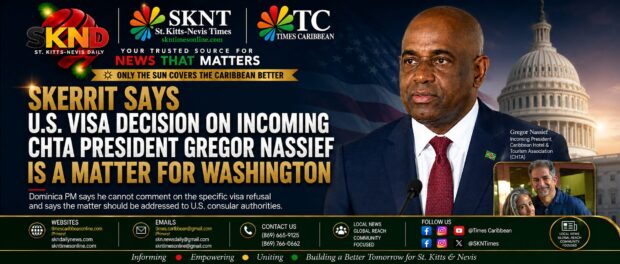
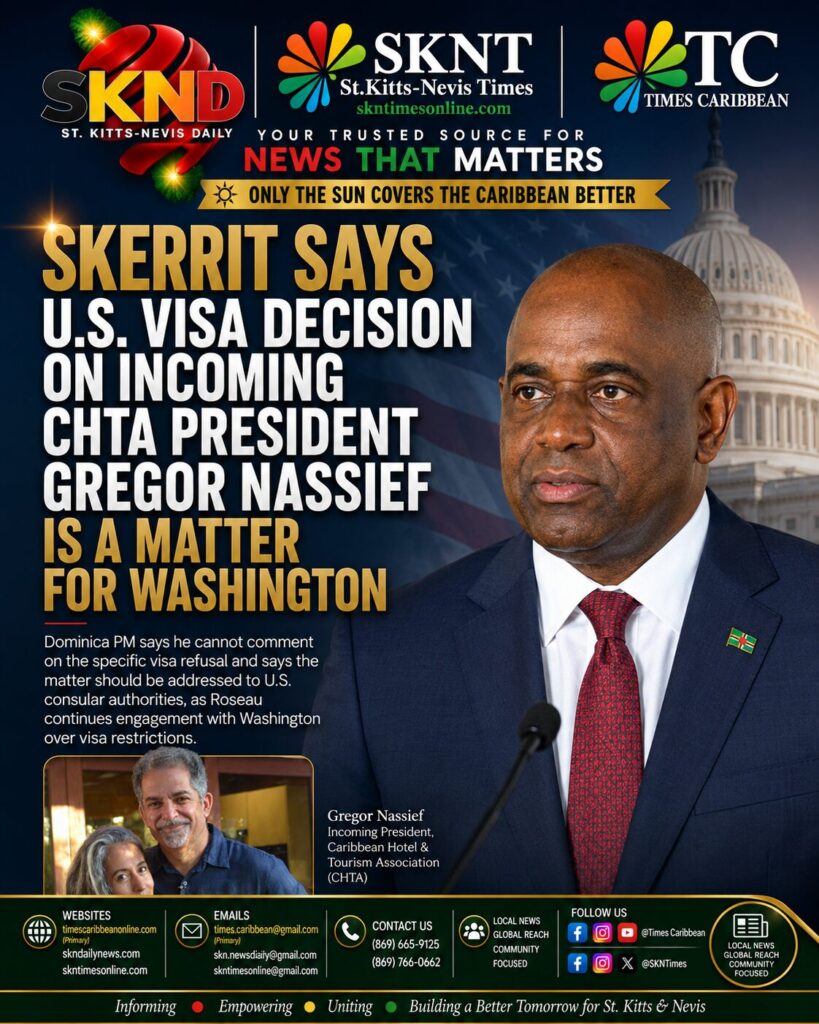
ROSEAU, Dominica — Prime Minister Roosevelt Skerrit has declined to comment directly on the United States government’s decision not to renew the U.S. visa of Dominican-born hotelier and incoming Caribbean Hotel and Tourism Association President Gregor Nassief, saying the matter rests solely with American consular authorities.
Speaking at a news conference on Wednesday, Skerrit said he was not in a position to speak to the specific circumstances surrounding Nassief’s visa refusal.
“I do not know the circumstances. I’m not part of the consular department of the United States government,” Skerrit told reporters. “This is not a denial of entry to Dominica, which I can speak to… so that question is better addressed to the United States government and the consular department in Barbados.”
Nassief, a prominent Dominican hotelier and businessman, confirmed last Friday that he and his Venezuelan-born wife were denied renewal of their U.S. visas. He suggested the decision may be connected to Washington’s recent implementation of partial travel restrictions affecting nationals of Dominica and Antigua and Barbuda.
The restrictions are linked to concerns raised by the Trump administration over Caribbean Citizenship-by-Investment programmes, under which foreign investors can obtain citizenship after making a qualifying contribution to national development.
Nassief, whose tenure as CHTA president is expected to begin at the end of the year, told the Caribbean Media Corporation that his 10-year U.S. visa was due to expire in August, while his wife’s visa expires in about two weeks.
According to Nassief, the U.S. consular officer indicated that there was a restriction affecting Dominica and that a visa could not be issued.
“We were turned down, we were denied,” Nassief said, adding that the official told him there was “a ban on Dominica.”
The development has triggered regional discussion because Nassief is not only a leading tourism figure in Dominica, but also the first Dominican-born national elected to lead the CHTA, one of the Caribbean’s most influential tourism bodies.
However, Skerrit cautioned against making the matter a diplomatic flashpoint, noting that visa decisions are made by sovereign governments and that many Caribbean nationals have been denied U.S. visas over the years under different American administrations.
“There are hundreds of Caribbean people, if not thousands, who have been denied U.S. visas over time,” Skerrit said. “I don’t think one should make a big issue of anyone being denied a visa to any country.”
The Prime Minister also noted that countries, including Dominica, sometimes deny visas or entry to foreign nationals based on their own immigration assessments.
“Personally, from an ideological standpoint, I do not believe in visas,” Skerrit said. “I believe that the world needs to get rid of visas completely and go back to the original way of how the world used to be, where people used to travel unhindered.”
Skerrit said Dominica continues to engage the United States on the wider visa restrictions affecting its nationals, including through regular communication with the U.S. Embassy in Barbados and the State Department.
“There’s an almost weekly engagement with the State Department by our Ambassador,” he said, adding that he has also been in regular contact with U.S. officials.
He further stated that U.S. Secretary of State Marco Rubio had indicated during a meeting with Caribbean Community leaders in St. Kitts and Nevis that Washington would review the situation around June.
But Skerrit acknowledged that small Caribbean states often have to navigate major power priorities carefully.
“One also has to be pragmatic with these things,” Skerrit said. “We all recognise the United States has bigger fish to fry at this time, and countries like ours are small sprats in a deep ocean.”
The Dominican leader maintained that his government does not believe there was sufficient justification for the restrictions to be imposed on Dominica in the first place. Nevertheless, he said Roseau would continue to engage Washington respectfully and constructively.
“We maintain that there was no real justification to impose this on Dominica in the first place, but it has been done,” Skerrit said.
He said Dominica is hoping for a favourable reconsideration of the U.S. position and the restoration of the previous visa arrangements.
“We’ll continue to engage on this, and any new developments will certainly inform the nation as time goes by,” Skerrit said. “This is entirely in the hands of the United States government.”
The visa issue has added to growing concerns across the region about the potential impact of U.S. travel restrictions on tourism leadership, business mobility, investment confidence, and Caribbean representation on the international stage.
For Dominica, the matter now sits at the intersection of sovereignty, diplomacy, tourism, and the future of Citizenship-by-Investment programmes, as Caribbean governments continue to seek clarity from Washington on the path forward. :::
















Leave a comment
You must be logged in to post a comment.