Grenada’s Franklyn Death Probe Under Fire: Attorney Cajeton Hood Says No Official Inquest Was Held, Questions Police and State Response
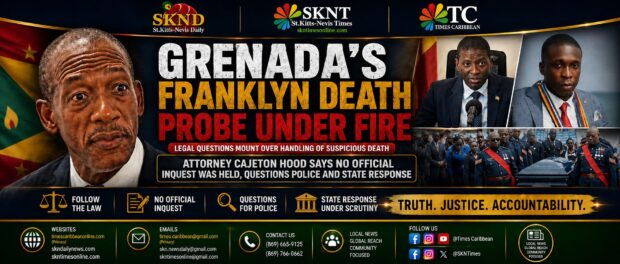
TIMES CARIBBEAN | GRENADA — The unresolved questions surrounding the death of former Grenada Senator Neilon Franklyn have intensified after prominent attorney Cajeton Hood, speaking in an exclusive interview with broadcaster Shelton Scott, asserted that he has found no evidence that any formal inquest was ever conducted into the young former parliamentarian’s passing.
Hood, who said he was retained by the Franklyn family, delivered a blunt assessment of the matter.
“There has not been any official inquest into the death of former Senator Franklyn,” Hood stated.
Franklyn, who was only 28, made history as one of Grenada’s youngest senators after being appointed to the Upper House in 2022. His death at the General Hospital later triggered public concern, political commentary, and calls for a fuller accounting of the circumstances surrounding his final hours. Earlier reporting noted that police had said the forensic examination was not concluded and that toxicology was pending, while other regional reports cited claims of toxic substances allegedly found in his body.
According to Hood, the issue is not merely whether investigators are still pursuing answers, but whether Grenada’s legal process was properly triggered from the start. He argued that the Coroners Act places a clear duty on law enforcement once a death occurs under suspicious circumstances.
“Once the coroner’s conditions are met, the coroner must take charge,” Hood said. “It is the coroner’s duty under the law to take charge of the situation. The police must conduct an inquiry under the supervision of the coroner, not the commissioner of police.”
Hood said he wrote to the Chief Magistrate, who serves as coroner for St. George’s, on behalf of the family. According to him, the response indicated that no police officer had reported Franklyn’s death to the coroner. Hood characterized that alleged failure as a serious breakdown in procedure and a matter that should attract urgent official scrutiny.
He further warned that if the coroner’s office was not properly notified, questions may arise not only for the police but also for public officials responsible for ensuring the law is followed.
Hood’s criticism extended to the state’s handling of the post-mortem process. He questioned whether the Government of Grenada ever commissioned its own autopsy, stating that, to his knowledge, the autopsy was arranged and paid for by the family.
“As far as I am concerned, the autopsy was commissioned and paid for by the family of the deceased,” Hood said. “I am not aware that the state ever commissioned an autopsy on his body.”
Reports at the time identified Trinidad-based pathologist Professor Hubert Daisley as having conducted an examination, with subsequent public discussion centering on alleged findings involving substances in Franklyn’s body. However, the Royal Grenada Police Force previously urged caution, saying in September 2025 that the cause of death had not been officially concluded because toxicology investigations were still pending.
Hood also directed criticism at Prime Minister Dickon Mitchell, who also holds responsibility for national security. Hood argued that, as an attorney, Mitchell could not credibly claim ignorance of the legal obligations surrounding suspicious deaths.
“He is a lawyer. He ought to know the law. This is one person who can’t get away by saying I didn’t know,” Hood said. “As Minister of National Security, you are to step up to the plate and call the Commissioner of Police in and inquire why no report was made to the coroner.”
The attorney’s central demand was direct: Grenada must follow the law and provide the Franklyn family and the public with clear answers.
“Follow the law,” Hood said. “Why was no inquest commissioned by the state of Grenada?”
The Franklyn case has remained one of Grenada’s most sensitive and closely watched public matters, not only because of his youth and former role in national leadership, but because of the troubling questions that have surrounded his death. Former Prime Minister Dr. Keith Mitchell previously called for an independent investigation, while the police maintained that official conclusions should await the completion of forensic and toxicology processes.
Hood’s latest intervention now places renewed pressure on the authorities to clarify whether the coroner was properly notified, whether an inquest was legally required, whether the state fulfilled its investigative obligations, and what official steps have been taken to determine the full circumstances of Neilon Franklyn’s death.
For the Franklyn family and many Grenadians, the central issue remains painfully simple: a young former senator died under circumstances that raised alarm, and the public is still waiting for a transparent, lawful, and credible process that can withstand scrutiny.
















Leave a comment
You must be logged in to post a comment.