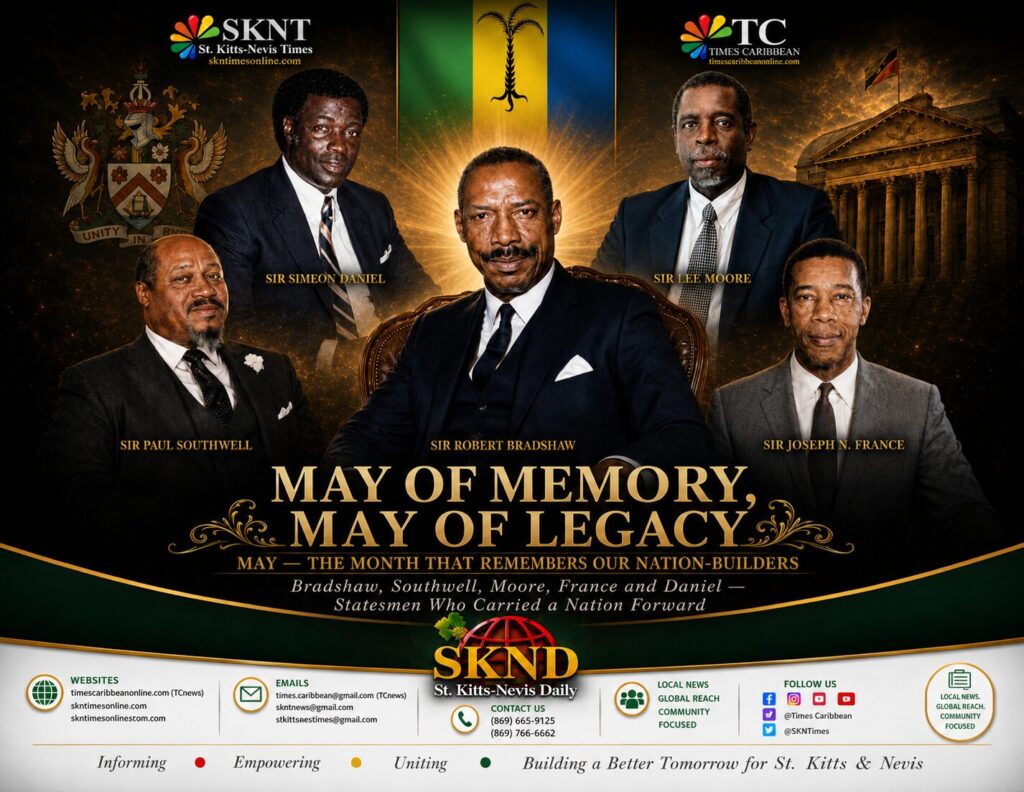
MAY OF MEMORY, MAY OF LEGACY, MAY THE MONTH THAT REMEMBERS OUR NATION-BUILDERS: Bradshaw, Southwell, Moore, France and Daniel Statesmen Who Carried a Nation Forward.
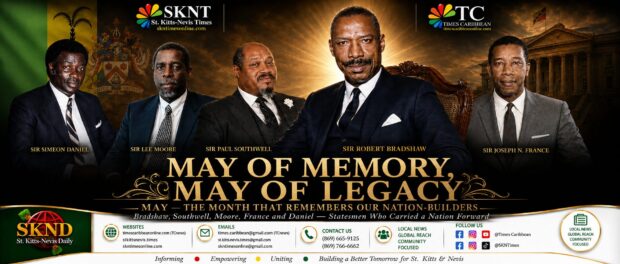
MAY, MEMORY AND NATIONHOOD: The Month St. Kitts and Nevis Remembers Several of Its Political Giants
ST. KITTS-NEVIS DAILY / SKN TIMES / TIMES CARIBBEAN FEATURE
BASSETERRE, ST. KITTS, May 23, 2026 — In the national calendar of St. Kitts and Nevis, May is more than a month of dates. It is a month of memory, reflection and historic weight — a period during which the Federation remembers several of the towering political leaders, national pioneers, constitutional architects, labour champions and public servants whose lives helped shape the destiny of the twin-island state.
Today, May 23rd, 2026, marks the 48th anniversary of the passing of The Right Excellent Sir Robert Llewellyn Bradshaw, St. Kitts and Nevis’ first National Hero, second Chief Minister, first Premier, labour titan and widely regarded Father of the Nation. Sir Robert died on May 23rd, 1978, at age 61, closing one of the most consequential chapters in the modern political history of St. Kitts, Nevis and Anguilla. Historic St. Kitts records that Bradshaw was born on September 16th, 1916, in St. Paul’s Village, and that his early exposure to the sharp inequalities of the sugar economy helped shape his lifelong commitment to workers’ rights and social justice. (historicstkitts.kn)
But Bradshaw is not the only national figure whose passing falls in May. Earlier this month, on May 18th, the Federation marked the anniversary of the passing of The Right Excellent Sir Caleb Azariah Paul Southwell, former Chief Minister and Premier. On May 6th, the nation remembered Sir Lee Llewellyn Moore, attorney, diplomat, former Premier and former United Nations Ambassador. On May 21st, the country reflected on the life of The Right Excellent Sir Joseph Nathaniel France, National Hero, educator, parliamentarian, minister and trade union stalwart. And in a few days, on May 27th, St. Kitts and Nevis will observe the anniversary of the passing of The Right Excellent Sir Simeon Daniel, first Premier of Nevis and one of the principal architects of modern Nevisian political identity.
Together, their May anniversaries form a powerful national reminder: the Federation was not built by accident. It was shaped through struggle, labour organising, constitutional negotiation, regional diplomacy, social reform, public education, legal service, and political courage.
Sir Robert Bradshaw: Labour, Nationhood and the Politics of Social Transformation
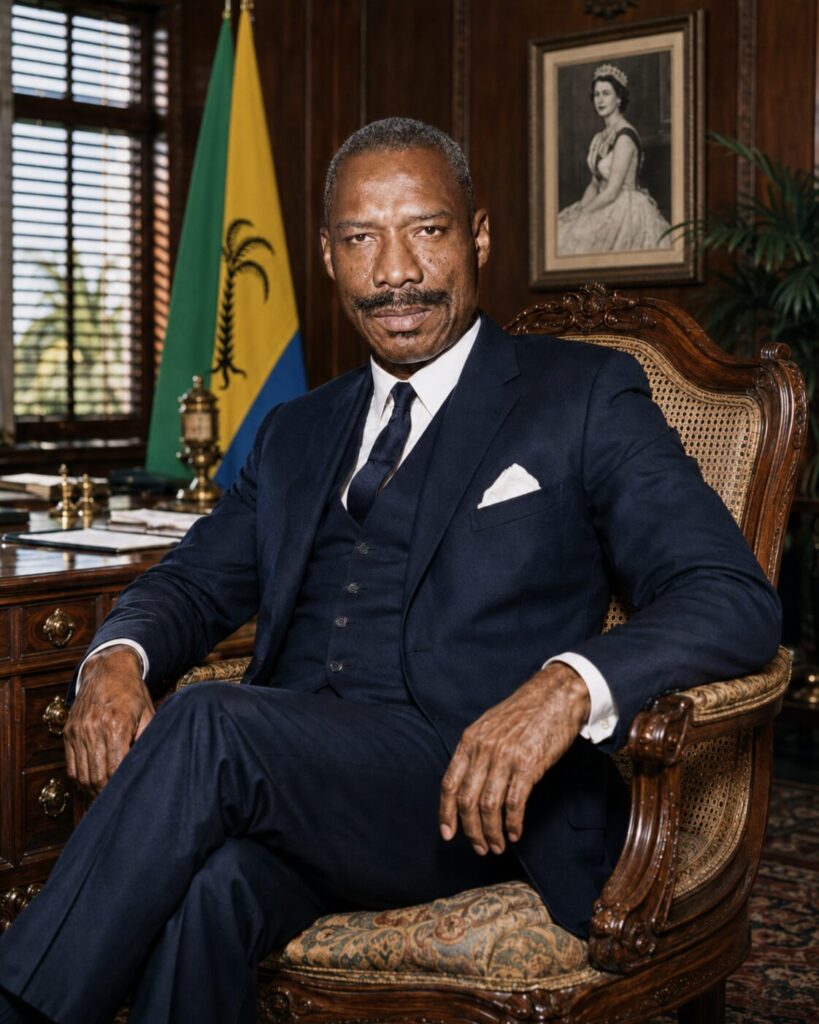
Sir Robert Llewellyn Bradshaw remains one of the defining figures of 20th-century St. Kitts and Nevis. His political rise was rooted in the labour movement, and his public life reflected the struggles of plantation workers, factory workers, domestic workers and ordinary citizens who demanded dignity in a colonial society built on deep social and economic inequalities.
Bradshaw’s early life was marked by modest circumstances. Historic St. Kitts notes that he was raised largely by his grandmother after his father migrated to the United States, and that as a young man he worked at the St. Kitts Sugar Factory, where he became increasingly aware of the imbalance between the lives of workers and those who controlled the sugar economy. (historicstkitts.kn)
That awareness became the foundation of his public mission. Bradshaw helped transform labour activism into political power. His leadership was not merely electoral; it was structural. He was part of a generation that moved the working class from the margins of colonial society into the centre of public decision-making.
His legacy is visible in the expansion of education, social services, housing, healthcare, worker protections, public infrastructure and the broader assertion that ordinary people had a right to participate meaningfully in the future of their country.
To his admirers, Bradshaw was a fearless defender of workers and a nation-builder whose vision laid the groundwork for independence. To historians, he remains a commanding and sometimes complex figure whose political influence stretched across labour, governance, constitutional development and Caribbean regional affairs.
May 23rd is therefore not simply the anniversary of a death. It is a reminder of the long march from plantation dependency to political self-determination.
Sir Paul Southwell: Regionalist, Premier and Bridge Between Eras
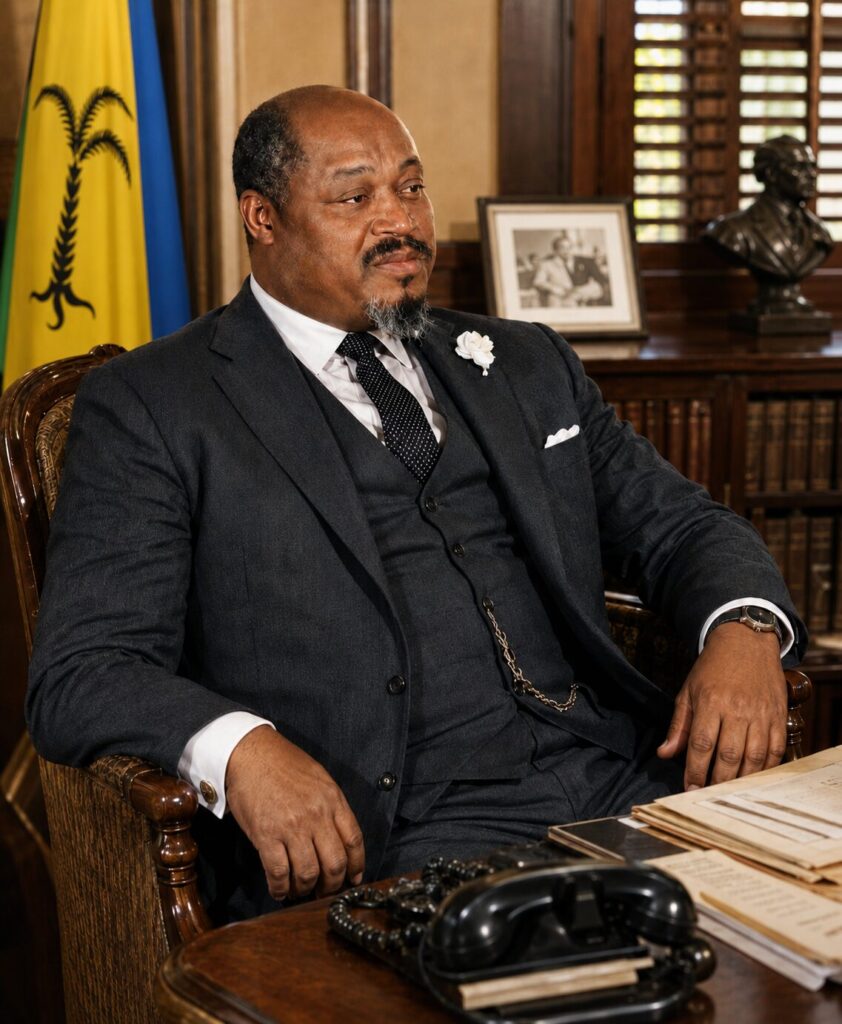
Just five days before Bradshaw’s anniversary, the nation remembers Sir Caleb Azariah Paul Southwell, who died on May 18th, 1979, while chairing a meeting of the West Indies Associated States Council of Ministers in Castries, St. Lucia. Historic St. Kitts records that Southwell became Premier after Bradshaw’s death in 1978 and had been deeply involved in regional organisations, including service as Chairman of the Caribbean Tourism Association and Chairman of the West Indies Associated States Council of Ministers. (historicstkitts.kn)
Southwell’s life represents another important dimension of national development: the bridge between domestic reform and regional institution-building.
Dominican-born but central to the political life of St. Kitts and Nevis, Southwell brought administrative skill, regional vision and political continuity at a sensitive moment in the country’s history. His death came less than a year after he assumed the premiership, at a time when St. Kitts-Nevis-Anguilla was still navigating complex constitutional questions, regional uncertainty and the road toward independence.
His work reflected the reality that small island states could not afford isolation. Southwell understood that political survival and economic progress required cooperation across the Eastern Caribbean. His involvement in regional councils and his commitment to Caribbean integration helped prepare the ground for the institutional cooperation that would later define the OECS era.
In the national story, Southwell is often remembered as a leader who stood between two great moments: the labour-nationalist rise of the Bradshaw era and the coming constitutional transformation of independence.
Sir Lee Moore: The Scholar-Statesman, Legal Mind and Diplomatic Voice
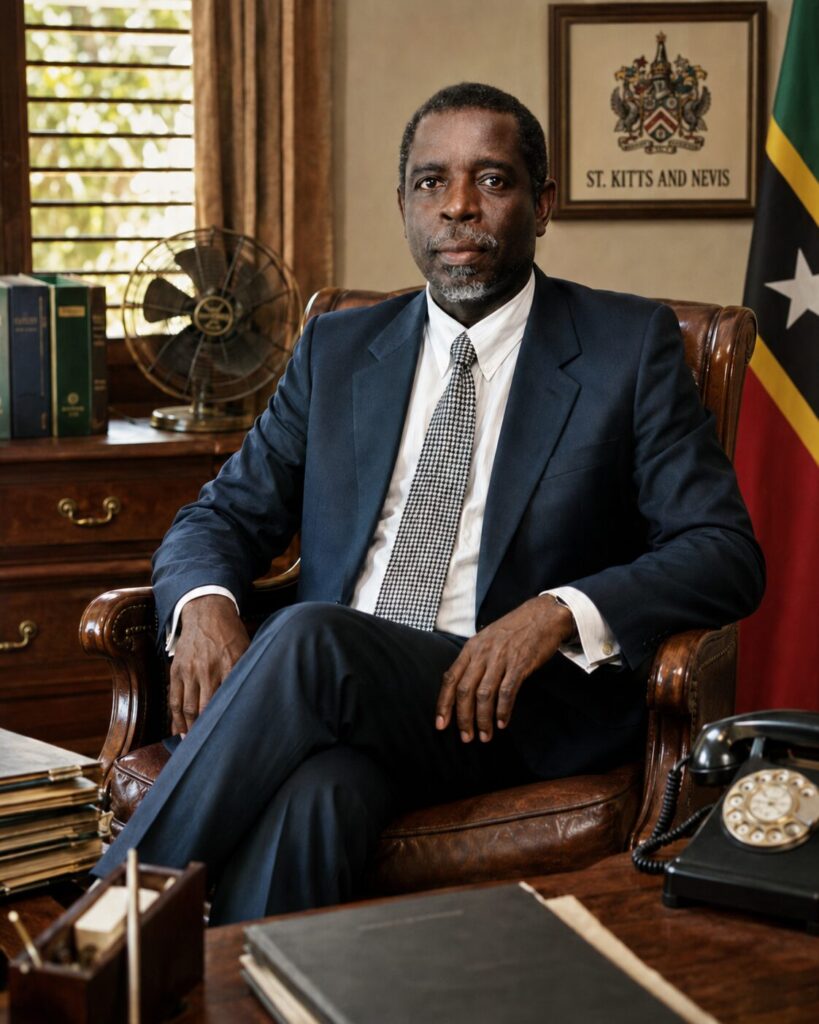
On May 6th, the Federation marked the anniversary of the passing of Sir Lee Llewellyn Moore, who died in 2000. A distinguished attorney, former Premier, diplomat and public intellectual, Moore represented a different but equally important tradition in the political development of St. Kitts and Nevis: the tradition of law, diplomacy, scholarship and principled public debate.
Historic St. Kitts records that Moore served as Ambassador Extraordinary and Plenipotentiary and non-resident Permanent Representative to the United Nations after Labour’s 1995 victory, advising government on treaties, conventions and international relations. It also notes his role in establishing diplomatic relations with South Africa in 1998 and his wider commitment to regional integration. (historicstkitts.kn)
Sir Lee’s contribution cannot be measured only by the brevity of his premiership. His influence was larger than office. He was a courtroom advocate, a parliamentarian, a regional legal figure, a statesman and an orator whose command of language and law made him one of the most formidable public figures of his generation.
At a time when small states were increasingly required to defend their interests in international forums, Moore helped demonstrate that St. Kitts and Nevis could speak with sophistication and confidence on the world stage.
His May 6th anniversary reminds the nation that governance is not only about popularity or political power. It is also about intellect, preparation, diplomacy and the ability to interpret national interest within a changing global order.
Sir Joseph N. France: The Worker’s Advocate and Social Services Pioneer
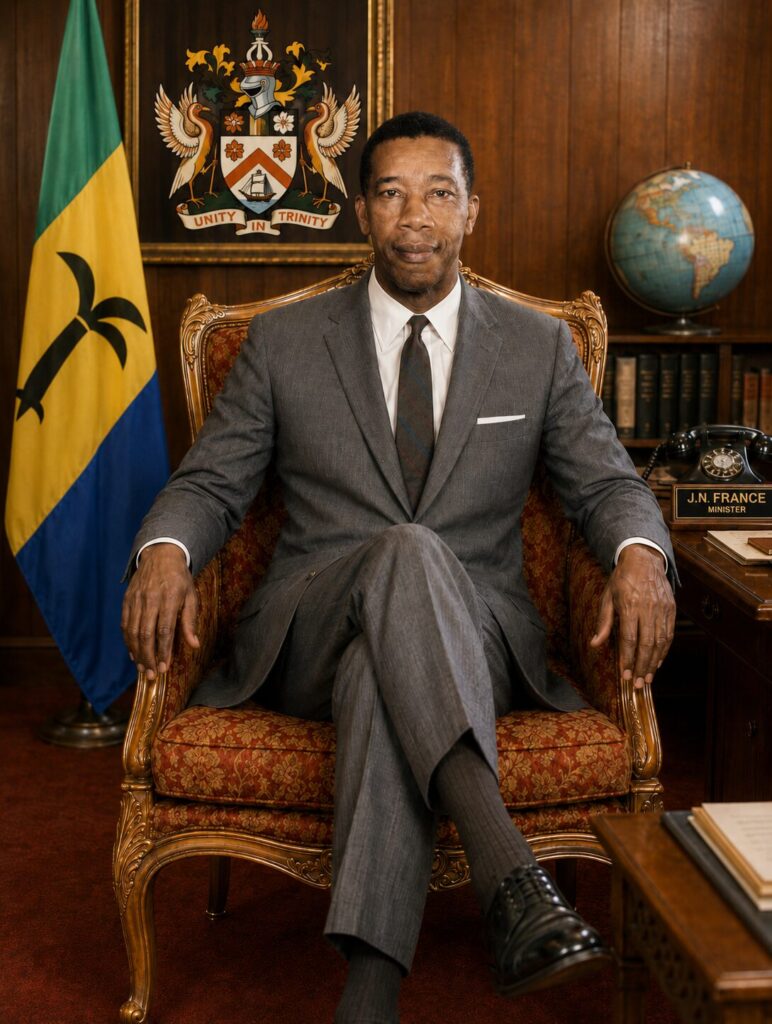
On May 21st, St. Kitts and Nevis remembered The Right Excellent Sir Joseph Nathaniel France, who died on that date in 1997. Born in Mount Lily, Nevis, Sir Joseph became one of the most enduring public servants in the history of the Federation.
His life was inseparable from the rise of the labour movement. Historic St. Kitts records that after the Trade Union Act of 1940 made it possible for a trade union to operate without legal restraint, the St. Kitts-Nevis Trades and Labour Union was launched and J.N. France became its first General Secretary. He later served as Minister for Social Services, with responsibility for education, health and social affairs. (historicstkitts.kn)
France’s legacy lies in institution-building. He helped turn protest into policy. He understood that the struggle for workers’ rights had to be matched by the building of public systems: schools, hospitals, social protections, wage safeguards and mechanisms for collective bargaining.
The naming of the Joseph N. France General Hospital stands as one of the most visible symbols of his contribution to health and social development. But his deeper legacy lies in the quiet architecture of social advancement — the laws, systems and public commitments that helped lift working people from vulnerability toward citizenship.
His life reminds the nation that progress is not only made by those who lead from the front page. It is also made by disciplined organisers, negotiators, educators and servants of the people.
Sir Simeon Daniel: Nevisian Identity, Autonomy and Development
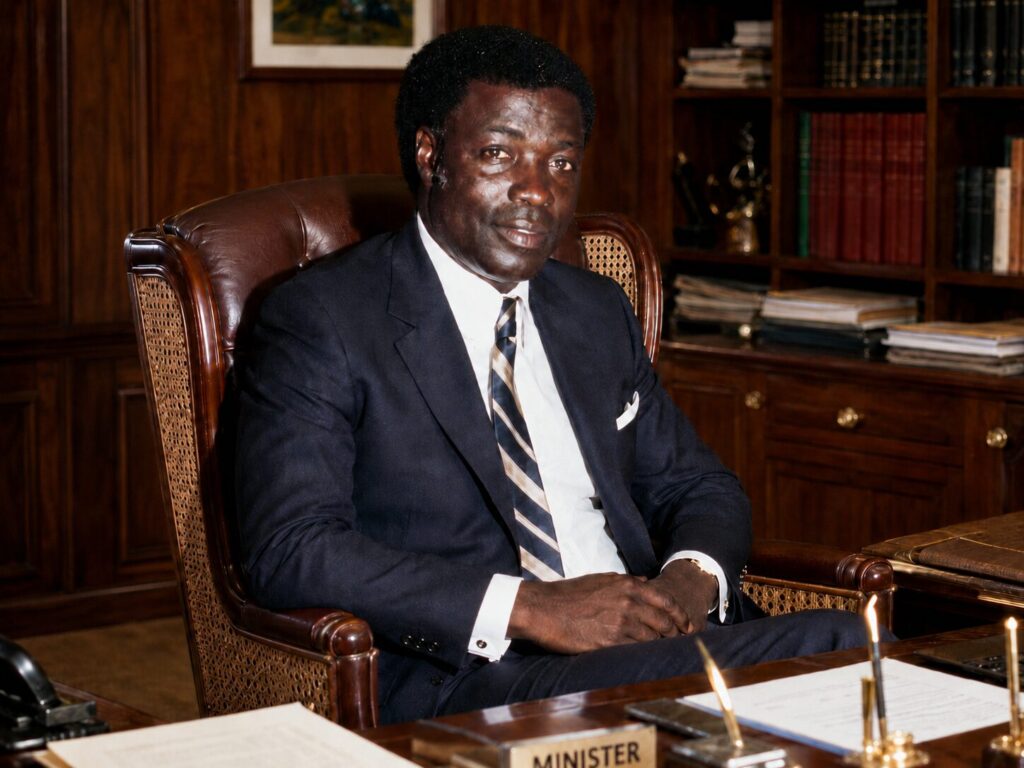
On May 27th, the Federation will observe the anniversary of the passing of The Right Excellent Sir Simeon Daniel, first Premier of Nevis and a foundational figure in modern Nevisian politics.
Born on August 22nd, 1934, in Barnes Ghaut, Nevis, Daniel rose through teaching, law and public service before becoming one of the founding members of the Nevis Reformation Party in 1970. Daniel Brantley & Associates records that he served as Chairman of the Local Council, entered the National Assembly, became Minister of Finance and Nevis Affairs in 1980, and became the first Premier of Nevis on Independence Day, September 19th, 1983. (Daniel Brantley Attorneys at Law)
Sir Simeon’s legacy is inseparable from the constitutional and political identity of Nevis. He gave organised expression to Nevisian concerns about development, representation, autonomy and dignity within the Federation.
His premiership was marked by major developmental initiatives, including improvements in electricity, water, roads, education, land ownership, housing and tourism. His role in the development of Nevis’ financial sector and the attraction of major investment helped shape the island’s modern economic direction. (Daniel Brantley Attorneys at Law)
For Nevisians, Sir Simeon remains more than a political figure. He is remembered as a symbol of self-respect, self-determination and the belief that Nevis must never be an afterthought in the national project.
A Month of National Memory
The deaths of Bradshaw, Southwell, Moore, France and Daniel all falling in May give the month a special place in the political memory of St. Kitts and Nevis.
They did not all lead in the same way. They did not all emerge from the same island, profession or political moment. Their styles differed. Their priorities differed. Their public reputations were shaped by different eras and different challenges.
But collectively, they represent the foundations of modern St. Kitts and Nevis:
Bradshaw represents labour power, social transformation and the push toward nationhood.
Southwell represents continuity, regional cooperation and constitutional advancement.
Moore represents law, diplomacy, intellect and international representation.
France represents workers’ rights, social services and the institutional upliftment of ordinary citizens.
Daniel represents Nevisian development, autonomy, constitutional identity and island empowerment.
Their combined story is the story of a small Federation wrestling with large questions: Who owns the land? Who controls labour? Who receives education? Who has access to healthcare? How should power be shared between St. Kitts and Nevis? How should small Caribbean states cooperate? How does a former colony become a confident nation?
These questions remain relevant today.
Why Their Legacies Still Matter
In 2026, the Federation faces a new generation of challenges: cost of living pressures, healthcare concerns, housing demands, water and infrastructure issues, public safety anxieties, youth opportunity, migration, climate vulnerability, governance debates and the ongoing need for balanced development between St. Kitts and Nevis.
The lives of these May leaders do not provide simple answers to every modern problem. But they provide a standard of seriousness. They remind today’s leaders that public office is not merely about ceremony, speeches or political advantage. It is about building systems that last beyond one administration.
Their generation understood that national development required organisation, sacrifice, discipline and vision. They worked in an era with fewer resources, less technology and heavier colonial burdens. Yet they built institutions, expanded rights, negotiated constitutional change and gave ordinary citizens a stronger voice in the affairs of the country.
That is why May should be remembered not only with wreaths and tributes, but with renewed national study. Their stories should be taught, debated, documented and preserved. Their achievements should be honoured honestly. Their shortcomings, where history records them, should also be examined maturely. True national memory does not require myth-making. It requires understanding.
A Call to Remember
As St. Kitts and Nevis pauses on this May 23rd, the 48th anniversary of Sir Robert Bradshaw’s passing, the country is also called to remember the wider circle of May pioneers whose service helped shape the Federation.
From St. Paul’s to Mount Lily, from Barnes Ghaut to Basseterre, from the union hall to the Cabinet room, from the courtroom to the United Nations, from local councils to regional councils, these men helped define the political and social journey of a young nation.
Their lives remind us that the Federation’s history is not abstract. It is human. It is built on names, places, struggles, choices, victories and unfinished work.
May they continue to rest from their labours.
May their legacies continue to instruct the nation.
And may May forever remain a month when St. Kitts and Nevis remembers the giants who helped carry the Federation toward dignity, self-government and national identity.
















Leave a comment
You must be logged in to post a comment.