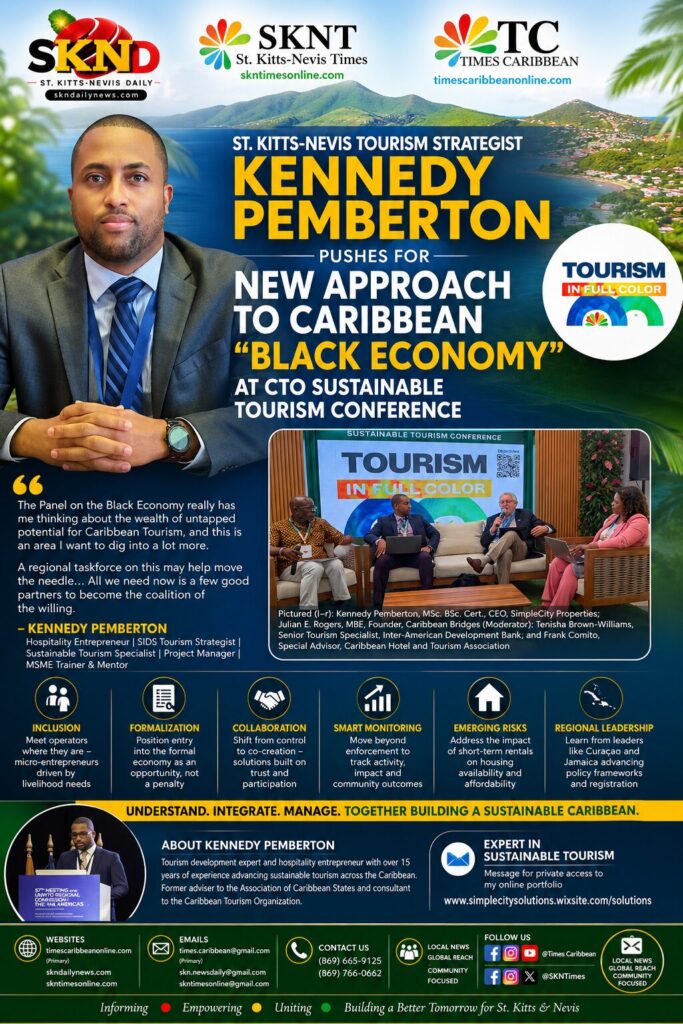
ST. KITTS-NEVIS TOURISM STRATEGIST KENNEDY PEMBERTON PUSHES FOR NEW APPROACH TO CARIBBEAN “BLACK ECONOMY” AT CTO SUSTAINABLE TOURISM CONFERENCE

A leading St. Kitts and Nevis tourism professional is helping to shape critical regional conversations on the future of sustainable tourism development in the Caribbean.
Kennedy Pemberton recently participated as a featured panelist at the Caribbean Tourism Organization Sustainable Tourism Conference 2026 (STC2026) held in Belize, where discussions focused heavily on one of the region’s fastest-growing and most controversial tourism realities — the so-called “black economy” in tourism, including the rapid rise of informal short-term rentals and unregulated tourism enterprises.
Pemberton, a respected hospitality entrepreneur, sustainable tourism specialist, and CEO of SimpleCity Properties in St. Kitts, joined an expert regional panel examining how Caribbean destinations can balance tourism growth with fairness, regulation, sustainability, and community impact.
Following the conference, Pemberton shared his enthusiasm about the high-level discussions, describing the experience as deeply energizing and intellectually stimulating.
“So I’m back from Belize and feeling absolutely wired about having gone to a great Caribbean Tourism Organization (CTO) Conference on Sustainable Tourism Development 2026,” Pemberton wrote.
“The Panel on the Black Economy really has me thinking about the wealth of untapped potential for Caribbean Tourism, and this is an area I want to dig into a lot more.”
He further proposed the establishment of a regional task force to examine and address the issue collaboratively across Caribbean territories.
“A regional taskforce on this may help move the needle so I’m sending up a batsignal and setting aside some time to volunteer for such a thing. All we need now is a few good partners to become the coalition of the willing,” he stated.
The panel discussion explored the increasingly complex relationship between tourism expansion and the informal economy throughout the Caribbean, particularly as short-term rental platforms continue to reshape local housing markets, tourism revenues, taxation systems, and destination governance structures.
Participants emphasized that many operators within the informal tourism economy are not criminal actors, but rather self-taught micro-entrepreneurs attempting to earn livelihoods in challenging economic environments.
Key themes emerging from the conference included:
- shifting from punitive enforcement toward collaboration and inclusion,
- creating registration systems and policy frameworks,
- improving stakeholder engagement,
- developing coaching and capacity-building initiatives,
- and balancing tourism profitability with community wellbeing and housing affordability.
The discussion also highlighted growing regional concerns surrounding the impact of unregulated short-term rentals on housing availability and affordability — issues already creating significant pressure in many major global cities and increasingly emerging across Caribbean islands.
The conference recognized countries such as Curaçao and Jamaica for taking proactive steps toward formalizing and managing aspects of the informal tourism sector through policy development and tourism registration systems.
Pemberton’s participation at the regional conference further underscores the growing influence of St. Kitts and Nevis nationals in international tourism policy and sustainable development conversations.
Over the years, Pemberton has built an impressive regional and international tourism résumé, having served in leadership and consultancy roles with the Association of Caribbean States, the Caribbean Tourism Organization, and Green Case Sustainable Tourism.
His professional experience includes advancing sustainable tourism policy across more than 25 Caribbean member states, developing regional tourism resilience projects, and helping secure international funding for tourism development initiatives.
Academically, Pemberton graduated with distinction from the University of Surrey with a Master’s degree in Tourism Development after previously earning First Class Honours in International Tourism Management with Marketing from the University of the West Indies.
Observers say the conference discussion reflects a broader shift taking place throughout Caribbean tourism policymaking — one that increasingly recognizes that sustainable tourism cannot simply focus on visitor arrivals and hotel investments, but must also address inclusion, equity, local livelihoods, housing pressures, and community resilience.
As Caribbean tourism continues evolving in the post-pandemic era, voices like Kennedy Pemberton’s are emerging as part of a new generation of regional thinkers pushing for more adaptive, people-centered, and data-driven tourism models capable of balancing economic opportunity with long-term sustainability.
TIMES CARIBBEAN | SKN TIMES | ST. KITTS-NEVIS DAILY
















Leave a comment
You must be logged in to post a comment.