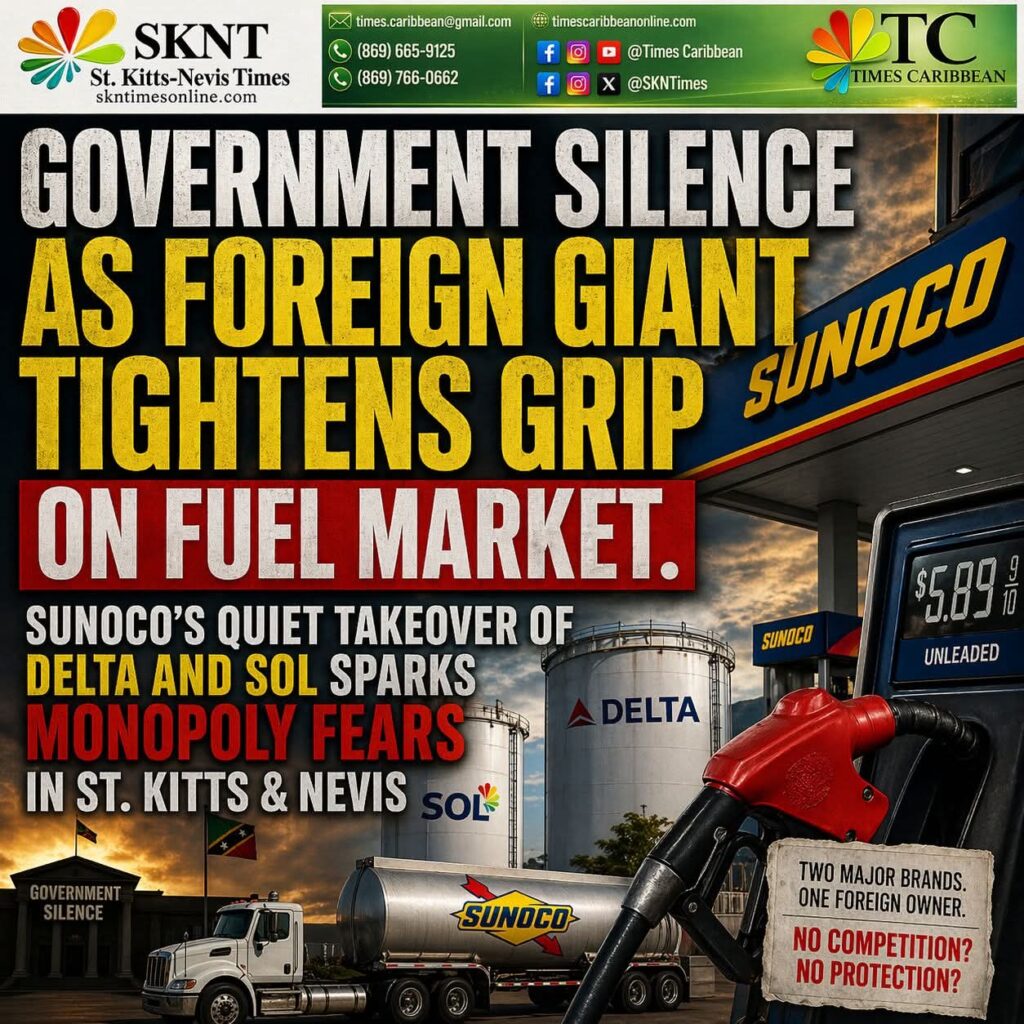
GOVERNMENT SILENCE AS FOREIGN GIANT TIGHTENS GRIP ON FUEL MARKET. SUNOCO’S QUIET TAKEOVER OF DELTA AND SOL SPARKS MONOPOLY FEARS IN ST. KITTS & NEVIS

BASSETERRE, St. Kitts & Nevis — Beneath the polished corporate language of “growth,” “stability,” and “expanded capability,” a far more consequential reality is taking shape—one that could fundamentally reshape fuel pricing power across the Caribbean.The longstanding Virgin Islands fuel supplier Delta Petroleum is now under the control of Sunoco LP, the parent company of Sol Petroleum, following a transaction that reportedly took effect on April 1, 2026.Framed internally as “an exciting new chapter,” the acquisition has been pitched to employees as a strategic alignment that brings greater strength, deeper resources, and uninterrupted supply. A letter from Sol Caribbean Ltd President Roger Bryan emphasized continuity—business as usual, familiar contacts, and a promise of enhanced service.But beyond the corporate optimism lies a more sobering question for small island economies:At what point does “strength” become dominance—and who protects the consumer when it does?—CORPORATE LANGUAGE VS. MARKET REALITYThe official narrative is predictable:A broader, more diversified energy networkAccess to global supply chainsImproved operational resilienceExpanded product offeringsOn paper, it reads like progress.In practice—especially in small, import-dependent markets—it raises red flags.When two significant players in the same regional supply ecosystem are consolidated under one corporate structure, the immediate effect is not just efficiency. It is reduced competitive tension.And in markets like St. Kitts and Nevis, where scale is limited and alternatives are few, that reduction can quickly translate into pricing influence.—THE CARIBBEAN’S STRUCTURAL VULNERABILITYUnlike large economies, Caribbean states do not benefit from:Multiple independent refiners competing for market shareDeep domestic reserves or refining capacityStrong anti-trust enforcement regimes with global leverageInstead, they rely heavily on imported fuel controlled by a small number of regional distributors.With Delta now integrated into the Sol/Sunoco framework, that already narrow field becomes even tighter.The result?A market structure where supply, storage, distribution, and retail influence can increasingly converge under one dominant network.—“BUSINESS AS USUAL” — FOR WHOM?The internal message to employees stresses continuity:> operations remain unchanged,contacts stay the same,services continue uninterrupted.That reassurance is aimed at stability within the company.But for consumers, the concern is not whether fuel will be available.It is whether it will remain affordable.Because history shows that major consolidations rarely produce immediate shocks. Instead, they create gradual shifts:Subtle price adjustmentsReduced promotional competitionStandardized pricing across networksIncreased sensitivity to global pricing strategiesThese changes are often incremental—but over time, they compound.—THE POLICY VACUUM IN ST. KITTS & NEVISPerhaps the most glaring issue is not the deal itself—but the absence of visible oversight.There has been no comprehensive public briefing from the government.No clear statement from regulators.No assurance that consumer interests are being actively safeguarded.The administration of Terrance Drew now faces a critical test:Will it proactively engage with this development—or react only after its consequences are felt?Because by the time price pressures emerge, the structural shift will already be complete.—GLOBAL POWER, LOCAL IMPACTWith a combined distribution network exceeding 15 billion gallons annually, the Sol/Sunoco structure is not just a regional player—it is a global force.That scale brings undeniable advantages:Purchasing powerSupply securityLogistical efficiencyBut it also introduces a fundamental imbalance:Decisions affecting Caribbean consumers may increasingly be made far outside the Caribbean.And when pricing, supply strategy, or cost recovery decisions are driven by global considerations, small markets risk becoming afterthoughts.—THE MONOPOLY WARNING SIGNALTo be clear, the acquisition does not automatically create a legal monopoly.But it undeniably moves the market closer to concentrated control.And in economics, concentration is often a precursor to:Reduced competitionIncreased barriers to entryGreater pricing discretionFor everyday citizens already grappling with rising living costs, the implications are direct and immediate.Fuel prices influence:Transportation faresElectricity generationFood distributionConstruction costsIn short, fuel is inflation’s accelerant.—THE QUESTIONS THAT DEMAND ANSWERSThis development cannot be allowed to pass quietly.Key questions remain unanswered:Has the government conducted a market impact assessment?Are there price control mechanisms ready to be deployed if necessary?Will there be greater transparency in how fuel prices are set?Is there a strategy to encourage competition or diversify supply sources?Without clear answers, public confidence will erode—and speculation will fill the void.—FINAL ANALYSIS: A TURNING POINT, NOT A FOOTNOTEThis is not just another corporate acquisition buried in regional business pages.It is a structural shift in how fuel may be supplied, priced, and controlled across the Caribbean.For St. Kitts and Nevis, the stakes are especially high.Because once market concentration reaches a certain threshold, reversing it becomes nearly impossible.The time for scrutiny is now.The time for policy is now.The time for leadership is now.Anything less risks leaving consumers exposed in a market where the balance of power has already begun to tilt.
















Leave a comment
You must be logged in to post a comment.