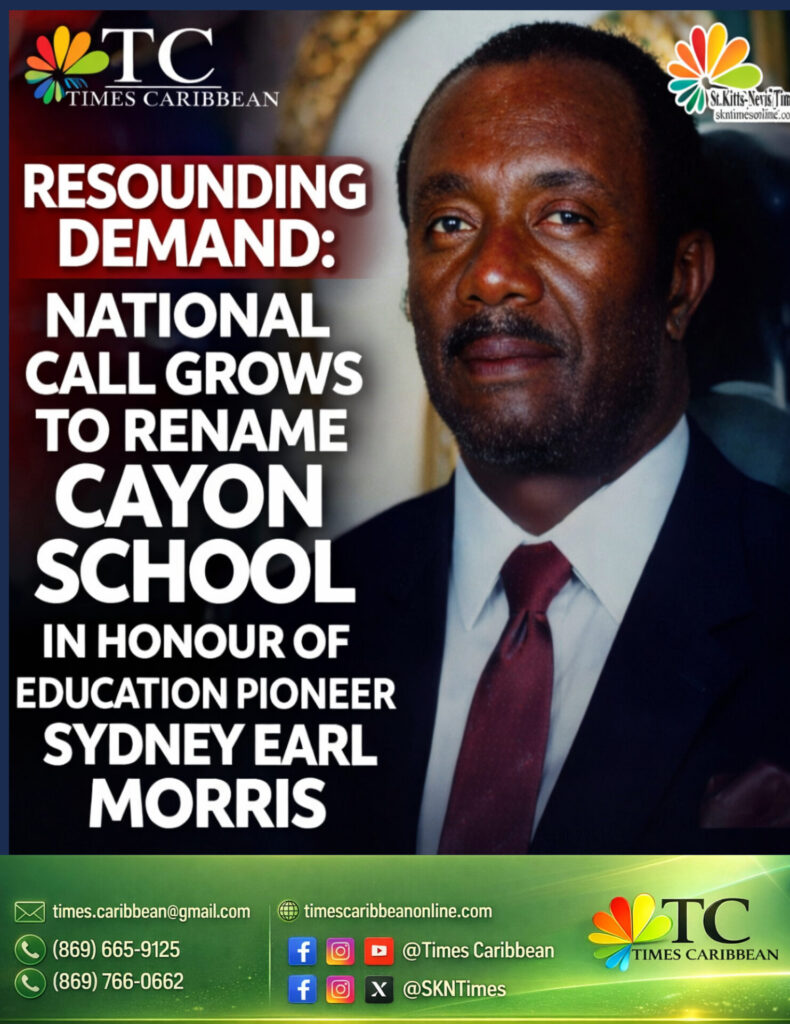
NATIONAL CALL TO RENAME CAYON SCHOOL IN HONOUR OF EDUCATION PIONEER SYDNEY EARL MORRIS

In what is rapidly evolving into a powerful national conversation, a groundswell of advocacy is building across St. Kitts and Nevis to immortalize one of the Federation’s most transformative figures in education — — through the renaming of either Cayon High School or Cayon Primary School.
At the heart of this movement lies a compelling argument: that Morris’s legacy is not merely historical, but foundational — etched into the very DNA of the Federation’s modern education system.
A LEGACY THAT BUILT A NATION’S INTELLECTUAL BACKBONE
To understand the urgency and emotional weight behind this call is to understand the magnitude of Morris’s contribution. As the Federation’s first Minister of Education, Morris did not inherit a system — he engineered one.
During his tenure spanning 1984 to 1993, Morris presided over a transformative era that positioned St. Kitts and Nevis among the Caribbean’s most progressive education systems. His policy direction was not incremental — it was structural, visionary, and nation-defining.
From curriculum modernization to institutional consolidation, Morris championed reforms that expanded access, strengthened teacher training, and aligned education with national development goals. His leadership laid the groundwork for a generation of thinkers, professionals, and leaders who would shape the Federation’s future.
THE ARCHITECT OF TERTIARY EDUCATION: A VISION REALIZED
Perhaps his most enduring legacy is the creation of the College of Further Education (CFE) — a bold and unprecedented integration of multiple institutions, including the Teacher’s Training College, Nurses Training School, Sixth Form, and Technical College.
This visionary consolidation formed the Federation’s first comprehensive tertiary institution, later renamed the .
It was not merely an administrative merger — it was a philosophical shift. Morris recognized early that national development demanded a unified, accessible, and dynamic tertiary framework. Today, CFBC stands as a towering testament to that foresight.
FROM CLASSROOM TO CABINET: A LIFE OF SERVICE
Morris’s journey was not forged in politics alone — it was rooted in education at its most fundamental level.
His academic formation began at in Barbados, followed by distinguished studies at , where he earned both a B.A. (Cum Laude) and an M.A. in Education Administration.
Upon returning home, he immersed himself in grassroots education — serving as Principal of Cayon All Age School and later St. Peter’s Primary School. He became the Federation’s first Graduate Head of a Primary School, setting a new standard for academic leadership.
Beyond the classroom, he served as Vice President of the St. Kitts Teachers’ Association and later transitioned into industrial relations, demonstrating a rare blend of academic insight and socio-economic awareness.
CAYON’S SON — A COMMUNITY ROOTED IN HIS LEGACY
For many, the renaming effort is not simply symbolic — it is deeply personal.
Morris’s connection to Cayon is profound. As Chairman of the Cayon Community Council and a lifelong advocate for community upliftment, his influence extended beyond policy into the everyday lives of citizens.
Supporters argue that no tribute could be more fitting than embedding his name into the very institutions that reflect his life’s work — schools that continue to educate generations from the very community he helped shape.
A QUESTION OF NATIONAL MEMORY AND HONOUR
The push to rename Cayon High or Cayon Primary raises broader questions about how nations honour their architects.
In a region where institutions often bear colonial-era names or generic identifiers, advocates say this is an opportunity to reclaim narrative space — to celebrate indigenous excellence and national builders whose contributions have too often gone under-recognized.
Critically, this is not just about commemoration — it is about educational identity. Attaching Morris’s name to a school would serve as a daily reminder to students of the power of vision, discipline, and service.
THE MOMENT FOR DECISION
As public discourse intensifies, attention now turns to policymakers, education authorities, and community stakeholders. Will this call translate into action?
If history is any guide, the legacy of is one that has already shaped the Federation in profound ways. The question now is whether the nation will formally recognize that legacy in a way that future generations can see, speak, and be inspired by — every single day.
THE BOTTOM LINE
This is more than a renaming proposal — it is a national reckoning with legacy, identity, and gratitude.
And as the chorus grows louder, one thing is clear:
Sydney Earl Morris did not just serve education — he transformed it.
The call now is simple, yet powerful:
Let his name stand where his impact still lives — in the classrooms of the nation he helped build.
















Leave a comment
You must be logged in to post a comment.