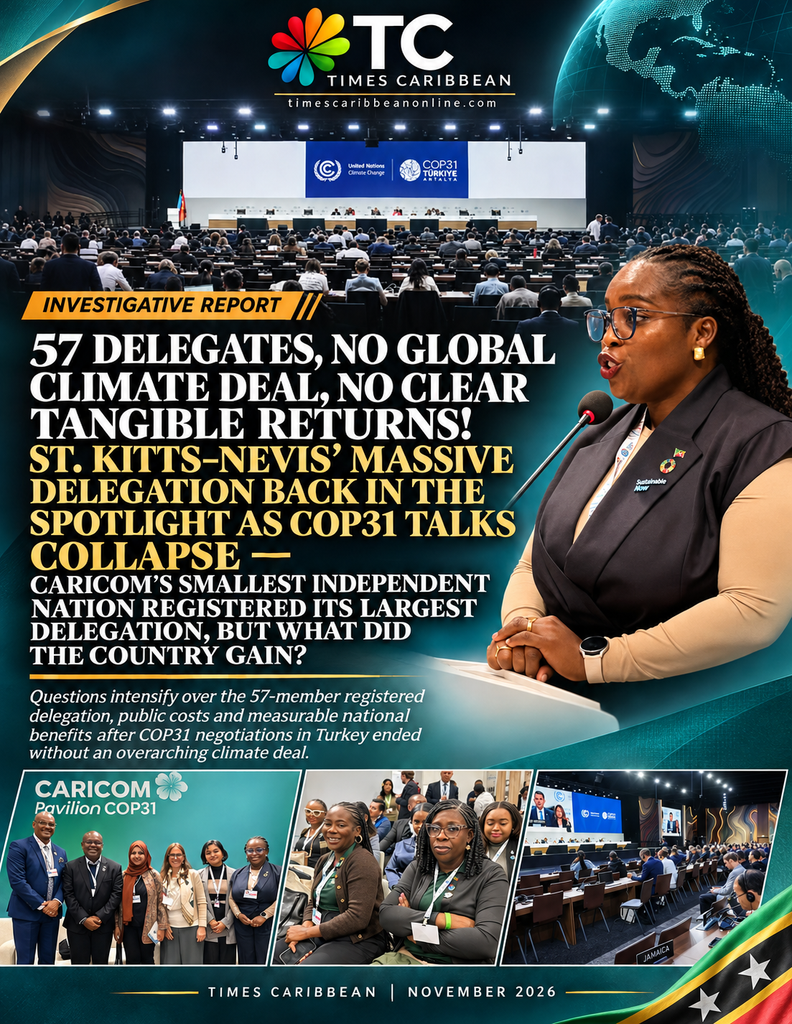
57 DELEGATES, NO GLOBAL CLIMATE DEAL, NO CLEAR TANGIBLE RETURNS! ST. KITTS–NEVIS’ MASSIVE DELEGATION BACK IN THE SPOTLIGHT AS COP31 TALKS COLLAPSE — CARICOM’S SMALLEST INDEPENDENT NATION REGISTERED ITS LARGEST DELEGATION, BUT WHAT DID THE COUNTRY GAIN?
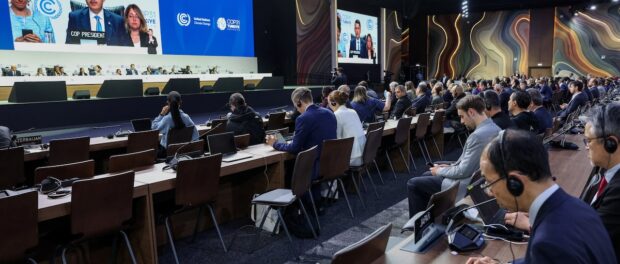
57 DELEGATES REGISTERED, GLOBAL CLIMATE DEAL COLLAPSES! ST. KITTS–NEVIS’ MASSIVE COP31 DELEGATION IN TURKEY RAISES QUESTIONS OVER COSTS, ACCOUNTABILITY AND NATIONAL BENEFITS!
FEDERATION REGISTERED 57 DELEGATES COMPARED TO TRINIDAD AND TOBAGO’S FOUR AND THE BAHAMAS’ 37 — WHAT DID ST. KITTS AND NEVIS SECURE, AND AT WHAT COST TO TAXPAYERS?
TIMES CARIBBEAN | INVESTIGATIVE NEWS REPORT | NOVEMBER 24, 2026
BASSETERRE, ST. KITTS — The collapse of negotiations for a major global climate agreement at COP31 in Antalya, Türkiye, has brought renewed attention to the extraordinary size of St. Kitts and Nevis’ registered delegation, raising legitimate questions surrounding public expenditure, accountability and measurable national benefits.
The Federation registered an astonishing 57 delegates for the international climate conference, the largest registered contingent among CARICOM member states, according to previously published figures based on United Nations registration data.
Deputy Prime Minister Dr. Geoffrey Hanley and Minister of Climate Action Dr. Joyelle Clarke were among the senior government representatives participating in the conference.
Yet, after more than two weeks of intensive international negotiations, COP31 ended on Sunday, November 22, without an overarching climate agreement. Deep divisions over fossil fuels prevented countries from reaching consensus, according to CNN, Reuters and other international media outlets. KVIA +3
THE WESTERN HEMISPHERE’S SMALLEST INDEPENDENT NATION REGISTERED CARICOM’S LARGEST DELEGATION
St. Kitts and Nevis, the smallest sovereign nation in the Western Hemisphere and the world’s smallest sovereign federation, registered 37 party delegates and 20 additional overflow delegates. Commonwealth of Learning +1
The disparity between the Federation and several significantly larger Caribbean countries is striking.
COP31 Caribbean delegation comparison
Provisional registered delegates
St. Kitts and Nevis
57
Cuba
40
The Bahamas
37
Belize
37
Antigua and Barbuda
34
Barbados
29
Grenada
28
Saint Lucia
25
Suriname
24
Guyana
20
Jamaica
17
Dominica
15
St. Vincent and the Grenadines
5
Trinidad and Tobago
4
Source: Carbon Brief and previously published UNFCCC-based registration figures. Times Caribbean Online +1
The Federation registered more than 14 times as many delegates as Trinidad and Tobago, 40 more than Jamaica and 20 more than The Bahamas.
The Dominican Republic, which is not a CARICOM member, registered 87 delegates.
Importantly, these provisional registration figures do not establish how many individuals actually travelled to Türkiye or how many were financed by the government.
WHAT DID THE ENTIRE EXERCISE COST?
International travel to Türkiye, hotel accommodation, subsistence allowances, transportation and other conference-related expenses can represent substantial financial commitments.
However, the total cost to the St. Kitts and Nevis Treasury remains unverified.
The size of the registered delegation warrants a detailed public accounting from the relevant government ministries.
Among the questions requiring answers are:
- Who were the 57 registered delegates, and what were their respective responsibilities?
- How many actually travelled to Türkiye?
- What was the total expenditure on airfare, accommodation, allowances and related expenses?
- How many delegates received government funding, and how many were externally sponsored?
- What new climate financing commitments or investment agreements were secured?
- What specific national objectives required representation on such a scale?
- Will the government publish a comprehensive post-conference expenditure and performance report?
These are reasonable questions of public financial accountability.
COP31: A MAJOR INTERNATIONAL SETBACK
The conference’s principal political agreement failed to materialise after countries could not reconcile their differences over language addressing the transition away from fossil fuels.
For vulnerable Caribbean nations facing rising sea levels, coastal erosion, extreme weather and mounting adaptation costs, the breakdown represents a significant setback.
However, some technical decisions were adopted despite the failure of the overarching agreement. The conference was therefore not entirely without outcomes. Reuters +2
GOVERNMENT ANNOUNCES NATIONAL LOSS AND DAMAGE STRATEGY
To its credit, the St. Kitts and Nevis Government officially launched its National Loss and Damage Strategy at COP31 on November 10.
According to the St. Kitts and Nevis Information Service, the initiative seeks to strengthen national climate resilience, improve financial preparedness and facilitate access to international climate funding.
Minister Clarke was also assigned regional negotiating responsibilities by CARICOM, covering the Global Stocktake and Just Transition. SKNIS +1
These are documented activities. However, launching a strategy is not the same as securing funding for its implementation.
A detailed assessment of the delegation’s achievements, financial commitments and follow-up arrangements would help establish whether the scale of participation was justified.
57 DELEGATES — THE QUESTION OF VALUE FOR MONEY
There is no dispute that St. Kitts and Nevis must maintain a strong presence in international climate negotiations. Small island developing states have considerable interests at stake.
But meaningful international representation and responsible management of public resources must go hand in hand.
With COP31’s overarching agreement now unsuccessful, the government has an opportunity to explain precisely what the Federation gained independently of the global negotiations.
How much was spent? Who benefited? What was secured? And what tangible improvements can the people of St. Kitts and Nevis expect?
The answers should be supported by documented expenditure, measurable outcomes and a clear implementation timetable.
Fifty-seven registrations. Thousands of miles from home. No overarching global climate agreement.
The next step is a transparent accounting of the Federation’s participation.
Sources: CNN, Reuters, Carbon Brief, UNFCCC, CARICOM and the St. Kitts and Nevis Information Service.
















Leave a comment
You must be logged in to post a comment.