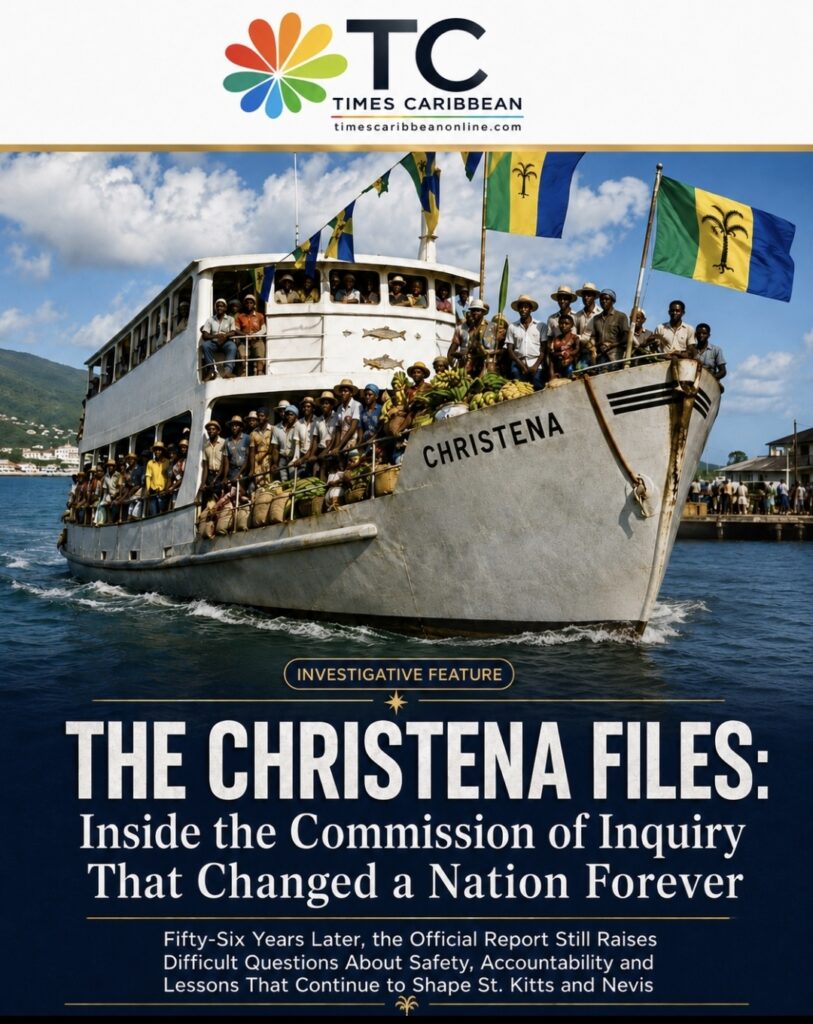
THE CHRISTENA FILES: Inside the Commission of Inquiry That Changed a Nation Forever
Fifty-Five Years Later, the Official Report Still Raises Difficult Questions About Safety, Accountability and Lessons That Continue to Shape St. Kitts and Nevis
By Times Caribbean | Special Historical Feature
On the afternoon of Saturday, August 1, 1970, the waters between St. Kitts and Nevis became the scene of the worst peacetime disaster in the history of the Federation.
Within minutes, the government-operated ferry MV Christena disappeared beneath the surface of The Narrows, claiming hundreds of lives, devastating nearly every community across both islands and forever altering the national consciousness.
Yet while generations have remembered the names of the victims, fewer people have studied the remarkable document that followed—the 1970 Commission of Inquiry Report.
More than simply identifying how a ferry sank, the Commission examined an entire system: government administration, maritime regulation, vessel operation, maintenance, passenger control, emergency preparedness and public accountability.
Even today, its findings remain strikingly relevant.
More Than an Investigation
Established under the Commissions of Inquiry Act, Commissioner J.D.B. Renwick was tasked with determining not only what happened aboard the MV Christena, but why it happened and what changes were needed to prevent another catastrophe.
Public hearings were conducted in Charlestown and Basseterre during August and September 1970. The inquiry heard evidence from 45 witnesses, including survivors, crew members, engineers, police officers, civil servants, marine experts, fishermen, rescuers and government officials. The report was completed on October 1, 1970.
Unlike many disaster investigations that focus on one isolated event, this inquiry examined years of operational practices leading up to the tragedy.
The Ferry That Connected Two Islands
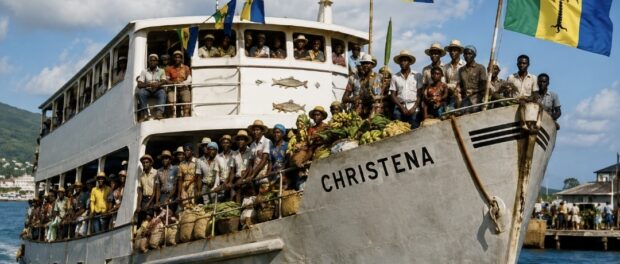
Completed in May 1959 by Sprostons Limited in Georgetown, British Guiana (now Guyana), the MV Christena had become far more than a ferry.
It was the economic and social lifeline between St. Kitts and Nevis.
Every day it transported:
- Students travelling to school
- Government workers
- Farmers
- Vendors
- Small business owners
- Families
- Holiday travellers
- Freight and agricultural produce
For thousands of people, there simply was no practical alternative.
The Commission noted the vessel measured approximately 66 feet in length, had a 16-foot beam, featured a steel hull with two decks, and was powered by twin Caterpillar diesel engines. It was designed to carry approximately 130 passengers, five tons of cargo and a crew of five.
A Disaster Years in the Making?
Perhaps the Commission’s most revealing conclusion is that the tragedy did not emerge without warning.
The inquiry uncovered evidence that concerns regarding overcrowding had been raised years before the disaster.
Correspondence reviewed by the Commission showed:
- complaints had been made;
- officials were aware of recurring overcrowding concerns;
- discussions occurred within government departments;
- investigations were undertaken.
Yet the report found little evidence that these concerns resulted in lasting corrective action before August 1, 1970.
This transformed the inquiry from a simple accident investigation into a broader examination of institutional responsibility.
The Holiday That Changed Everything
The Commission reconstructed the final voyage in remarkable detail.
Saturday, August 1 marked the beginning of the August holiday weekend.
Passengers crowded Basseterre’s Deep Water Harbour throughout the afternoon.
Entire families travelled to Nevis for weekend celebrations.
Students returned home.
Workers headed to spend the holiday with relatives.
Late arrivals rushed aboard moments before departure.
Witnesses consistently described a vessel filled beyond normal conditions.
Passengers occupied benches, aisles, railings, open deck spaces and virtually every available standing area.
Some witnesses estimated passenger numbers far beyond the ferry’s intended capacity, although the exact figure has remained one of the enduring mysteries of the disaster.
Weather Was Not the Villain
One of the Commission’s most significant findings challenged widespread assumptions.
Sea conditions, investigators concluded, were generally calm.
Visibility remained good.
Weather was not considered the primary cause of the sinking.
That conclusion redirected attention toward issues of vessel stability, loading practices and operational management.
What Witnesses Saw
Survivors described the vessel beginning to list before rolling heavily.
The ferry eventually capsized with terrifying speed.
Passengers were thrown directly into the sea.
Others became trapped inside the vessel.
The report recounts harrowing testimony from survivors who described screams, panic and desperate attempts to escape as the vessel overturned. Nearby fishermen and private boat operators rushed toward the scene almost immediately, rescuing as many people as they could under extremely difficult conditions.
Ordinary Citizens Became Heroes
One of the report’s most moving sections recognises the courage of ordinary people.
Before official emergency systems could fully respond, local fishermen, private captains and volunteers were already pulling survivors from the sea.
Many rescued strangers while risking their own lives.
Without those spontaneous efforts, the Commission suggested, the loss of life would almost certainly have been even greater.
The Mechanical Question
Investigators carefully examined whether a catastrophic mechanical failure alone explained the sinking.
The inquiry reviewed:
- the hull;
- steering systems;
- structural integrity;
- vessel stability;
- cargo distribution;
- trim;
- maintenance records.
The report ultimately concluded that no single mechanical defect, by itself, fully explained what occurred. Instead, the disaster resulted from several interacting factors that together compromised the vessel’s safety.
Overcrowding Under the Microscope
The Commission devoted significant attention to passenger loading.
Evidence indicated:
- passenger numbers exceeded intended capacity;
- weight distribution became uneven;
- many passengers congregated on the upper deck and stern;
- passenger movement influenced vessel stability.
Importantly, the inquiry did not attribute the tragedy solely to overcrowding. Rather, it identified overcrowding as one major factor within a wider chain of operational and administrative failures.
Government Administration Examined
The report scrutinised how the ferry service itself was managed.
Investigators examined:
- ticket sales;
- revenue collection;
- passenger counting procedures;
- crew responsibilities;
- maintenance schedules;
- regulatory compliance;
- government supervision.
Among the strongest criticisms was the absence of an independent and reliable system for verifying passenger numbers before departure—a weakness the Commission viewed as fundamental to safe operation.
Life-Saving Equipment
The inquiry also reviewed emergency preparedness.
Although life jackets and lifebuoys were carried aboard, the Commission concluded that the speed with which the vessel capsized left many passengers with little or no opportunity to locate or use them effectively.
In other words, equipment existed—but circumstances prevented many from accessing it in time.
A Blueprint for Reform
Rather than ending with criticism alone, Commissioner Renwick proposed sweeping reforms that would influence maritime policy long after the tragedy.
Among the recommendations were:
- strict enforcement of passenger limits;
- mandatory vessel inspections;
- comprehensive stability testing;
- stronger maintenance standards;
- improved crew training and certification;
- modern licensing procedures;
- enhanced communications equipment;
- better life-saving equipment;
- clearer legal responsibilities for operators and regulators;
- tougher penalties for breaches of maritime safety rules.
Many of these recommendations anticipated modern maritime safety standards that later became commonplace throughout the Caribbean.
More Than Numbers
Perhaps the most sobering part of the report lies in its appendices.
The Commission painstakingly compiled lists of those identified, those reported missing, survivors and witnesses who testified before the inquiry. These pages serve as a stark reminder that behind every statistic stood a family, a neighbour, a classmate or a friend whose life was forever changed.
The Enduring Legacy
Fifty-five years later, the MV Christena Commission of Inquiry remains one of the most important official documents ever produced in St. Kitts and Nevis.
It is not simply a record of how a ferry sank.
It is a study of how public institutions respond to risk, how warnings should be treated before tragedy strikes, and how accountability, regulation and safety must work together to protect lives.
Its central conclusion remains as relevant today as it was in 1970: catastrophic disasters rarely result from a single failure. More often, they arise when technical issues, human decisions, administrative weaknesses and overlooked warnings converge.
For St. Kitts and Nevis, the Christena Report stands as both a solemn memorial and a lasting call to vigilance—one whose lessons continue to resonate across Caribbean maritime transport more than half a century after the nation suffered its darkest day.
















Leave a comment
You must be logged in to post a comment.