FOUR YEARS AFTER TEAM UNITY COLLAPSE, BRANTLEY AGAIN SOUNDS ALARM OVER TREATMENT OF NEVIS. BLASTS FEDERAL GOVERNMENT OVER TREATMENT OF NEVIS, SCHOLARSHIPS, GEOTHERMAL AND DESTINY
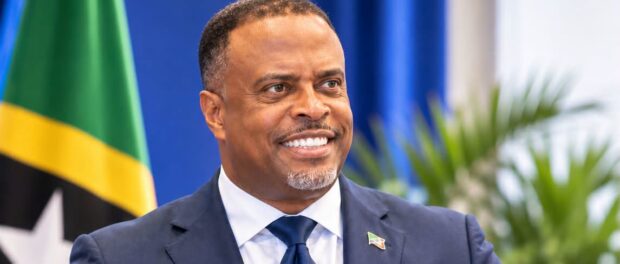
Nevis Premier blasts Drew-led Federal Government over scholarships, geothermal and Destiny, arguing that Nevis is still being sidelined in national development
CHARLESTOWN, NEVIS — Nearly four years after the dramatic collapse of the Team Unity Government, during a period when Premier Mark Brantley was among the senior coalition figures publicly demanding what he described as a “fair share” for Nevis, the Nevisian leader is once again sounding the alarm over what he sees as unequal treatment of the island by the Federal Government.
This time, Brantley’s criticisms are directed at the administration of Prime Minister Dr. Terrance Drew.
Brantley, who served as Deputy Prime Minister and Minister of Foreign Affairs in the former Team Unity administration, was a central figure in the bitter political breakdown of 2022. At the time, relations between Brantley’s Concerned Citizens Movement, the People’s Action Movement and then-Prime Minister Dr. Timothy Harris deteriorated amid several disputes, including Brantley’s repeated contention that Nevis was not receiving an equitable share of Citizenship by Investment revenues.
The disagreement eventually contributed to the collapse of the three-party Team Unity coalition, the dissolution of Parliament in May 2022 and a snap general election that August.
Now, four years later, Brantley is again raising concerns that Nevis is being treated as secondary within the Federation.
In a wide-ranging statement on the national political landscape, the Premier pointed to the distribution of overseas scholarships, the pace of geothermal development, the proposed Destiny project, the Nevis airport expansion and the longstanding question of equitable access to federal resources.
His central argument was clear: policies described as “national” too often appear, in his view, to be St. Kitts-centred policies with insufficient consideration for Nevis.
“DOES NEVIS NOT MATTER?”
Brantley questioned why discussions about national politics frequently focus almost exclusively on parties and political leaders based in St. Kitts.
“Is this a way of saying that the 30% of the populace and the 27% of the national seats on the island of Nevis do not matter?” he asked.
He argued that Nevis is too often left out of national policymaking.
“Too often the national debate seeks to relegate the people of Nevis to the back of the bus,” Brantley said, claiming that policies are sometimes framed with “zero input from Nevis, zero consultation with Nevis and zero regard” for their impact on the island.
According to Brantley, the problem cannot simply be blamed on the Constitution.
He argued that the constitutional relationship between the two islands can work where political leaders approach governance with what he described as a genuinely national outlook rather than an island-based perspective.
SCHOLARSHIP DISTRIBUTION COMES UNDER FIRE
One of Brantley’s strongest complaints concerned government-facilitated overseas scholarships.
He claimed that of approximately 40 students selected this year, just two were from Nevis.
Brantley recalled speaking with a young Nevisian who had applied but was unsuccessful.
According to the Premier, the young man asked: “Lord you mean not even 10 of the 40 could have been allocated to Nevis?”
Brantley said that question captured the broader problem.
He argued that allocating the overwhelming majority of available opportunities to students from one island cannot reasonably be viewed as balanced national development.
Times Caribbean has not independently confirmed an official island-by-island breakdown of the scholarship recipients, and the figure should therefore be understood as Brantley’s account.
GEOTHERMAL: “WHAT IF IT WAS IN ST. KITTS?”
Brantley also revisited one of Nevis’ most important potential economic assets — geothermal energy.
He argued that geothermal offers a possible long-term solution to the Federation’s energy challenges by providing a local, renewable source of power.
But the Premier questioned why development has taken so long.
His explanation was pointed.
Brantley suggested that because the geothermal resource is located on Nevis, it historically failed to receive the national urgency he believes it deserved.
“Can you imagine if geothermal energy lay beneath the soil of Tabernacle or Old Road?” he asked.
“My wager is that it would have been developed a long time ago.”
The criticism comes even as the geothermal initiative has advanced significantly in recent years and Brantley has publicly acknowledged cooperation from the current Federal Government on the project.
His latest argument therefore focuses largely on what he describes as decades of delay and the broader question of whether projects located on Nevis receive the same national priority as developments on St. Kitts.
DESTINY PROJECT BECOMES ANOTHER FLASHPOINT
Brantley also turned his attention to the proposed Destiny project, which he has described as potentially the largest private-sector investment ever undertaken in St. Kitts and Nevis.
According to Brantley, economic analysis prepared for the proposed development points to significant potential GDP growth, employment and wider economic activity.
But he says the project has spent months awaiting federal approval.
“Why?” Brantley asked.
His answer: because the project is located on Nevis.
The Premier questioned whether a project of similar size proposed for Cayon, Sandy Point or elsewhere on St. Kitts would have attracted the same degree of delay or public opposition.
Federal authorities, however, have previously stated that the Destiny proposal requires detailed examination because of its implications for areas falling within federal jurisdiction, including immigration, customs, citizenship, law enforcement, public finance and legislation.
That difference in perspective remains at the heart of the dispute: the NIA has pushed for the project to move ahead, while the Federal Government has maintained that proper regulatory and constitutional scrutiny is necessary.
NEVIS AIRPORT EXPANSION
Brantley also cited the ongoing expansion of the Vance W. Amory International Airport.
He said an outstanding issue remains regarding a Federal Government guarantee associated with a highly concessional loan being pursued for the project.
The Premier recalled a discussion with national business leaders during which one participant reportedly asked what an expanded Nevis airport would mean for traffic at the Robert L. Bradshaw International Airport in St. Kitts.
Brantley said the question illustrated what he considers a fundamental problem.
Instead of seeing development in Nevis as national progress, he argued, some persons continue to view economic gains on Nevis as potentially competing with St. Kitts.
ECHOES OF THE 2022 “FAIR SHARE” BATTLE
The latest intervention carries particular political weight because the issue of Nevis’ treatment within the Federation is not new for Brantley.
In the months before Team Unity disintegrated in 2022, he repeatedly complained that Nevis was not receiving what he considered a fair share of CBI revenues.
Then-Prime Minister Dr. Timothy Harris rejected the suggestion that his administration had treated Nevis unfairly and pointed to hundreds of millions of dollars in federal support and social programmes benefiting the island.
Brantley nevertheless maintained that the fundamental issue was not whether Nevis received money, but whether it received an equitable share of national revenues.
That dispute became one of the defining issues in the deterioration of relations within Team Unity.
After the Drew administration took office in August 2022, Brantley continued pressing the same issue. In 2023, however, he publicly described his discussions with Prime Minister Drew over the fair-share question as open and mature and said a committee had been proposed to examine the matter.
The Premier’s latest comments suggest that, despite that dialogue, his broader concerns about Nevis’ place within the Federation remain unresolved.
CCM TAKING ISSUE TO THE NATIONAL ELECTORATE
Brantley made clear that this will not remain merely a dispute between the Nevis Island Administration and Basseterre.
He said the Concerned Citizens Movement intends to take a message of what it describes as fairer and more inclusive national development into the next federal election.
CCM currently holds all three elected parliamentary constituencies on Nevis and represents the largest bloc on the opposition benches in the National Assembly.
Brantley says the party intends to campaign on an agenda that treats both islands as equal stakeholders in the Federation’s development.
“I say these things not to be controversial but for us as a Nation to start a conversation, a real conversation, about how we truly see the development of our beloved St. Kitts and Nevis,” he said.
For Brantley, the argument in 2026 sounds strikingly similar to the one he was making as Team Unity unravelled in 2022:
Can St. Kitts and Nevis truly speak of national development if Nevis believes it is still waiting for its fair share?
Four years and a change of Federal Government later, that question is once again moving toward the centre of the national political debate.
















Leave a comment
You must be logged in to post a comment.